

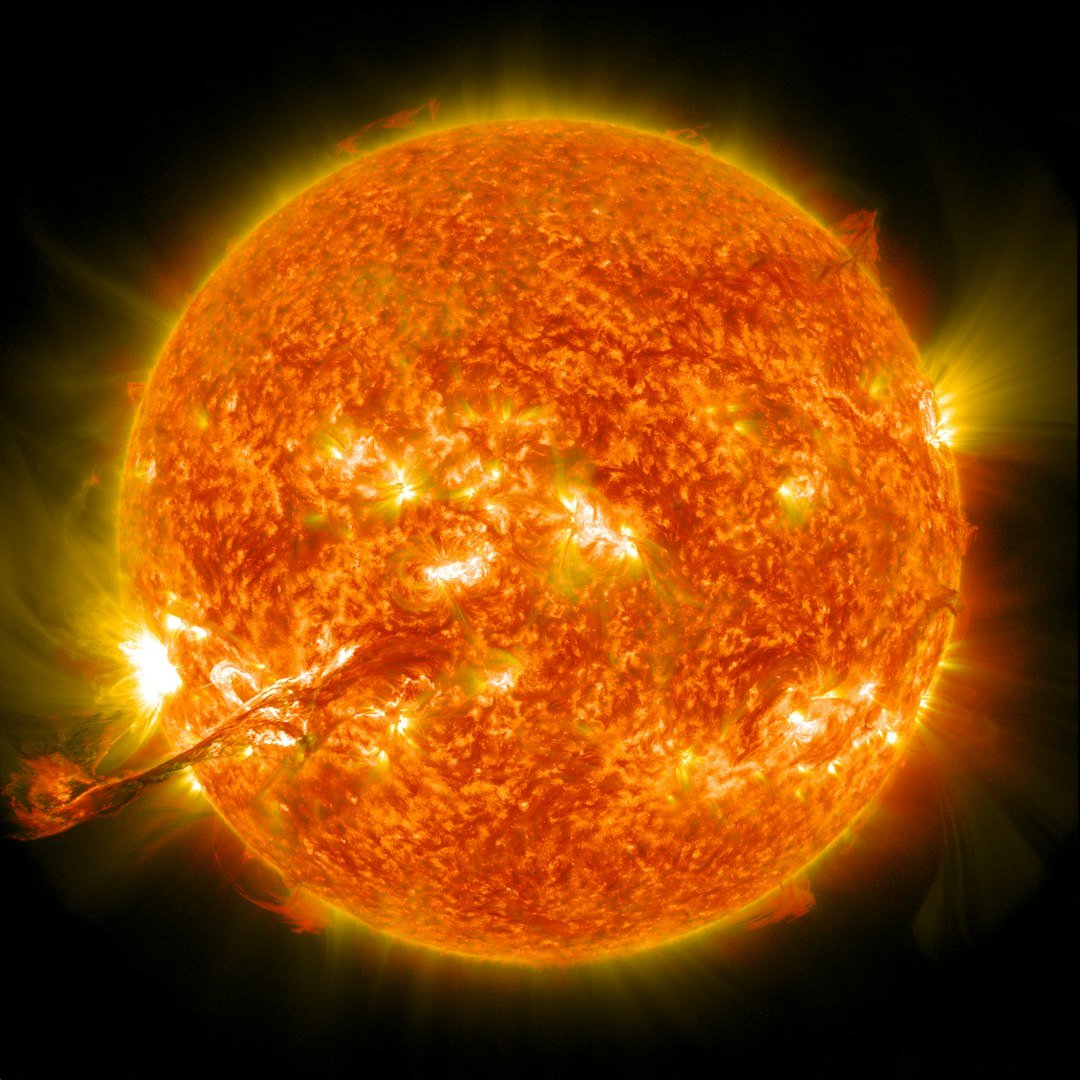
Unseen Fury Captured from Afar (Image Credits: Unsplash)
A powerful explosion rocked the sun’s far side on April 13, 2026, launching a coronal mass ejection on a trajectory toward Mars. Satellite observations captured the dramatic event, highlighting ongoing solar dynamism despite a relatively calm Earth-facing disk. Forecasters now watch a large coronal hole that promises heightened geomagnetic activity as early as tomorrow.
Unseen Fury Captured from Afar
The eruption unfolded around 18 UTC on April 13. NOAA’s GOES-19 satellite recorded video of the blast, where much of the activity stayed hidden behind the solar horizon.[1]
Only a portion peeked into view, yet the force proved immense. No matching flare appeared on the sun’s Earth-facing side, confirming the far-side origin. This event underscores how solar monitoring extends beyond direct line-of-sight observations.
Specialized instruments like GOES-19’s SUVI provided critical glimpses. Such blasts reveal the sun’s restless plasma layers in action.
Coronal Mass Ejection’s Interplanetary Voyage
The blast ejected a coronal mass ejection, or CME, directly toward Mars. NASA’s ENLIL model simulated its path, projecting arrival around April 18.[1]
Coronagraph images over the past day confirmed no Earth-directed CMEs. This plasma cloud poses no threat to our planet but could influence Martian space weather.
Missions on or orbiting Mars might monitor for effects. The event highlights solar influences across the solar system.
Quiet Conditions on the Earth-Facing Sun
Solar flare activity remained low over the last 24 hours ending 11 UTC on April 14. Eight flares occurred: one C-class and seven B-class, with the strongest a C1.2 from active region AR4414.[1]
Four numbered active regions dotted the visible disk, all featuring simple alpha or beta magnetic configurations. Newcomers included AR4418 near the center and AR4419 at the northeast limb.
- AR4414 led with four B-class flares.
- Overall levels stayed subdued through April 15.
- Forecasters noted a 10% chance of an isolated M-class flare, mainly from AR4416.
- X-class events appeared unlikely at 1% probability.
Solar wind speeds had dropped to low levels, with the interplanetary magnetic field remaining weak.
Coronal Hole Sets Stage for Geomagnetic Stir
A mid-latitude coronal hole in the southern hemisphere crossed the central meridian late on April 11. Another expansive hole now dominates the northeast quadrant, as shown in GOES-19 SUVI footage.
High-speed solar wind streams from these features could reach Earth late on April 14 or early April 15. Current geomagnetic conditions stayed quiet, with Kp indices at 0-2 over the recent day.[1]
| Date | Forecast Kp | Activity Level |
|---|---|---|
| April 14 | 1-3 | Quiet-to-unsettled |
| April 15 | 3-4 | Unsettled-to-active; G1 possible |
Earth’s magnetic field experienced one unsettled period on April 12. The incoming streams might elevate activity significantly.
Aurora Watch Intensifies
If conditions hit Kp=5 on April 15, a G1 minor geomagnetic storm could unfold. Northern lights might then extend to mid-latitudes like Seattle, Minneapolis, and Edinburgh.
High-latitude viewers should prepare for displays regardless. Recent solar wind waning set a calm backdrop before this shift.[1]
Space weather specialists track these developments closely. For real-time updates, check EarthSky’s solar news.
Key Takeaways
- Far-side blast produced a Mars-bound CME, no Earth risk.
- Low flare activity persists; sunspots stable.
- Coronal hole high-speed wind may trigger G1 storm and widespread auroras on April 15.
Solar events like this far-side spectacle and approaching coronal influences remind us of the sun’s profound reach. Skywatchers, gear up for potential lights – what aurora sightings have you captured lately? Share in the comments.