

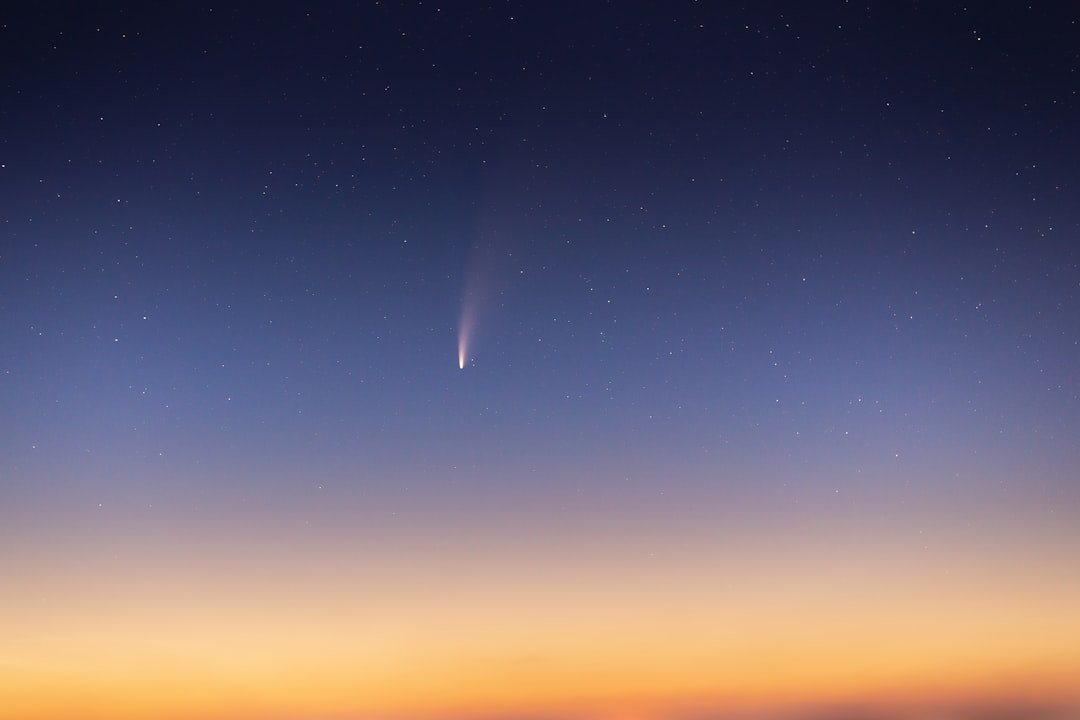
A Cosmic Relic Returns After Millennia (Image Credits: Unsplash)
Stargazers in the Northern Hemisphere now have a prime opportunity to observe Comet C/2025 R3 (PanSTARRS) low in the eastern sky roughly 90 minutes before sunrise.[1][2] This long-period visitor, already detectable as a hazy patch to the unaided eye from dark locations, continues to brighten as it nears its closest approach to the sun on April 19.[3] Discovered last year, the comet promises one of the year’s most accessible celestial displays for amateur astronomers.
A Cosmic Relic Returns After Millennia
Comet C/2025 R3 (PanSTARRS) traces its origins to the distant Oort Cloud, a reservoir of icy bodies far beyond Pluto.[3] With an orbital period of about 170,000 years, this marks its first passage through the inner solar system in recorded human history.[1] Astronomers first spotted it on September 7, 2025, thanks to the PanSTARRS survey telescope atop Haleakala in Hawaii.
The comet’s nucleus, a mountain of dirty ice, has begun shedding gas and dust as solar heat intensifies. This activity forms its distinctive tails – one of reflective dust, the other an ion tail sculpted by the solar wind – now stretching up to 10 degrees across the sky.[3][2] Unlike riskier sungrazers that recently disintegrated, PanSTARRS follows a safer path at perihelion.
Finding the Comet Tonight
On April 15, the comet lingers in the constellation Pegasus, positioned just below the Great Square asterism near the star Markab at its lower-right corner.[1] It appears as a fuzzy glow rather than a sharp star point, rising low on the eastern horizon amid the subtle glow of the zodiacal light, often called false dawn.[3] Current brightness hovers around magnitude 4 to 4.5, placing it on the edge of naked-eye visibility under pristine conditions.
Head out 90 minutes before local sunrise to a site with an unobstructed eastern view. The new moon phase around April 17 ensures minimal moonlight interference, enhancing contrast.[2] From mid-northern latitudes, the comet clears the horizon for up to two hours pre-dawn, though southern observers face shorter windows initially.
- Scan low east with 10×50 binoculars for the best detail, revealing the greenish coma and emerging tails.
- Use apps like Star Walk 2 for real-time charts tracking its motion toward Pisces by April 19.
- Seek rural spots far from city lights; even brief camera exposures can capture its structure.
- Northern Hemisphere viewers: Focus mornings now through April 20; post-perihelion, it dives toward the sun.
- Southern Hemisphere: Await late April evenings as it shifts higher after dusk.
Major Milestones Ahead
PanSTARRS reaches perihelion on April 19 at approximately 0.5 AU from the sun – half the Earth-sun distance – where sunlight will vaporize more surface ices, potentially spiking its brilliance.[1][4] The comet then swings closest to Earth on April 26 or 27, at roughly 45 to 71 million miles away, positioned between our planet and the sun.
Forecasts vary, but baseline predictions point to a peak magnitude of 3, easily naked-eye from anywhere. Optimistic models, factoring forward-scattering effects, suggest even magnitude -0.5, rivaling bright stars.[2] By late April, it transitions into Pisces and briefly Aries before entering Cetus, though solar glare will challenge northern observers.
Maximizing Your Observation Experience
Patience pays off with comets, as their development unfolds unpredictably. Recent reports confirm PanSTARRS has doubled in brightness recently, underscoring its active nature.[1] Binoculars remain ideal, transforming the hazy blob into a structured wanderer with multiple tail components.
April’s lineup adds context: On April 19, the comet passes near a planetary parade featuring Mercury, Mars, Saturn, and Neptune. Track its path daily, as it covers constellations swiftly post-perihelion.
Key Takeaways
- Visible now to naked eye in dark skies; binoculars reveal tails up to 10 degrees long.
- Perihelion April 19 at 0.5 AU; Earth closest April 26-27 at ~45 million miles.
- Best northern views: 90 minutes pre-sunrise in Pegasus through April 20.
This fleeting encounter with Comet PanSTARRS reminds us of the solar system’s dynamic edges, where ancient ices awaken under the sun’s gaze. Step outside before dawn to connect with a relic from cosmic dawn – what have you seen so far? Tell us in the comments.