

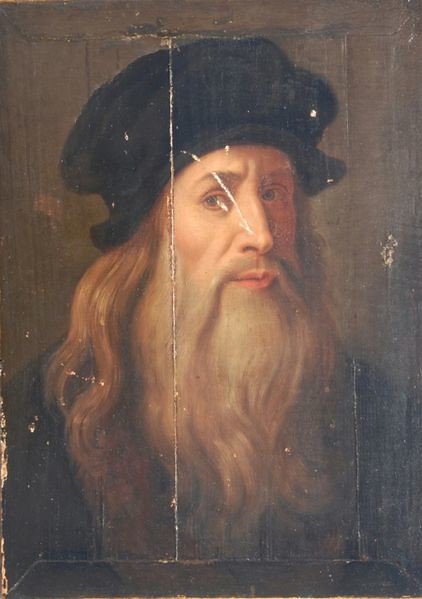
No Formal Education, Boundless Curiosity (Image Credits: Flickr)
Vinci, Italy – Leonardo da Vinci came into the world on April 15, 1452, as the illegitimate son of a Florentine notary and a young peasant. This rural birthplace in Tuscany set the stage for a life that defied conventions and expanded human knowledge. With minimal formal schooling, he apprenticed under the artist Andrea del Verrocchio in Florence, honing skills that propelled him into realms of art, science, and beyond.[1]
No Formal Education, Boundless Curiosity
Leonardo received only basic elementary lessons before entering Verrocchio’s workshop around age 14. There, he mastered painting, sculpture, and mechanical arts, but his inquisitive mind reached far wider. He dissected cadavers to understand anatomy, sketched intricate botanical details, and pondered the mechanics of flight through bird studies. These pursuits revealed a self-taught intellect that challenged the era’s scholarly elite.
His notebooks, filled with mirror-script entries and thousands of drawings, captured ideas across disciplines. Engineering feats emerged from these pages, including designs for machines that anticipated modern inventions. Yet, amid these endeavors, Leonardo turned his gaze upward, recording celestial observations that placed him at odds with prevailing beliefs.[1]
Mastery in Art and Invention
Leonardo’s artistic legacy endures through masterpieces like The Last Supper and Mona Lisa, works that captured human emotion with unprecedented realism. These paintings stemmed from his deep anatomical knowledge, gained through dissections that mapped muscles and organs in animals and humans alike. His technical drawings extended to architecture and urban planning, envisioning ideal cities resilient to floods.
Invention defined his ingenuity. He conceptualized armored vehicles resembling tanks, pedal-driven contraptions akin to bicycles, submersible vessels, aerial screws foreshadowing helicopters, and mechanical calculators. Music and writing also claimed his attention; he crafted musical instruments and penned treatises in his cryptic handwriting. Such versatility marked the Renaissance ideal of the universal man.[1]
- Armored car prototype for battlefield use
- Self-propelled cart, an early automobile concept
- Aerial devices inspired by ornithology
- Hydraulic machines for canals and mills
- Parabolic compasses for precise drafting
Astronomical Insights Ahead of Their Time
Leonardo pursued astronomy through direct observation, sketching planets, stars, and lunar phases in his codices. His interest intertwined with optics and light, fields he explored rigorously. He noted how celestial bodies reflected sunlight, challenging the geocentric model dominant in his day. These sketches, often mingled with geometry and anatomy studies, demonstrated a holistic approach to knowledge.[1][2]
Between 1505 and 1508, he produced early drawings of the Moon’s surface, predating similar efforts by over a century. His Milanese period sharpened these observations, as he grappled with light propagation and visual perception. Though he rejected some ancient theories upon closer scrutiny, his empirical method laid groundwork for future astronomers. Notably, a single notebook page preserved his simultaneous work on astronomy, geometry, and equine anatomy.[3]
Earthshine: Decoding the Moon’s Gentle Glow
Leonardo achieved a pivotal breakthrough by explaining earthshine, the faint illumination on the Moon’s dark side during crescent phases. He proposed that sunlight reflected off Earth’s atmosphere bathed the Moon in this subtle light, a concept far ahead of contemporaries wedded to Ptolemaic astronomy. This insight required grasping planetary reflection as mirrors of solar radiance.[1][4]
Most scholars overlooked such ideas until later validation. Leonardo’s reluctance to publish diminished his immediate impact; he preferred private notebooks over dissemination. Still, his earthshine theory endures as a testament to observational acuity. Modern viewers recognize this “da Vinci glow” during twilight lunar displays.[5]
A Timeless Legacy in the Stars
Leonardo died in 1519 at age 67, leaving 13,000 notebook pages that scholars unpacked over centuries. His astronomical contributions, though unpublished, influenced optics and cosmology indirectly. Today, on the 574th anniversary of his birth, his story reminds us that genius thrives on curiosity, not credentials. For deeper reading, explore the original account at Astronomy.com.[1]
Key Takeaways:
- Leonardo pioneered earthshine explanation through atmospheric reflection.
- His Moon sketches anticipated telescopic astronomy by a century.
- Optics studies bridged art, vision, and celestial mechanics.
Leonardo da Vinci proved that one mind could illuminate the heavens and earth alike. His legacy challenges us to observe the night sky with fresh eyes. What draws you to his astronomical work? Share your thoughts in the comments.