

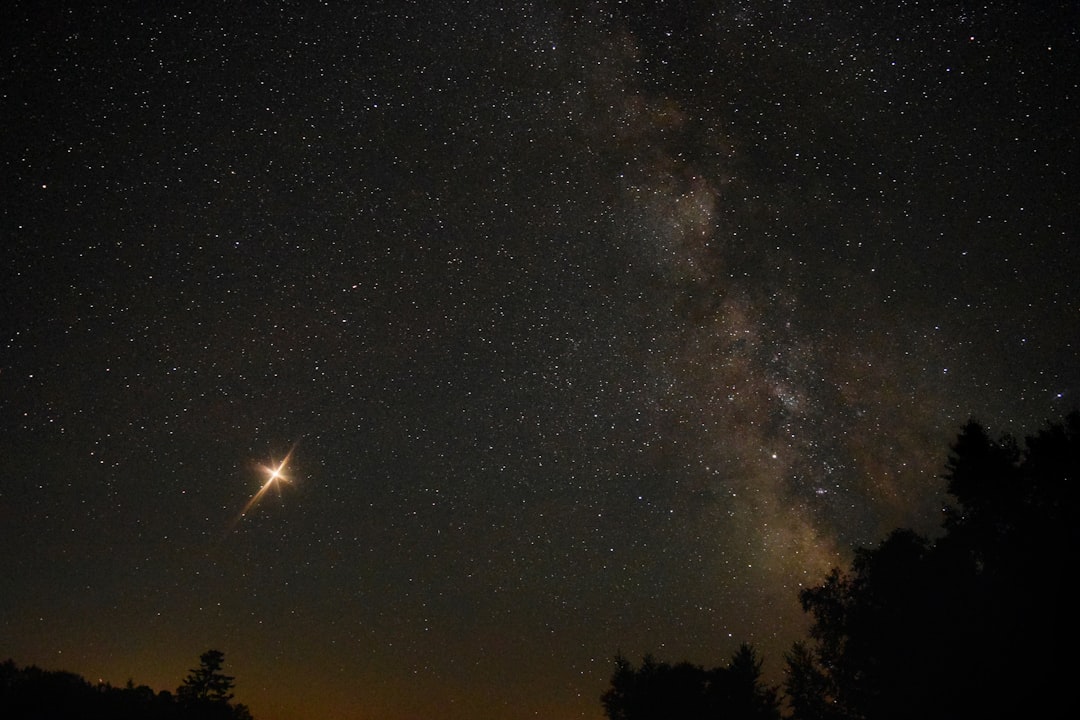
Venus and Jupiter Dazzle After Dark (Image Credits: Unsplash)
April 2026 delivers a celestial feast for skywatchers worldwide, with all five naked-eye planets on display alongside a rare comet sweeping through the predawn sky. Venus and Jupiter command attention after sunset, while Mercury, Mars, and Saturn huddle low in the east before sunrise. The Lyrid meteor shower peaks later in the month, capping off a sky rich in wonders.[1][2]
Venus and Jupiter Dazzle After Dark
The evening sky bursts with brilliance as Venus, the brightest planet, rises higher in the west following sunset. Observers spot it near the sparkling Pleiades star cluster and the reddish star Aldebaran early in the month, with its setting time stretching from 90 minutes after sunset on April 1 to two hours by April 30. A waxing crescent moon joins the scene on April 18 through 20, framing Venus with these stellar neighbors before they dip below the horizon around midnight.[1]
Jupiter complements Venus high overhead near the Gemini twins, Castor and Pollux, as twilight fades. It sets progressively earlier, from three hours past midnight early in April to just after midnight by month’s end. The moon pairs with Jupiter on April 22 and 23, offering a striking trio with the star cluster. These positions hold especially well for northern latitudes, though southern viewers enjoy similar views with slight horizon adjustments.[3]
Dawn Reveals a Planetary Trio
Early risers catch Mercury, Mars, and Saturn clustering low on the eastern horizon in morning twilight, particularly vivid on April 20 when they form a tight group. Mercury, the brightest of the trio, reached its greatest western elongation on April 3, standing 28 degrees from the sun and easiest for southern hemisphere observers. Mars and Saturn appear fainter, demanding binoculars amid the glow, but they climb higher as spring advances.[1][4]
A waning crescent moon hovered above this group on April 15, enhancing the dawn display for southern skies. Northern viewers face a steeper challenge due to the ecliptic’s angle, yet persistence pays off around dawn. All five planets traced the ecliptic line on April 15, invisible by day but underscoring the solar system’s alignment.[5]
Comet PanSTARRS Lights the Predawn Sky
Comet C/2025 R3 (PanSTARRS), a long-period visitor unseen for millennia, gleams in Pegasus before sunrise throughout mid-April. Discovered in 2025, it brightens steadily, visible to the naked eye under dark skies or easily through binoculars. Peak visibility spans April 17 to 27, with its position shifting slowly against faint stars.[6][7])
This comet marks a fleeting highlight, potentially the brightest of 2026, as it hurtles toward perihelion. Northern hemisphere stargazers find it highest around 90 minutes before dawn; cell phone cameras capture its tail on long exposures. Southern observers note it lower but still accessible.[8]
Key Events: Meteors, Moon, and Alignments
The Lyrid meteor shower crests after midnight into dawn on April 22, radiating from Lyra near Vega in a moonless sky. Up to 20 meteors per hour streak overhead, best from dark sites. A new supermoon arrived on April 17 at 226,299 miles from Earth, ideal for deep-sky viewing.[9]
Other highlights include the first quarter moon on April 24, pairing with Regulus in Leo on April 24-25 and Spica in Virgo April 28-30. Earthshine illuminates the moon’s dark side during April 18-19 crescents. For precise timings, consult resources like EarthSky.[1]
| Planet | Best Time | Location |
|---|---|---|
| Venus | 1 hour after sunset | West, near Pleiades |
| Jupiter | Evening twilight | High, near Gemini |
| Mercury | Pre-sunrise | East horizon |
| Mars/Saturn | Dawn | Low east |
Master the April Skies with These Tips
Seek dark-sky locations away from city lights to maximize visibility, especially for faint morning planets and the comet. Binoculars reveal details in Mars, Saturn, and PanSTARRS; apps like Stellarium provide local charts. Allow eyes 20 minutes to adapt to darkness, and check weather for clear nights.[1]
Track moon phases for optimal viewing windows, and photograph conjunctions with a tripod. Northern and southern hemispheres experience slight differences in horizon views, so adjust expectations accordingly. Patience rewards the dedicated observer this month.
Key Takeaways
- Evenings favor Venus and Jupiter; mornings bring Mercury, Mars, Saturn.
- Comet C/2025 R3 peaks mid-April before dawn in Pegasus.
- Lyrids shine April 22; new moon April 17 boosts faint objects.
April 2026’s sky parade connects us to the cosmos, from wandering planets to ancient comets. Grab your gear and step outside – what catches your eye under these stars? Share your observations in the comments.