

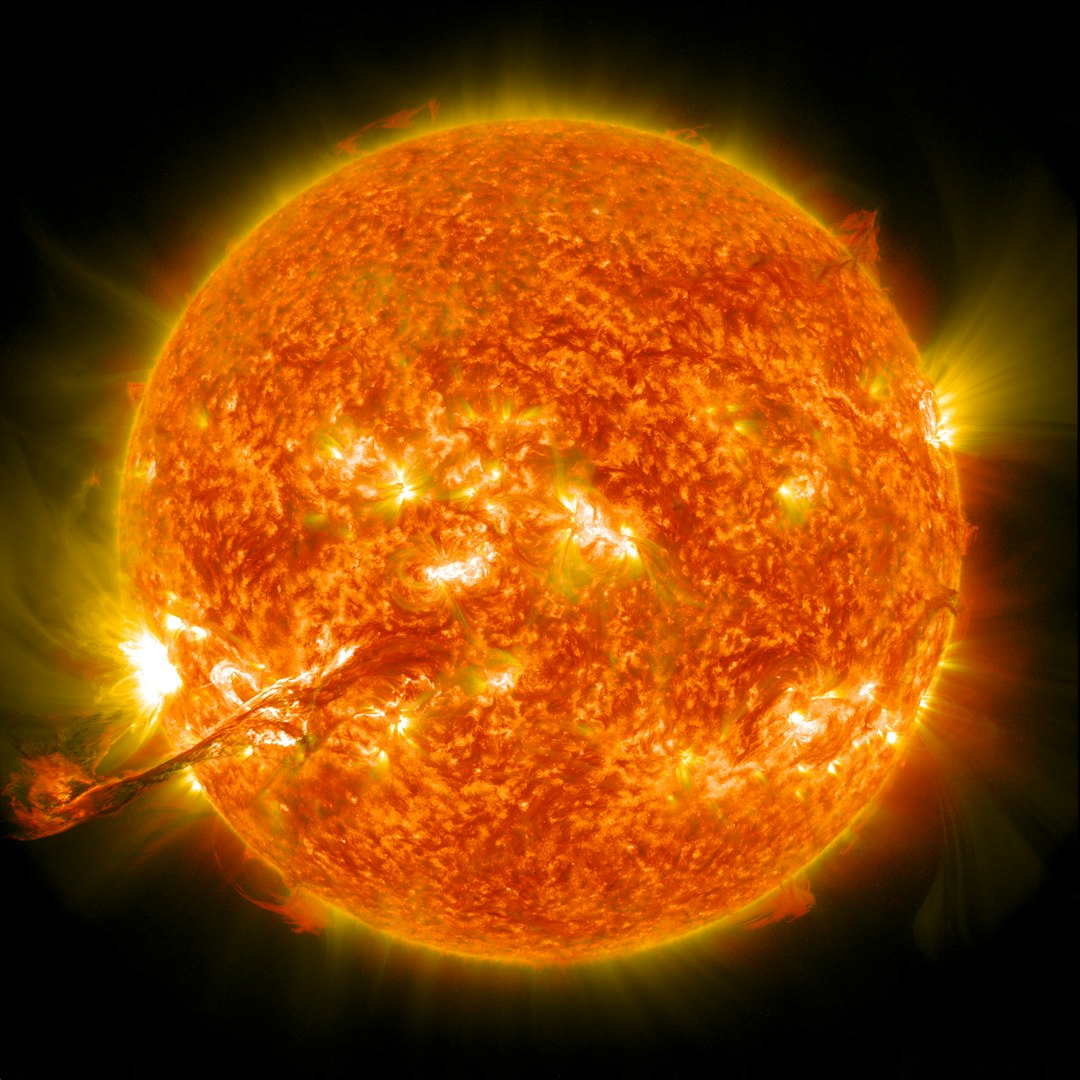
Back-to-Back Blasts from the Same Fiery Spot (Image Credits: Unsplash)
On April 15, 2026, astronomers observed a second major solar blast erupting from the Sun’s far side, captivating observers with its dramatic display over the southwestern solar horizon. This event followed a similar, even larger outburst the day before, signaling robust activity from a region hidden from Earth’s direct gaze. While the spectacle unfolded beyond view, the side of the Sun facing our planet maintained unusual tranquility.[1][2]
Back-to-Back Blasts from the Same Fiery Spot
Two significant eruptions in as many days originated from the same area on the Sun’s far side. The first, a huge blast around 18 UTC on April 13, billowed solar material high into space.[1] Observers noted no corresponding flare on the Earth-facing disk, confirming the event’s remote origin. Video footage from NOAA’s GOES-19 satellite captured the plasma lifting and hurling outward in a mesmerizing arc.
The April 15 event mirrored its predecessor but packed slightly less punch. A large filament lifted and erupted, producing a coronal mass ejection (CME) that mostly saw ejecta fall back toward the Sun. Experts highlighted the coincidence: “Two big blasts in two days from the same area is no coincidence: there is almost certainly a fiery active region just behind the horizon.”[1]
Decoding the Far-Side Phenomenon
Solar filaments, also known as prominences, consist of cool plasma suspended in the Sun’s hot corona by magnetic fields. When unstable, they erupt spectacularly, as seen in these blasts. The southwestern horizon position allowed extreme ultraviolet imagers to record the events clearly, revealing billowing clouds of material against the solar limb.[1]
These far-side occurrences provide early warnings of potential active regions rotating into Earth’s view. NASA’s Solar Dynamics Observatory (SDO) labeled current disk regions, showing three numbered spots as of 5 UTC on April 15. The blasts underscored the Sun’s dynamic nature during Solar Cycle 25, even amid quieter phases.
Calm on the Earth-Facing Disk
In stark contrast, the visible solar hemisphere stayed subdued. Faint B-class flares marked the strongest activity, with 10 such events recorded, peaking at B9.5 from Active Region 4416 at 5:15 UTC. No C-class or higher flares disrupted the peace.[1]
Active regions AR4416 and AR4419 led the mild flare production, both exhibiting beta-gamma and beta magnetic configurations. Solar wind speeds remained low, and the interplanetary magnetic field (IMF) stayed weak and northward-directed. Earth’s magnetic field registered quiet conditions at Kp 0-1.
- AR4416: Beta-gamma configuration, produced strongest B9.5 flare.
- AR4419: Beta configuration, contributed to minor flaring.
- Third region: Stable beta setup, no notable output.
- Total B-class flares: 10 on April 15.
- No Earth-directed CMEs from recent activity.
Space Weather Implications and No Direct Threats
Neither blast posed risks to Earth, as the CMEs directed ejecta away from our planet. Models like NASA’s ENLIL suggested the April 13 CME might reach Mars by April 18. Reports confirmed: “Most of the resulting ejecta returned back to the sun and any coronal mass ejection (CME) from this event is not heading our way.”[1]
Geomagnetic conditions held steady, though a coronal interaction region (CIR) and fast solar wind from a coronal hole could elevate activity to unsettled-to-active levels (Kp 3-4) by April 17. No auroral displays or disruptions materialized from these far-side events.
| Event Date | Location | Earth Impact |
|---|---|---|
| April 13, 2026 | Southwestern horizon | None; possible Mars hit |
| April 15, 2026 | Southwestern horizon | None; ejecta returned |
Solar Outlook: Low but Watchful
Forecasts predicted very low flare activity persisting on April 15, with slim chances for C-class events (10%) and X-class flares nearly impossible (1%). Sunspot regions held potential for minor upticks as they evolve. The far-side activity hinted at invigorating disk conditions in coming days.[1]
“The Earth-facing sun is taking a breather, but the far side tells a different story,” observers noted of the earlier blast.[1] Continuous monitoring via SDO and GOES satellites ensures timely updates. For more, visit EarthSky.
- Two far-side blasts in days reveal a potent active region rotating into view soon.
- Earth-facing Sun quiet with only B-class flares; no threats from these events.
- Minor geomagnetic stir possible by April 17 from coronal hole effects.
These far-side fireworks remind us of the Sun’s unrelenting energy, even when calm prevails on our side. As the active region emerges, skywatchers may soon witness heightened drama. What do you think this means for upcoming aurora chances? Tell us in the comments.