

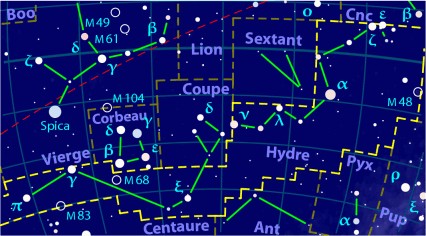
A Colossus in the Heavens (Image Credits: Upload.wikimedia.org)
April nights offer a prime view of one of the night sky’s most expansive figures. Hydra, the Water Snake, uncoils fully along the southern horizon for observers in the Northern Hemisphere. This constellation stands out as the largest among the 88 officially recognized ones, covering 1,303 square degrees and stretching over 100 degrees from end to end.[1][2]) Its serpentine shape bridges zodiacal patterns like Cancer and Libra, drawing eyes southward during spring evenings.
A Colossus in the Heavens
Hydra claimed its place as the biggest constellation through ancient cataloging efforts. Ptolemy listed it among the original 48 in the second century, and modern astronomy confirms its dominance in size.[3] Spanning from the head near Cancer the Crab, under Leo the Lion, to the tail near Virgo the Maiden, it snakes across a third of the celestial sphere.
Despite its immensity, Hydra features mostly faint stars, which challenges casual viewers. The pattern lies low for northern latitudes, often hugging the horizon where light pollution and haze interfere. Yet, its full visibility peaks in April, marking spring’s arrival for skywatchers.[1]
The Mythic Origins of the Water Snake
Ancient tales imbued Hydra with dramatic lore. One story from Greek mythology linked it to Apollo, where the god’s crow delivered water tainted by the snake, prompting Apollo to hurl the crow, a cup, and the serpent into the stars. Corvus the Crow and Crater the Cup now perch on Hydra’s back in the sky.[1]
Another narrative tied Hydra to Hercules’ second labor, slaying the multi-headed Lernaean Hydra. This monstrous serpent symbolized chaos, its form preserved eternally among the stars. Babylonian astronomy influenced the Greek view, reinterpreting an earlier water monster pattern.[4]
Key Stars Marking the Serpent’s Form
Alphard, or Alpha Hydrae, gleams as Hydra’s brightest beacon at magnitude 1.98. This orange giant, 177 light-years distant, earned the name “the solitary one” for standing out amid dimmer companions. Located 23 degrees south of Regulus in Leo, it pulses subtly, hinting at its giant status.[5][2])
The head appears as a circlet of stars from magnitude 3.1 to 4.4, positioned below the Beehive Cluster in Cancer. Zeta Hydrae shines at 3.11, Epsilon at 3.39, while others like Delta and Sigma fill the pattern. Follow the body southeastward through fainter links toward Libra.[1]
| Star | Magnitude | Distance (light-years) |
|---|---|---|
| Alphard (Alpha Hydrae) | 1.98 | 177 |
| Zeta Hydrae | 3.11 | 152 |
| Epsilon Hydrae | 3.39 | 134 |
| Gamma Hydrae | 3.0 | 132 |
Deep-Sky Gems Within the Coils
Hydra hosts diverse treasures for telescope users. M48, an open cluster on the western edge, spans magnitude 5.8 and lies 1,500 light-years away, revealing about 50 stars through binoculars. Nearby, NGC 3242, the Ghost of Jupiter, presents a ninth-magnitude planetary nebula resembling the planet’s disk.[1]
Further along, M68 offers a globular cluster at magnitude 8.19, 33,000 light-years distant, ideal for mid-sized scopes. The Southern Pinwheel Galaxy, M83, adds a barred spiral at magnitude 7.6, 15 million light-years out. These Messier objects showcase Hydra’s variety: cluster, nebula, globular, and galaxy.[1]
- M48: Open cluster, 80 stars total.
- NGC 3242: Planetary nebula, Jupiter-sized in sky.
- M68: Globular cluster, below Corvus.
- M83: Barred spiral galaxy, east of M68.
Tips for Spotting Hydra Tonight
Locate the head near Cancer’s Beehive, then trace southeast past Alphard toward Spica in Virgo for the tail. Northern observers need clear southern views; southern hemisphere viewers see it overhead. Dark skies enhance the faint chain – binoculars reveal the head’s circlet clearly.[1]
April evenings, around 21:00 local time, provide optimal positioning between latitudes 54°N and 83°S. Patience pays off as the snake rises higher later into the night. Check resources like EarthSky for charts and updates.[2])
Key Takeaways
- Hydra spans 1,303 square degrees, largest of 88 constellations.
- Alphard marks the heart; head near Beehive Cluster.
- April offers full views; explore deep-sky quartet with scopes.
Hydra’s enduring presence reminds us of the sky’s ancient stories and hidden depths. As the serpent slithers into view this April, it invites a closer look at the cosmos’s scale. What stands out most to you in this vast pattern? Share your observations in the comments.