

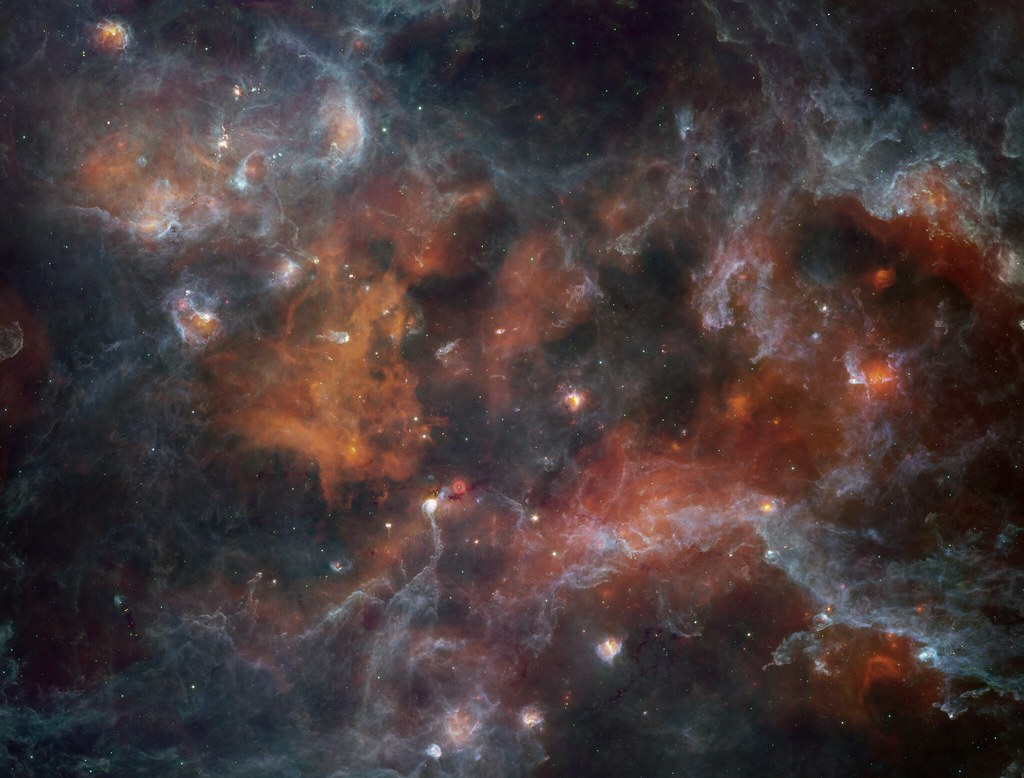
Vast Frozen Complexes Emerge from Infrared Data (Image Credits: Flickr)
In the swirling chaos of Cygnus X, a prolific star-forming region within the Milky Way, NASA’s SPHEREx mission has uncovered extensive reservoirs of water ice intertwined with interstellar dust. These frozen expanses, resembling cosmic glaciers, span hundreds of light-years and hold clues to how water and life’s building blocks assemble amid turbulent stellar births. Researchers detailed the findings in a study published today in The Astrophysical Journal, highlighting the mission’s power to map molecular signatures across vast galactic scales.[1][2]
Vast Frozen Complexes Emerge from Infrared Data
SPHEREx captured chemical signatures of water ice across Cygnus X, one of the galaxy’s most dynamic zones for newborn stars. The observatory revealed bright blue traces of frozen water overlaying dark lanes of dust, marking regions where ice thrives despite harsh radiation.[1] These structures align precisely with the densest dust concentrations, confirming that ice forms on minuscule grains comparable to candle smoke particles.
Lead author Joseph Hora, an astronomer at the Center for Astrophysics at Harvard & Smithsonian, noted a key surprise. “We expected to detect these ices in front of individual bright stars: The light from a star acts like a spotlight, revealing any ice in the space between us and that star. But this is something different,” he said.[2] The mission’s wide-field view exposed diffuse ice absorption over broad areas, painting a comprehensive picture of molecular clouds more than 600 light-years wide.
The Chemistry of Ices and Polycyclic Aromatic Hydrocarbons
Water ice dominated the maps at the 3-micrometer wavelength, but SPHEREx also pinpointed carbon dioxide ice at 4.27 micrometers and carbon monoxide at 4.67 micrometers. These features traced filamentary, dense clouds like LDN 935 and the Dobashi complexes, where conditions favor ice buildup.[3] Variations in the relative strengths of water and carbon dioxide ices suggested shifts in local chemistry or physical states along different sightlines.
Polycyclic aromatic hydrocarbons, or PAHs, appeared in orange hues at 3.28 micrometers, emitting strongly in UV-exposed zones. PAHs showed a striking anti-correlation with ice absorptions, as dust-shielded areas suppressed their glow while fostering ice growth. This pattern aligned with longer-wavelength PAH bands at 7.7 and 11.2 micrometers, hinting at influences from grain sizes and radiation fields.[3]
- Water ice (H2O): Broad absorption near 3 micrometers, strongest in shielded filaments.
- Carbon dioxide ice (CO2): Peaks at 4.27 micrometers, varies relative to water ice.
- Carbon monoxide ice (CO): Narrow feature at 4.67 micrometers in background sources.
- PAHs: Emission at 3.28 micrometers, anti-correlated with ices in dense regions.
Dust as Guardian of Cosmic Water
Dense dust lanes in Cygnus X blocked intense ultraviolet light from young stars, creating safe havens for ice formation. The SPHEREx data supported long-held theories: Interstellar ices coat dust grains in cold, shielded environments, accumulating as clouds collapse to spawn stars.[1]
Study coauthor Gary Melnick, also from the Center for Astrophysics, emphasized the mission’s scope. “We can investigate the environmental factors that contribute to different ice formation rates across large areas of interstellar space,” he explained. “The SPHEREx mission’s ‘big picture’ view provides valuable new information you can’t get when zooming in on a small region.”[2] Such shielding proved crucial, as exposed areas favored PAH emission over ice persistence.
SPHEREx Ushers in a New Era of Galactic Surveys
Launched on March 11, 2025, from Vandenberg Space Force Base, SPHEREx became the first infrared telescope dedicated to all-sky spectral mapping of ices. Its 102 near-infrared channels delivered unprecedented resolution, completing the initial full-sky survey by late 2025 and charting millions of galaxies in 3D.[1]
Managed by NASA’s Jet Propulsion Laboratory with principal investigator Jamie Bock at Caltech, the mission processes data at IPAC for public access. Unlike targeted observations from James Webb or Spitzer, SPHEREx’s broad strokes reveal galaxy-wide patterns in star formation physics and interstellar chemistry.
| Molecule | Wavelength (micrometers) | Key Distribution |
|---|---|---|
| Water Ice | 3 | Dense, shielded clouds |
| CO2 Ice | 4.27 | Filamentary structures |
| PAHs | 3.28 | UV-exposed regions |
Phil Korngut, SPHEREx instrument scientist at Caltech, captured the excitement. “These vast frozen complexes are like ‘interstellar glaciers’ that could deliver a massive water supply to new solar systems that will be born in the region,” he stated. “It’s a profound idea that we are looking at a map of material that could rain on nascent planets and potentially support future life.”[2]
These maps not only trace water’s journey from interstellar clouds to planetary systems but also illuminate pathways for delivering life’s ingredients. As SPHEREx continues its surveys, it promises deeper insights into our cosmic neighborhood. What role do these ice reservoirs play in your view of life’s origins? Share your thoughts in the comments.
Key Takeaways
- SPHEREx mapped water ice and other molecules across 600+ light-year regions in Cygnus X, revealing dust-shielded “glaciers.”
- Ices form on tiny dust grains, protected from stellar UV, while PAHs thrive in exposed areas.
- The mission’s all-sky infrared survey opens new windows on star formation and water delivery to planets.