

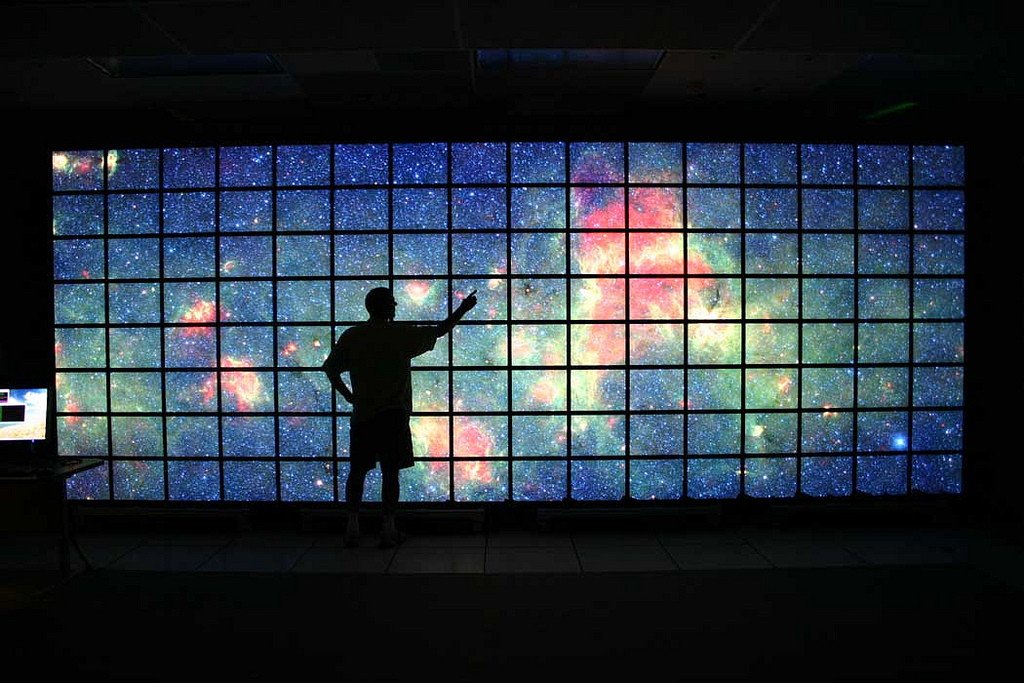
Thursday Launch: Space Weather and Artemis Insights Lead the Way (Image Credits: Upload.wikimedia.org)
Anaheim, California – The National Science Teaching Association’s annual conference opened this week under the theme “Growing Together: Collective Insights for Lifelong Learning.” NASA enhanced the event with its Hyperwall at Booth #1265 in the Exhibit Hall, offering 15-minute storytelling presentations from April 16 to 18. Educators can expect hands-on resources tied to active missions, from lunar exploration to Earth observation.[1][2]
Thursday Launch: Space Weather and Artemis Insights Lead the Way
The first day packed a dynamic morning lineup starting at 11 a.m., drawing teachers eager for mission-relevant content. Christina Milotte kicked things off with “Teaching Space Weather in the Artemis Mission Era,” exploring solar activity’s role in upcoming lunar voyages. This session highlighted how educators can integrate real-time data into lessons on astronaut safety and technology.
Presentations continued seamlessly with Tina Harte Ballinger’s “5E StoryMaps using NASA Resources,” a practical guide to interactive mapping tools. Amy Padolf followed on “Growing Beyond Earth,” detailing collaborations with Fairchild Tropical Botanic Garden for plant growth experiments in space. Sarah Kirn then presented “Learn Science by Doing Science: Real NASA Research That Your Class Can Do Today,” emphasizing citizen science opportunities.
- 12:00 p.m.: “Unlock NASA’s Eyes and Inspire the Scientists of Tomorrow” by Jason Craig
- 12:15 p.m.: “Access NASA Earth Data for your Class” by Angela Rizzi
- 12:30 p.m.: “Solar System Treks” by George Chang
- 12:45 p.m.: “Earth in Motion: How the NISAR Satellite Mission will Transform Our View of the Planet” by Erika Podest
Afternoon slots repeated select favorites after a lunch break, including more on NISAR and space weather, ensuring broader access for attendees.[3]
Friday Builds Momentum with Solar System Exploration
Day two shifted toward outreach and telescopic wonders, opening with Sarah Marcotte’s overview of the “NASA Solar System Ambassador Program.” This initiative equips volunteers to share planetary science locally, sparking student interest in our cosmic neighborhood. Amy Padolf returned for another “Growing Beyond Earth” talk, reinforcing sustainable agriculture themes.
Midday brought Angela Rizzi on Earth data access, Begoña Vila discussing the “Roman Space Telescope and Webb Space Telescope,” and Sarah Kirn’s hands-on research session. Tina Harte Ballinger closed the morning with StoryMaps. Afternoon repeats focused on botanic partnerships, authentic research, and telescope capabilities.
| Time | Session | Presenter |
|---|---|---|
| 11:00 a.m. | NASA Solar System Ambassador Program | Sarah Marcotte |
| 11:45 a.m. | Roman Space Telescope and Webb Space Telescope | Begoña Vila |
| 2:00 p.m. | Roman Space Telescope and Webb Space Telescope | Begoña Vila |
| 2:15 p.m. | NASA Solar System Ambassador Program | Sarah Marcotte |
No sessions appeared listed for Saturday, allowing attendees to explore other conference highlights.[1]
Recurring Sessions Maximize Teacher Impact
NASA designed the agenda with repetition in mind, enabling more educators to catch popular topics. “Earth in Motion” by Erika Podest ran multiple times Thursday, showcasing the NISAR mission’s potential to monitor natural disasters and climate shifts. Similarly, “Solar System Treks” by George Chang offered virtual tours of planetary surfaces, ideal for geography and astronomy units.
These loops addressed conference crowds, a common challenge at large events. Teachers praised similar formats in past years for blending inspiration with actionable lesson plans. The Hyperwall’s high-resolution displays brought data visualizations to life, bridging complex science with classroom reality.
Tools and Missions to Transform Classrooms
Sessions spanned Earth science, astrophysics, and biology, aligning with NSTA’s lifelong learning focus. Tools like My NASA Data and Solar System Treks emerged as favorites for free, standards-aligned resources. NISAR previews promised future data on earthquakes and ice sheets, while Artemis talks connected history to tomorrow’s moon landings.
- StoryMaps for inquiry-based learning
- Citizen science projects for student engagement
- Telescope previews for stargazing extensions
- Plant growth experiments linking biology and space
- Ambassador programs for community outreach
Full details await at NASA’s official page.
Key Takeaways:
- Hyperwall offers 15-minute bursts of mission-driven content, perfect for busy schedules.
- Repeats ensure inclusivity amid high attendance.
- Free tools empower teachers to integrate NASA data immediately.
NASA’s Hyperwall stands out as a gateway to agency missions, equipping teachers with fresh ways to captivate students. As the conference unfolds, these sessions promise to seed innovative lessons nationwide. Which presentation aligns best with your curriculum? Share your thoughts in the comments.