

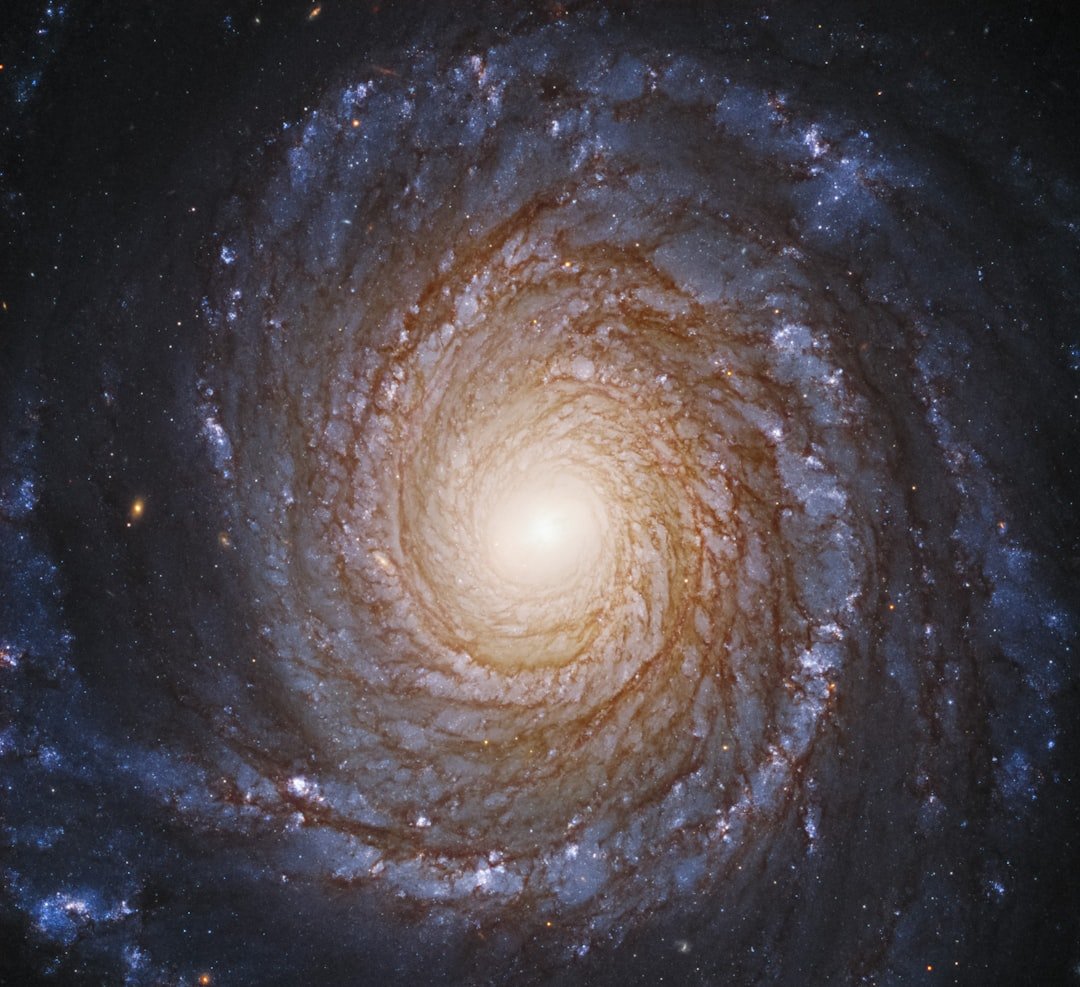
The Striking Features of IC 486 (Image Credits: Unsplash)
The Hubble Space Telescope captured a luminous image of the barred spiral galaxy IC 486, situated 380 million light-years from Earth in the constellation Gemini.[1][2] This striking view reveals a soft glow emanating from the galaxy’s core, where spiral arms unfurl in a nearly ring-like embrace. Scientists value such observations for their insights into galactic evolution and the forces shaping distant cosmic structures.
The Striking Features of IC 486
A bright central bar dominates the galaxy’s heart, from which elegant spiral arms extend outward.[1] Hubble’s advanced imaging exposed subtle color shifts across the disk: a pale, luminous center populated by older stars contrasted with faint bluish patches signaling recent star birth. Dust lanes weave through the arms, hinting at dense molecular gas clouds ripe for new stellar formation.
Foreground stars and distant galaxies pepper the wide-field backdrop, some displaying classic diffraction spikes from Hubble’s optics. These elements underscore the telescope’s precision in isolating the main subject amid the cosmic tapestry. The overall composition evokes a sense of ordered chaos, where gravity orchestrates long-term transformations.[2]
Unveiling the Active Galactic Nucleus
At IC 486’s center, a prominent white glow overshadowed surrounding starlight. This radiance stemmed from the galaxy’s active galactic nucleus (AGN), fueled by a supermassive black hole exceeding 100 million solar masses.[1] The black hole accreted gas and dust into a swirling disk, generating intense radiation that rivaled the galaxy’s collective output.
Hubble astronomers noted, “Every sufficiently large galaxy hosts a supermassive black hole at its center, but some of these black holes are particularly ravenous, assembling vast amounts of gas and dust into swirling accretion disks from which they feed.”[2] Such activity marked IC 486 as a dynamic entity, far from the serene appearance suggested by its spiral form. X-rays from this process could outshine the rest of the galaxy, a hallmark of active systems.
Hubble’s Role in Probing Galactic Growth
Data for this image came from two Hubble observing programs: #17310, led by principal investigator M. J. Koss, and #15444, headed by A. J. Barth.[1] These efforts surveyed nearby active galaxies to map central black holes and surrounding stellar populations. Researchers linked large-scale features like bars and arms to nuclear processes, advancing models of galaxy development.
- Pale center: Older stellar populations.
- Bluish disk regions: Active star formation zones.
- Dust wisps: Molecular gas reservoirs for future stars.
- Central AGN: Supermassive black hole-driven luminosity.
- Spiral structure: Gravity-influenced arm patterns.
Citizen science platforms like Galaxy Zoo aided in classifying these morphologies. Upcoming public data releases will fuel further analysis, including tests of machine learning for scalable galaxy studies.[1]
Galaxies in Constant Evolution
Though IC 486 appeared orderly, underlying forces drove relentless change. Stars ignited, matured, and extinguished over eons, reshaping the galaxy’s profile. Hubble astronomers observed, “Though it may appear calm and orderly, IC 486 is a dynamic system shaped by gravity and stellar evolution.”[2]
This image contributed to broader surveys preparing for missions like Euclid, the Vera Rubin Observatory, and NASA’s Roman Space Telescope. Such work illuminated how structures influence central activity, offering clues to the universe’s expansion history.
Key Takeaways:
- IC 486 hosts a voracious supermassive black hole powering its brilliant core.
- Hubble discerned star formation hotspots amid dust-shrouded arms.
- Observations bridge galactic architecture to nuclear dynamics.
Hubble’s gaze on IC 486 reminded observers of the cosmos’s perpetual motion, where beauty masked vigorous transformation. Future telescopes will build on these findings to decode galactic lifecycles. What strikes you most about this distant spiral? Share your thoughts in the comments.