

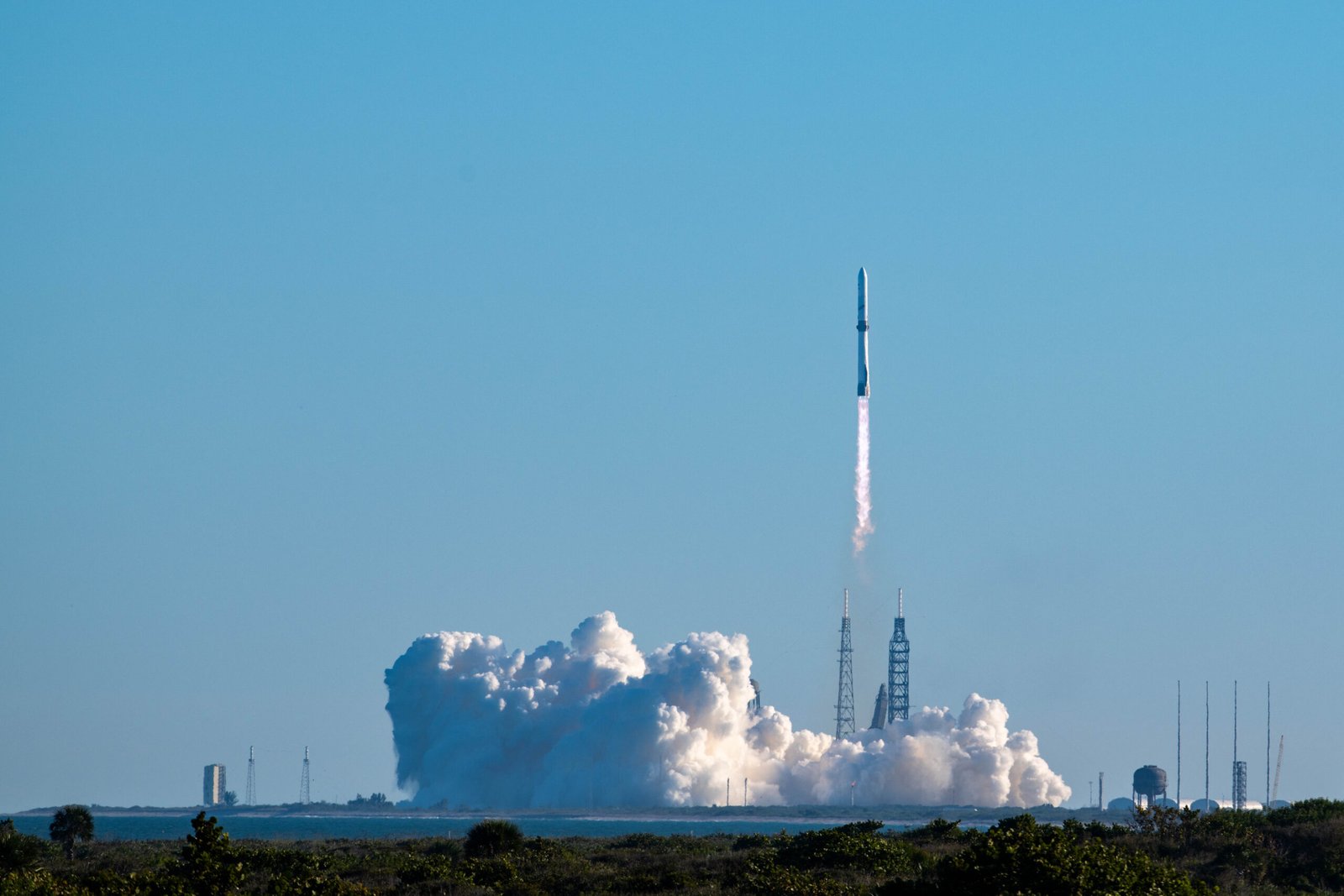
A Swift Evolution from Debut to Reuse (Image Credits: Upload.wikimedia.org)
Cape Canaveral Space Force Station, Florida – Excitement builds ahead of Blue Origin’s New Glenn rocket third mission, scheduled for liftoff no earlier than Sunday morning. The flight marks a pivotal step with the first reuse of a previously flown first-stage booster. This event underscores the company’s push toward routine reusability in heavy-lift launches.[1][2]
A Swift Evolution from Debut to Reuse
New Glenn completed its inaugural flight on January 16, 2025, successfully reaching orbit from the same Florida pad. The second mission followed on November 13, 2025, deploying NASA’s ESCAPADE twin spacecraft to a loiter orbit while achieving a key goal: the first-stage booster landed intact on the droneship Jacklyn in the Atlantic Ocean.[3][2]
That booster, named Never Tell Me The Odds, now returns for NG-3 after refurbishment. Blue Origin installed fresh engines on it, reserving the previous set for future missions. Such rapid turnaround highlights progress in processing hardware between flights.[1][2]
The rocket stands over 320 feet tall with a seven-meter fairing, powered by seven BE-4 engines on the first stage using liquid oxygen and liquefied natural gas. The upper stage relies on two BE-3U engines fueled by liquid oxygen and hydrogen. Designed for at least 25 flights per booster, New Glenn aims for 45 metric tons to low Earth orbit or 13 metric tons to geostationary transfer orbit.[4]
Refurbished Booster Takes Center Stage
Never Tell Me The Odds separated about 3.5 minutes after liftoff during NG-2 and touched down roughly six minutes later. Blue Origin recovered it cleanly, paving the way for this reuse demonstration. The company conducted a static fire test on April 16, confirming readiness.[2]
Reusability promises lower costs and higher launch rates, a strategy long pursued by competitors. Blue Origin rebuilt Launch Complex 36 from the ground up, enabling integration, launch, recovery, and refurbishment nearby. This closed-loop approach supports ambitions like NASA’s Artemis program via the Blue Moon lander.[4]
- First stage: Seven BE-4 engines, 640,000 lbf thrust each at sea level.
- Second stage: Restartable BE-3U engines for versatile orbits.
- Payload bay: Twice the volume of typical five-meter fairings.
- Reusability target: Minimum 25 missions per booster.
- Launch site: LC-36, Cape Canaveral Space Force Station.
BlueBird Satellite Ushers in Space-Based Broadband
NG-3 carries AST SpaceMobile’s BlueBird 7, a Block 2 satellite with a massive 2,400-square-foot antenna. Deployed to low Earth orbit, it bolsters a direct-to-smartphone broadband network. The constellation enables seamless connectivity for standard mobile devices, aiding commercial and government users.[1][2]
“We’re proud to have AST SpaceMobile as our customer on NG-3,” said Dave Limp, CEO of Blue Origin. This mission supports initial service rollout planned for later this year. BlueBird transitions users effortlessly between ground and space networks.[5]
| Mission | Date | Payload | Booster Outcome |
|---|---|---|---|
| NG-1 | Jan 16, 2025 | Test | Orbit achieved |
| NG-2 | Nov 13, 2025 | NASA ESCAPADE | Landed on Jacklyn |
| NG-3 | Apr 19, 2026 (NET) | BlueBird 7 | Reuse + landing attempt |
How to Catch the Action Live
The two-hour window opens at 6:45 a.m. EDT (10:45 UTC) on April 19. Coverage streams on BlueOrigin.com starting 30 minutes before liftoff. Expect updates on first-stage separation and ocean landing.[1]
Prelaunch milestones included pad rollout on April 13 and the recent hot fire. Weather and technical checks will dictate the exact go-time. Viewers can follow from home or witness the spectacle pad-side at Cape Canaveral.[2]
Toward a Reusable Space Future
Success here validates New Glenn’s design for frequent, affordable access to orbit. It positions Blue Origin to secure more contracts, from satellites to lunar missions. The heavy-lift capability fills a growing market demand.
Reusable rockets transform spaceflight economics, much like aviation. NG-3’s outcome could accelerate industry-wide adoption.
Key Takeaways
- New Glenn reuses its NG-2 booster, Never Tell Me The Odds, for the first time.
- Payload BlueBird 7 advances direct-to-phone satellite internet.
- Liftoff NET 6:45 a.m. EDT April 19; watch on BlueOrigin.com.
This launch reinforces Florida’s role as a launch hub. What do you think about Blue Origin’s reusability push? Tell us in the comments.