

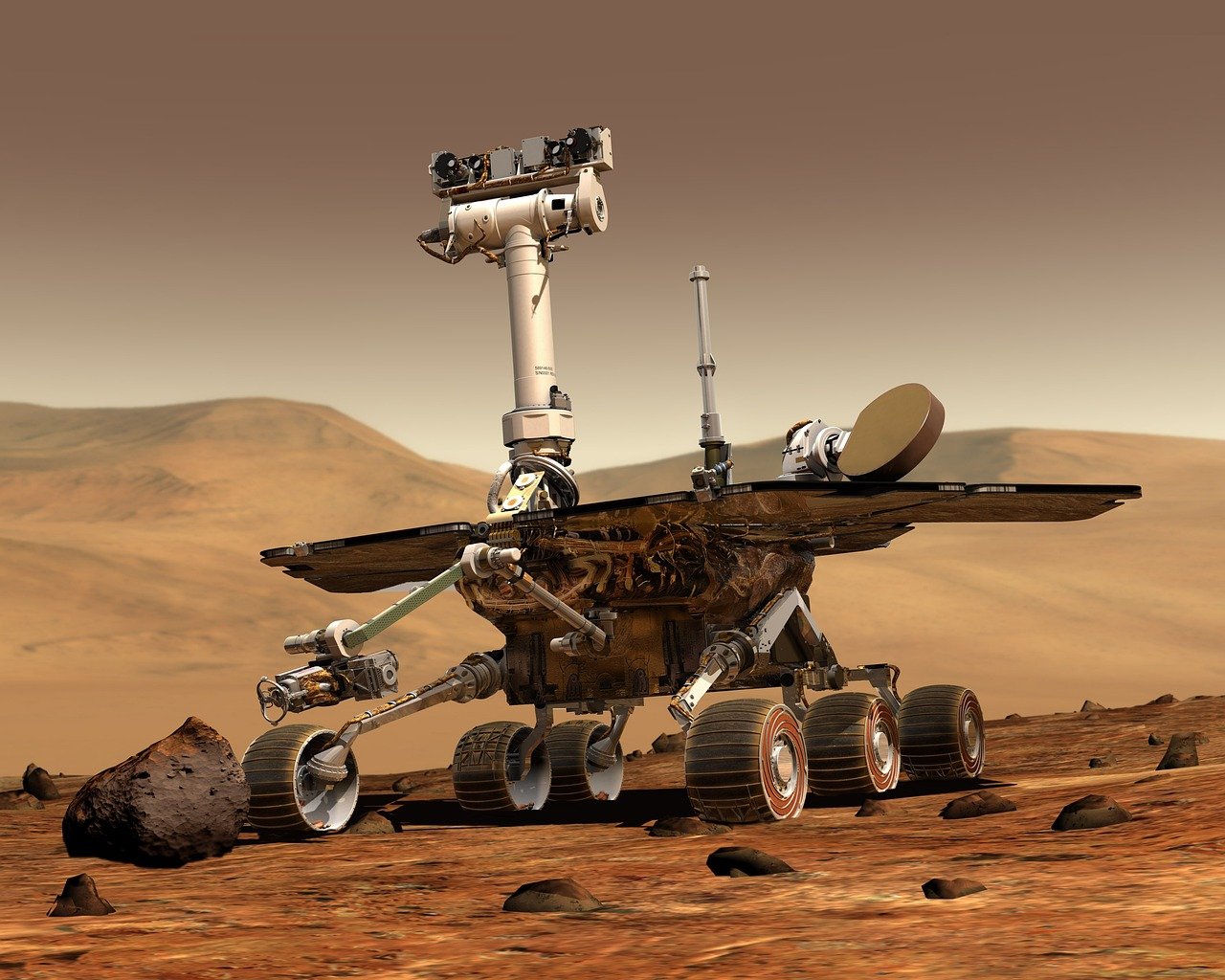
First Rover to Drill for Hidden Life (Image Credits: Pixabay)
Kennedy Space Center, Florida – NASA selected SpaceX’s Falcon Heavy rocket to launch the European Space Agency’s Rosalind Franklin Mars rover no earlier than late 2028 from Launch Complex 39A.[1][2] This decision advances a long-delayed mission designed to probe deeper into the Red Planet’s subsurface than any prior rover. The spacecraft will target Oxia Planum, a region rich in ancient clays that hint at past water flows.
First Rover to Drill for Hidden Life
The Rosalind Franklin rover stands out with its ability to extract samples from up to two meters beneath Mars’ surface, shielding them from destructive radiation.[3]) No previous mission achieved such depth, positioning this explorer to uncover organic molecules preserved from billions of years ago. Engineers equipped it with a specialized drill capable of retrieving 17 core samples, each analyzed for biosignatures.
Mobility defines its operations too. The six-wheeled design allows traversal of 70 meters per Martian day across rugged terrain, using “wheel walking” to navigate obstacles. Autonomous navigation relies on stereo cameras for 3D mapping, ensuring safe paths during limited communication windows via ESA’s Trace Gas Orbiter.[3])
A History Marked by Delays and Determination
Conceived over two decades ago under ESA’s Aurora program, the mission faced repeated setbacks. Initial plans targeted a 2009 launch on a Russian Soyuz, but technical and funding issues pushed timelines forward. A brief NASA partnership in 2009 aimed for 2018, only for budget overruns to prompt withdrawal in 2012.[2]
ESA turned to Russia for Proton rockets and descent systems, launching the Trace Gas Orbiter successfully in 2016 while delaying the rover to 2022. Parachute failures and the COVID-19 pandemic compounded problems. Russia’s invasion of Ukraine in 2022 severed ties, forcing ESA to remove Russian components and seek new partners. Congress rejected a 2025 attempt to cut NASA’s support, paving the way for current progress.[2]
SpaceX Enters the Mars Arena
This launch represents SpaceX’s first delivery of a payload destined to land on Mars. The Falcon Heavy, proven in prior heavy-lift missions, provides reliable power from Kennedy Space Center. Unlike the experimental Starship, its track record suits the international stakes.[2]
NASA’s Rosalind Franklin Support and Augmentation project supplies critical elements: the rocket, lander braking engines, radioisotope heaters to warm electronics through cold nights, and parts of the Mars Organic Molecule Analyzer. ESA leads rover assembly by Airbus, carrier spacecraft by OHB, and operations. A 2024 memorandum expanded this cooperation, with approvals in 2026 greenlighting implementation.[1]
| Partner | Contributions |
|---|---|
| ESA | Rover (Airbus), lander platform (Airbus), carrier (OHB), assembly (Thales Alenia Space) |
| NASA | Falcon Heavy launch, braking engines, heaters, MOMA components |
| SpaceX | Launch vehicle operations from LC-39A |
Instruments Poised to Unravel Mars’ Past
The rover’s Pasteur suite packs nine instruments for exobiology and geology. These tools target water traces, minerals, and organics in untouched soil.
- PanCam: Maps terrain and spots biological signatures on rocks.
- WISDOM: Radar probes subsurface layers up to three meters deep.
- MOMA: Mass spectrometer detects organics via laser and heat methods, with NASA-supplied core.
- RLS: Raman laser identifies minerals and potential biosignatures.
- CLUPI: Microscopic images of rocks and drill samples.
- ENFYS: Infrared scans for clays linked to ancient water.
- Adron-RM: Neutrons detect hydrogen, signaling ice or hydration.
- Ma_MISS: Analyzes borehole walls during drilling.
- MicrOmega: Hyperspectral microscope examines sample grains.
[3])
Solar panels generate 1200 watt-hours daily, backed by batteries for seven months of roaming. At 310 kg, the rover balances power and endurance for its ambitious goals.
Key Takeaways
- Rosalind Franklin drills 2 meters deep, first to access radiation-protected samples.
- Launch on Falcon Heavy marks SpaceX’s Mars debut, targeted for late 2028.
- ESA-NASA partnership overcomes geopolitical hurdles for subsurface life hunt.
As preparations accelerate, the Rosalind Franklin mission promises revelations about Mars’ habitability. This collaboration underscores global commitment to unlocking planetary secrets. What signs of life might it find? Share your thoughts in the comments.