

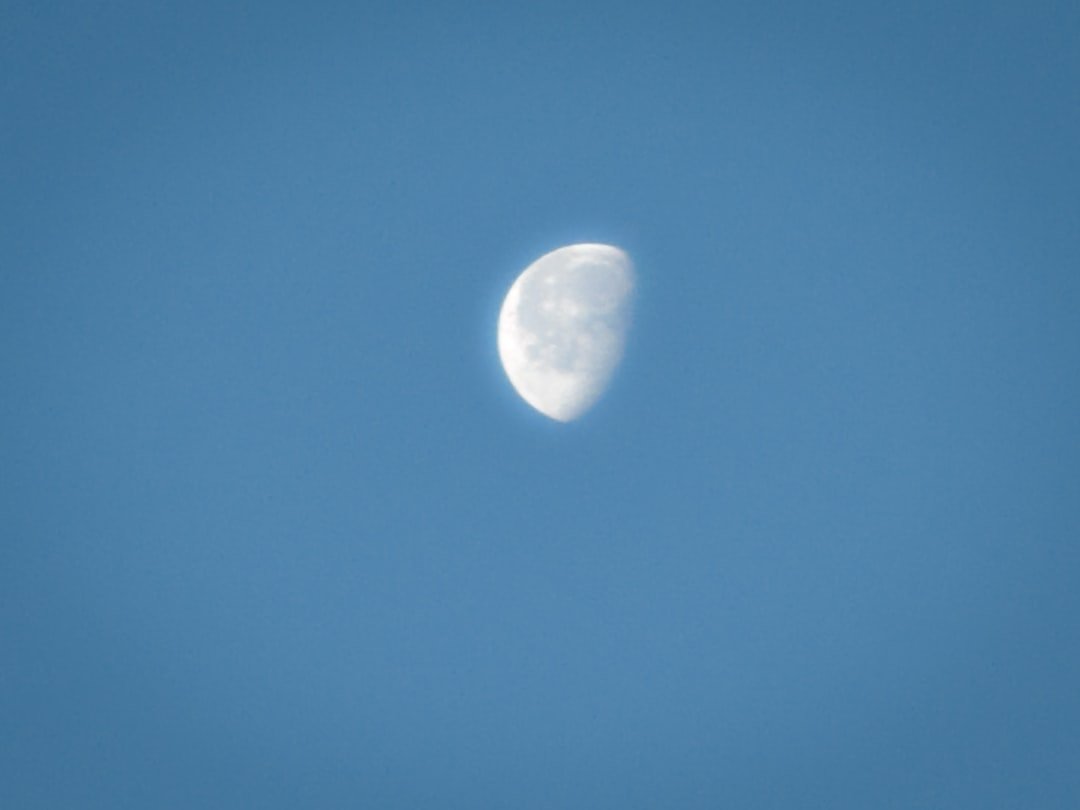
Earthshine Steals the Show on the Waxing Crescent (Image Credits: Unsplash)
Stargazers have a prime opportunity tomorrow evening as a slender waxing crescent moon positions itself near brilliant Venus and the sparkling Pleiades star cluster. This alignment unfolds low in the west-northwest sky shortly after sunset, offering a fleeting yet memorable display illuminated by the subtle glow of earthshine.[1][2] Clear horizons will reveal the scene in its full glory, drawing eyes upward during the early spring twilight.
Earthshine Steals the Show on the Waxing Crescent
The waxing crescent moon, just two days past new moon and illuminated by about 9 to 11 percent, presents a razor-thin curve against the deepening sky.[1] Earthshine provides the highlight, casting a soft glow across the moon’s shadowed side as sunlight reflects off Earth’s oceans, clouds, and land surfaces before reaching our satellite.[2] This phenomenon, sometimes called the Da Vinci Glow, peaks around new moon phases when viewing geometry aligns perfectly.
On April 19, the moon climbs to around 20 degrees above the horizon about an hour after sunset, making it accessible even from urban areas with minimal obstruction.[3] Observers noted similar setups in past years drew crowds to open fields, underscoring the event’s appeal to casual skywatchers.
Venus Shines as the Evening’s Brightest Beacon
Venus dominates the view at magnitude -3.9, outshining all other points of light save the moon itself.[4] Positioned about 10 degrees above the west-northwest horizon and roughly 11 degrees below the moon, it appears as a steady, untwinkling beacon amid fading twilight.[2] The planet sets about two hours after the sun, giving ample time for appreciation.
This alignment marks Venus stepping into Taurus territory, enhancing the tableau with its proximity to ancient constellations.[2] Sky enthusiasts often describe Venus as the “evening star” during such evenings, a title earned through countless similar conjunctions.
The Pleiades: A Cluster of Ancient Stars
Sandwiched between the moon and Venus, the Pleiades open star cluster – home to over 1,000 stars – resembles a tiny dipper or the profile of the Big Dipper in miniature.[2] Located 4.6 degrees below the moon on April 19, it fits neatly into binocular fields of view, revealing its hot blue stars against the Taurus backdrop.[3] The cluster rides on the bull’s shoulder, a fixture in spring skies.
Visibility improves as twilight deepens, with the Pleiades emerging about 30 to 90 minutes post-sunset.[1] Ancient cultures knew it as the Seven Sisters, though sharper eyes or aids reveal more members.
Navigating the Scene: Positions and Neighbors
To locate the trio, face west-northwest with a clear view to the horizon. The moon serves as the anchor at 20 degrees up, Venus lower at 10 degrees, and Pleiades bridging the gap.[2] Nearby, red-orange Aldebaran marks Taurus’s eye, 11 degrees to the moon’s right, while the Hyades form a V-shape outlining the bull’s face.
Jupiter gleams higher overhead in Gemini, about 50 degrees from Venus, near the twin stars Castor and Pollux.[3] Orion lingers briefly in the southwest before fading.
| Object | Altitude (approx., 1 hr after sunset) | Relation to Moon |
|---|---|---|
| Moon | 20° | – |
| Pleiades | ~15° | 4.6° below |
| Venus | 10° | 11° below |
| Aldebaran | ~25° | 11° right |
Viewing Tips for the Best Experience
No equipment proves necessary, though binoculars transform the view, framing the moon and Pleiades together while sharpening Venus’s glow.[2] Seek elevated spots away from city lights for optimal contrast.
- Arrive 30 minutes after sunset to catch Venus first.
- Use a tripod for photos; exposures up to five seconds capture earthshine.
- Observe over April 18-20 as positions shift nightly.
- Check weather for clear western views.
- Northern Hemisphere observers enjoy prime sightlines.
Key Takeaways
- Earthshine on the 9-11% crescent moon offers a rare glow visible to the naked eye.
- Venus at -3.9 magnitude anchors the low western alignment.
- Binoculars reveal the Pleiades’ full splendor between moon and planet.
This alignment reminds us of the sky’s quiet rhythms, where moon, planet, and stars briefly converge. Head outside tomorrow – what will you capture in the twilight? Share your views in the comments.