

Astronomers have spent decades modeling what triggers dwarf nova outbursts – a unique binary with a 1.81-hour orbit just upended their theories – Image for illustrative purposes only (Image credits: Unsplash)
Astronomers have long relied on established models to explain the sudden brightening events known as dwarf nova outbursts. Those models centered on familiar pairings of ordinary stars and white dwarfs. Now a newly characterized system has shown that the same dramatic flares can occur in an entirely different configuration, one that had never been expected to produce them.
The Unexpected Discovery
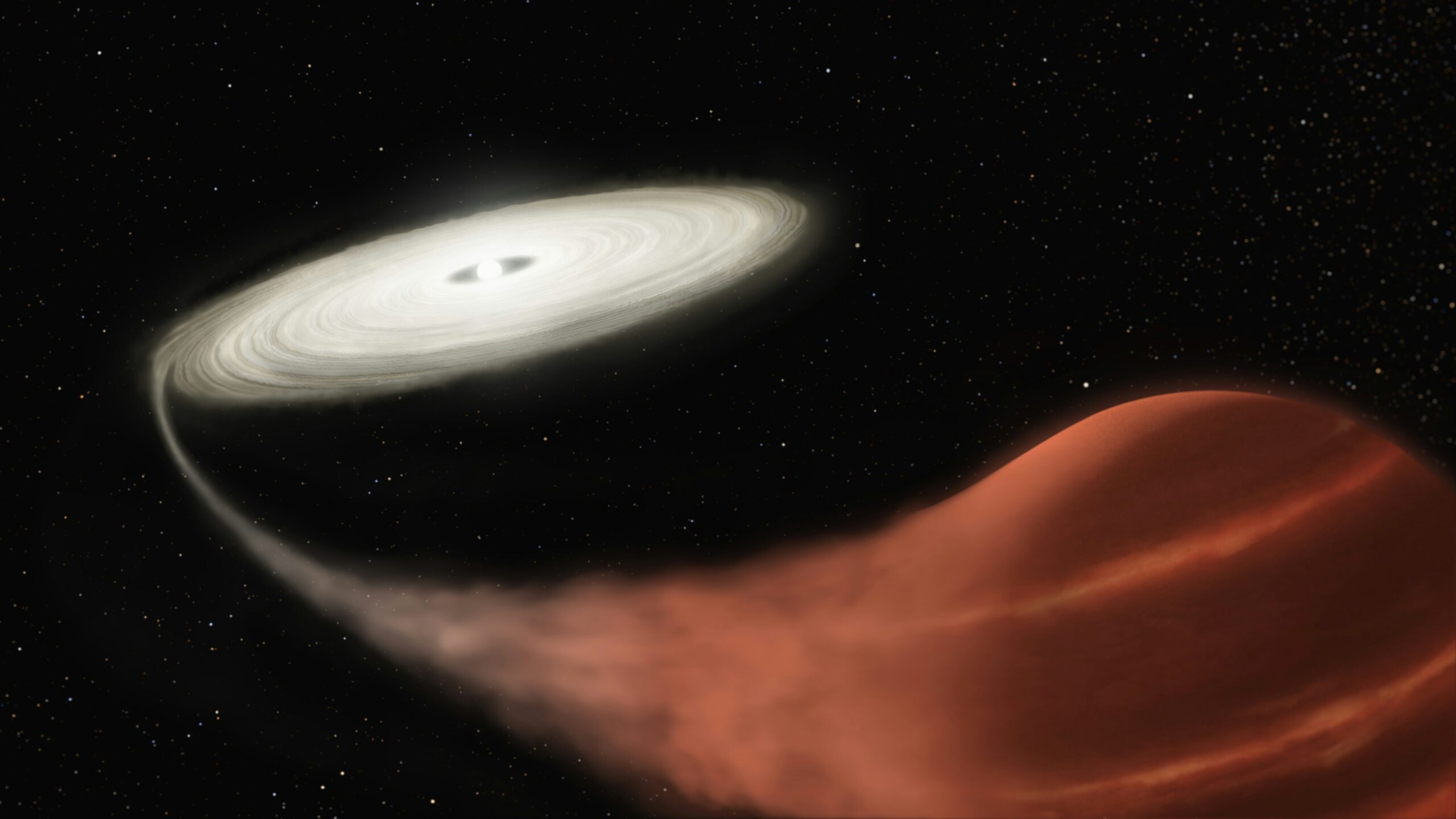
Researchers identified the system, designated ZTF J0007+4804, through sustained monitoring by the Zwicky Transient Facility and NASA’s TESS satellite. The binary consists of a white dwarf and a hot subdwarf star locked in an orbit that completes one revolution every 108.72 minutes. This makes it the first hot subdwarf–white dwarf pair observed to display repeated dwarf nova outbursts.
The white dwarf has a mass of roughly 0.48 solar masses, while the subdwarf companion weighs about 0.42 solar masses. Unlike typical cataclysmic variables, the donor star here is a stripped, helium-rich remnant rather than a normal hydrogen-burning star. Yet material from a thin outer hydrogen layer is still being transferred, forming an accretion disk around the white dwarf.
Rapid Outbursts That Defied Predictions
The system produces SU UMa-type outbursts roughly every nine days. These events arise when the accretion disk reaches a critical density and switches to a hotter, brighter state. Data from the Zwicky Transient Facility provided more than 2,200 optical measurements between 2018 and 2024, while TESS contributed over 47,000 high-cadence points across multiple sectors.
Conventional theory held that the intense heat from a hot subdwarf would stabilize any surrounding disk and prevent such thermal-viscous instabilities. The observed cycling between faint and bright states directly contradicts that expectation and shows that disk behavior can remain unstable even under strong irradiation.
Implications for Binary Evolution and Future Observations
Only three other hot subdwarf–white dwarf systems have been found transferring mass through Roche-lobe overflow, and none had previously shown dwarf nova activity. The new case supplies fresh constraints on how such pairs survive common-envelope phases and lose orbital energy through gravitational waves.
Models indicate the two stars will merge in approximately 226 million years. Their combined mass of about 0.9 solar masses lies below the threshold for a typical Type Ia supernova, suggesting a quiet merger into a single massive white dwarf is the most likely outcome. A faint thermonuclear explosion remains possible but cannot be confirmed without further study.
Key parameters at a glance
- Orbital period: 108.72 minutes
- White dwarf mass: ~0.48 solar masses
- Hot subdwarf mass: ~0.42 solar masses
- Outburst recurrence: ~9 days
- Time to merger: ~226 million years
A Natural Laboratory for Gravitational-Wave Astronomy
The system’s short period and compact components place it squarely in the sensitivity range of the upcoming LISA mission. Once operational, LISA will detect continuous gravitational-wave signals from such verification binaries, allowing precise calibration of the observatory well before any merger events are recorded.
Continued analysis of existing survey archives is expected to reveal additional examples of these rare, rule-breaking systems. Each new detection will help refine the physical parameters that govern accretion disks and binary evolution in the most extreme stellar environments.