

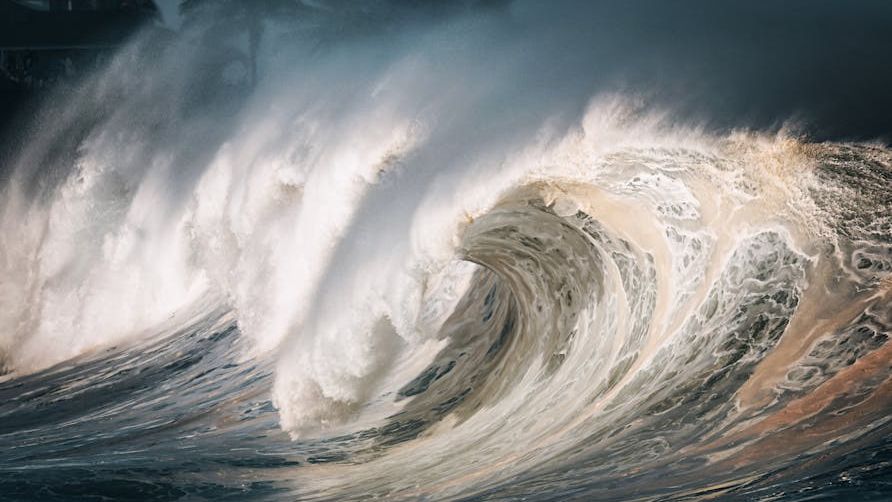
Huge landslide created a 500-meter-high tsunami in a major tourist area – Image for illustrative purposes only (Image credits: Pexels)
Tracy Arm, Alaska – A sudden detachment of rock from a mountainside above the fjord set off a powerful wave on August 10, 2025. The event occurred at 5:26 a.m. local time when at least 63.5 million cubic meters of material fell into the water at the edge of the South Sawyer Glacier. Scientists have since pieced together the sequence using field data and modeling, showing how the displacement created an initial wave that raced across the narrow inlet at more than 70 meters per second.
How the Wave Developed
The falling rock struck the deep water near the glacier terminus and immediately forced a large volume of water upward. This produced a breaking wave roughly 100 meters high that crossed the fjord in seconds. Upon reaching the opposite shore, the water climbed the steep rock walls to a measured runup of 481 meters above sea level. The confined geometry of the fjord amplified the effect, turning a localized slide into one of the most extreme wave events documented in modern records.
Comparison With Past Events
Landslide-generated tsunamis differ from those caused by earthquakes because they displace water directly and often reach greater heights in narrow basins. Since 1925, researchers have identified 27 similar cases worldwide with runup heights above 50 meters. The Tracy Arm wave ranks just below the 1958 Lituya Bay event in Alaska, which reached 530 meters.
| Event | Runup Height | Year |
|---|---|---|
| Lituya Bay, Alaska | 530 meters | 1958 |
| Tracy Arm, Alaska | 481 meters | 2025 |
These comparisons help place the recent incident among the most violent wave events tied to slope failures rather than seismic activity.
Why No One Was Hurt
The wave struck an area popular with cruise ships and kayakers, yet no injuries or deaths occurred. The timing, just before dawn, meant few vessels or visitors were present in the immediate path. Aram Fathian, a researcher at the University of Calgary and co-author of the study published in Science, noted that the outcome was fortunate but not guaranteed in future cases.
Lessons From the Reconstruction
The detailed analysis shows how quickly such waves can form and travel in glaciated fjords. Fathian described the Tracy Arm wave as the second-highest tsunami ever recorded on Earth, adding that it remained largely unknown until the recent study because it caused no damage. The findings highlight the value of monitoring steep slopes near retreating glaciers, where similar rock detachments could occur again without warning. Continued observation in these remote settings may help identify conditions that precede large slides before they reach the water.