

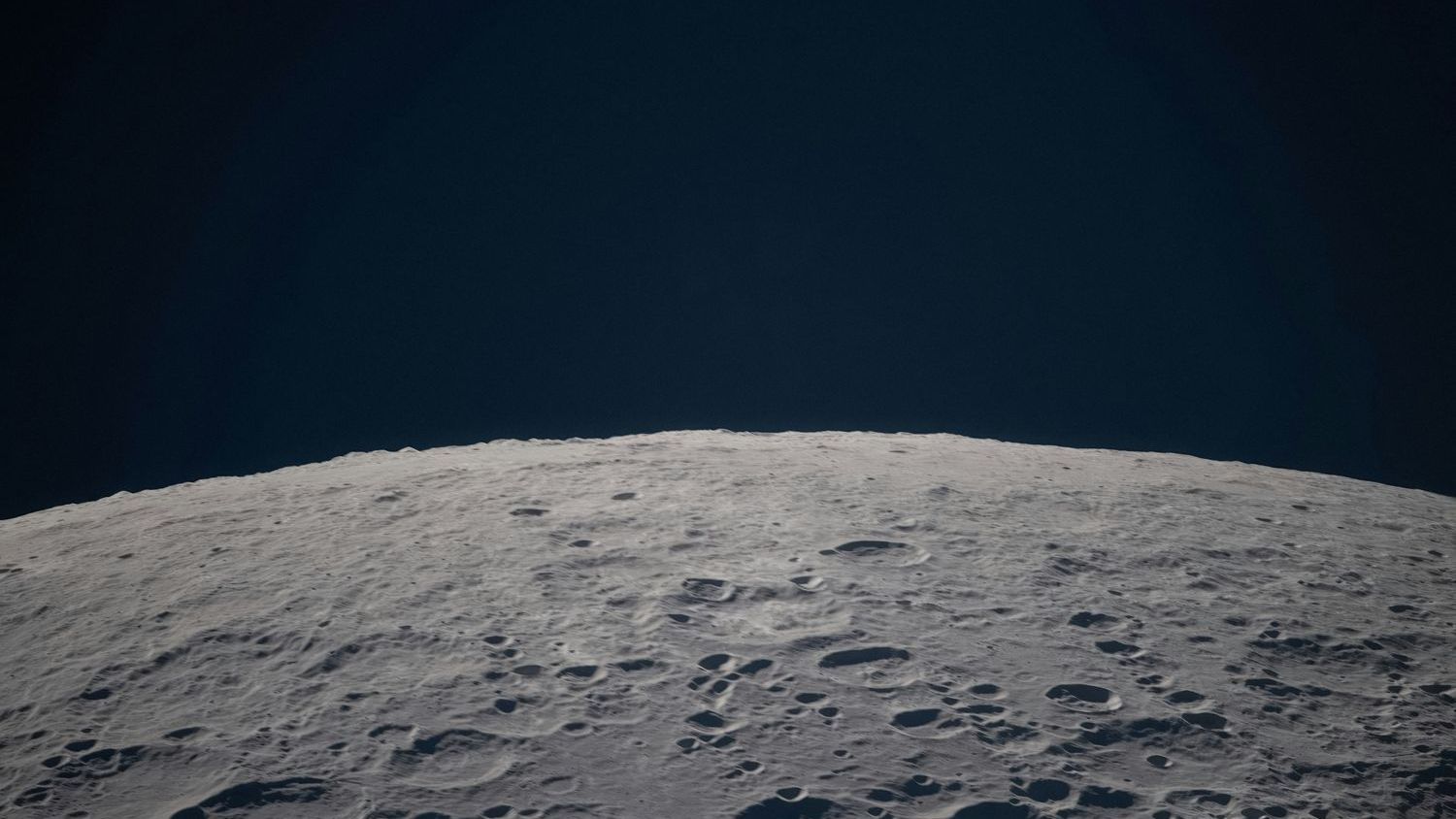
NASA Laser Terminal enhances views during Artemis II mission – Image for illustrative purposes only (Image credits: Unsplash)
NASA’s Artemis II mission captivated global audiences with its daring lunar flyby, pushing four astronauts farther into space than any humans before. The crew’s 10-day journey around the moon relied on a groundbreaking NASA laser terminal to transmit high-definition footage and data back to Earth. This technology not only enhanced public engagement but also proved essential for real-time mission support.[1][2]
A Crew Breaks Distance Records
The Artemis II spacecraft lifted off on April 1, 2026, from Kennedy Space Center’s Launch Complex 39B aboard the Space Launch System rocket. Commander Reid Wiseman, Pilot Victor Glover, Mission Specialist Christina Koch – all from NASA – and Canadian Space Agency astronaut Jeremy Hansen guided Orion through a free-return trajectory. The mission reached a peak distance of 252,756 miles from Earth, eclipsing Apollo 13’s previous record.[2]
Orion skimmed within 4,067 miles of the lunar surface on April 6, allowing the crew to observe a solar eclipse and conduct science operations. The voyage lasted nine days, one hour, and 32 minutes before splashing down in the Pacific Ocean southwest of San Diego. Recovered by the USS John P. Murtha, the crew emerged unscathed, having validated deep-space systems for future Artemis flights.[2][3]
This flight represented milestones beyond distance. Koch became the first woman, Glover the first person of color, and Hansen the first non-U.S. citizen to venture beyond low Earth orbit on a lunar trajectory. Wiseman, the oldest, joined them in setting these benchmarks after more than five decades since Apollo 17.
Laser Communications Outpaces Traditional Systems
The Orion Artemis II Optical Communications System, or O2O, featured a laser terminal developed by MIT’s Lincoln Laboratory. Known as MAScOT, this compact payload – about the size of a house cat – mounted externally on Orion with a 4-inch telescope on a two-axis gimbal. It used invisible infrared light to encode and transmit data, far surpassing radio frequency limits.[4]
Traditional radio systems via NASA’s Near Space and Deep Space Networks managed single-digit megabits per second at lunar distances. O2O achieved multiple 260 megabits-per-second downlinks, enabling richer content. Ground stations at NASA’s Jet Propulsion Laboratory in Southern California, White Sands in New Mexico, and Australia’s Canberra site received the beams during line-of-sight windows.[1]
| Communication Method | Typical Data Rate (Lunar Distance) | Mission Total |
|---|---|---|
| Radio Frequency | Single-digit Mbps | Limited by bandwidth |
| Laser (O2O) | 260 Mbps | 484 GB exchanged |
Engineers from Lincoln Laboratory’s Optical and Quantum Communications Group led development, drawing on prior demos like the 2013 Lunar Laser Communication Demonstration. The system earned a 2025 R&D 100 Award for its scalable design using commercial parts.
Stunning Data Streams Bring the Mission Home
Over the mission, O2O exchanged 484 gigabytes – equivalent to 100 high-definition movies. Transmissions included high-definition video, flight procedures, engineering telemetry, science data, voice loops, and striking photos of Earthset and Earthrise. Australian ground teams streamed dual video for over 15.5 hours, fueling the “Live Views from Orion” broadcasts.[1]
“Access to high-resolution imagery and other scientific data during dynamic science mission phases is a game changer,” said Dr. Kelsey Young, Artemis II lunar science lead. “It means faster insights, better science decision-making to support the crew as they’re completing science exploration.”[1]
- High-definition mission footage for public viewing
- Real-time photos during lunar flyby
- Engineering data for immediate analysis
- Voice communications with ground control
Peak performance hit design targets, with tests showing potential for 622 Mbps downlinks and 51 Mbps uplinks. The system downlinked 26 gigabytes in under an hour from select sites, accelerating post-flyby science reviews.
Space communications isn’t just about moving bytes. It’s about delivering the images, the video, and the voices of the crew that bring a mission to life.
Greg Heckler, SCaN deputy program manager for capability development
Paving the Way for Deeper Exploration
O2O’s success positions laser communications as a cornerstone for Artemis lunar landings and Mars voyages. Higher data volumes will boost scientific returns and enable videoconferencing for crew health checks. Costs dropped through off-the-shelf components in ground stations.[4]
Teams at NASA’s Johnson Space Center and White Sands ran monthly simulations to ensure readiness. This operational debut on a crewed deep-space flight confirms scalability. Future systems could handle terabytes daily, transforming how humanity connects across the cosmos.