

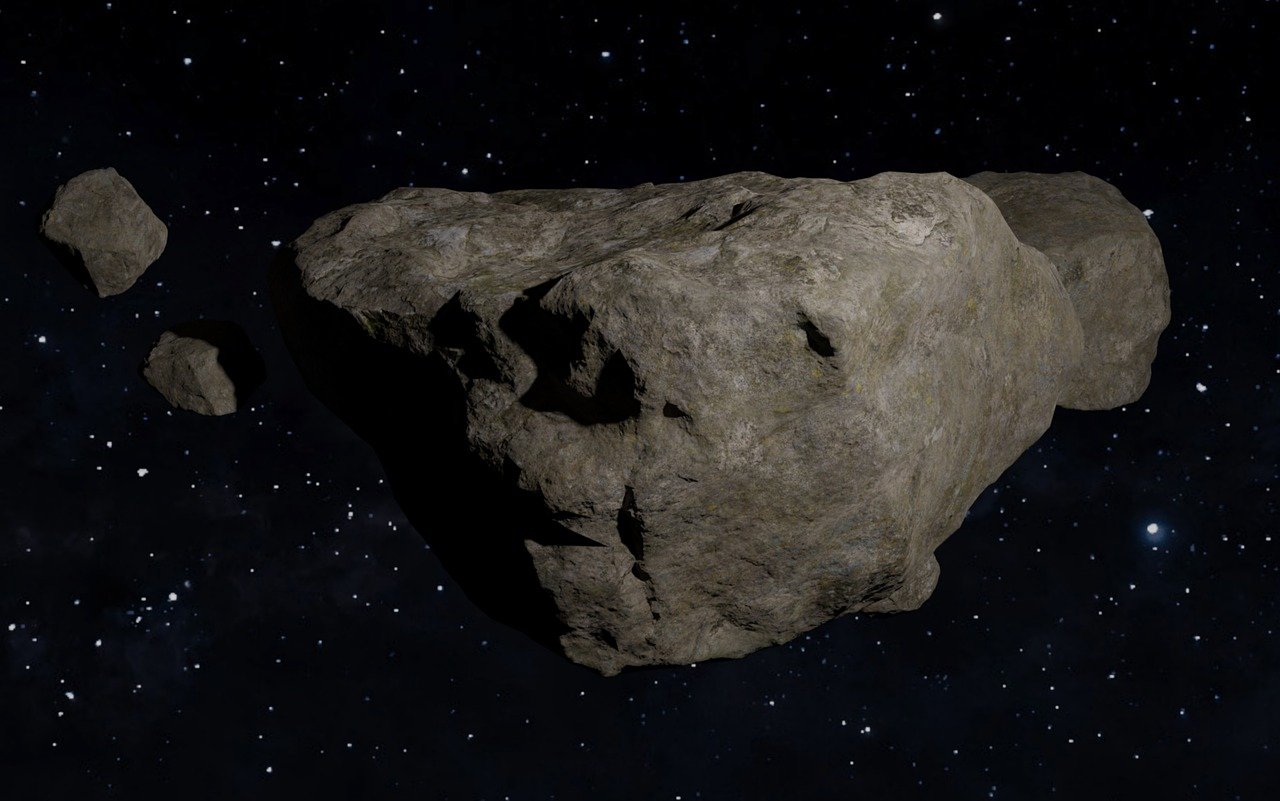
From Ominous Discovery to Scientific Gem (Image Credits: Pixabay)
On April 13, 2029 – just three years from tomorrow – the asteroid Apophis will streak past Earth at a distance closer than geostationary satellites. This peanut-shaped space rock, roughly the length of an NFL football field, offers astronomers a rare chance to observe a potentially hazardous object up close without any collision risk. The event marks the nearest approach by an asteroid of its size that experts have tracked in advance.[1][2]
From Ominous Discovery to Scientific Gem
Astronomers first spotted Apophis on June 19, 2004, at Arizona’s Kitt Peak National Observatory. Roy Tucker, David Tholen, and Fabrizio Bernardi identified the object, initially labeled 2004 MN4, using the 2.3-meter Bok telescope. Early calculations sparked alarm, as models suggested a small chance of impact in 2029 or later years. Further observations quickly refined its path and eased those fears.[1][3]
The asteroid earned its name in 2005 from the Egyptian god of chaos and destruction. Radar imaging later revealed its elongated, bilobed shape – about 340 meters across on average and up to 450 meters long. Composed of silicate materials laced with nickel and iron, Apophis tumbled end-over-end every 30 hours or so. These traits made it a prime target for study, transforming initial worry into excitement.[1]
Unpacking the 2029 Close Approach
Apophis will hurtle by at roughly 7 kilometers per second relative to Earth, passing just 32,000 kilometers above the surface. That proximity – nearer than many communication satellites at 36,000 kilometers – beats the Moon’s average distance by a wide margin. The flyby occurs on a Friday the 13th, adding cosmic irony, with closest approach around 21:00 to 23:00 UTC over regions like Taiwan.[1][3]
Observers in Europe, Africa, and western Asia will spot it with the naked eye at magnitude 3.1, weather permitting. It traces a path about 15 degrees north of the Pleiades star cluster for North American viewers with telescopes. Earth’s gravity will tug at the asteroid, potentially triggering surface quakes, landslides, and orbital tweaks – from an Aten-class to Apollo-class path.[2]
- Distance from Earth’s surface: 31,600–32,000 km
- Relative speed at closest: Up to 7.4 km/s
- Visibility: Naked eye in Eastern Hemisphere; telescopic elsewhere
- Duration of bright phase: Several hours at peak
- Effect on Apophis: Possible reshaping and spin changes
Risks Ruled Out: A Safe Spectacle
Initial fears of a 2029 strike faded by 2006, thanks to precise tracking that accounted for the Yarkovsky effect – sunlight gently nudging the orbit. Radar from NASA’s Goldstone in 2013 and 2021 confirmed no danger for 2036 or 2068 either. Davide Farnocchia of NASA’s Center for Near-Earth Object Studies noted, “A 2068 impact is not in the realm of possibility anymore, and our calculations don’t show any impact risk for at least the next 100 years.”[2]
The 2036 pass falls at over 46 million kilometers, far safer. By 2068, refined data eliminated even tiny odds. Though classified as potentially hazardous due to its size and path, Apophis poses no threat during this flyby or beyond the century horizon. These assessments underscore advances in planetary defense.[3]
| Encounter Year | Distance (km) | Risk Status |
|---|---|---|
| 2029 | 31,600 (surface) | None |
| 2036 | 46 million | None |
| 2068 | Safe | Ruled out |
Missions Gear Up for Unprecedented Insights
NASA’s OSIRIS-APEX, repurposed from the OSIRIS-REx Bennu mission, will rendezvous with Apophis in April 2029, shortly after the flyby. The spacecraft will orbit at half a mile, mapping the surface, probing chemistry, and even blasting thrusters to expose subsurface material. ESA’s proposed Ramses mission aims to shadow the asteroid through the encounter, measuring gravity shifts.[4][3]
Ground telescopes worldwide, coordinated via the International Asteroid Warning Network, will track changes in brightness, spin, and shape. Space observatories will capture radar echoes for a detailed 3D model. Scientists expect revelations about internal structure and how tidal forces reshape such bodies – data vital for future defense strategies.[1]
Key Takeaways
- Apophis’ flyby is the closest predicted approach by a large asteroid in centuries.
- No collision risk exists for the next century, per NASA radar data.
- Multiple missions will transform this event into a wealth of scientific knowledge.
This once-feared visitor now promises to deepen our grasp of solar system relics and deflection techniques. Mark your calendar for April 13, 2029 – what preparations will you make to witness it? Tell us in the comments.