

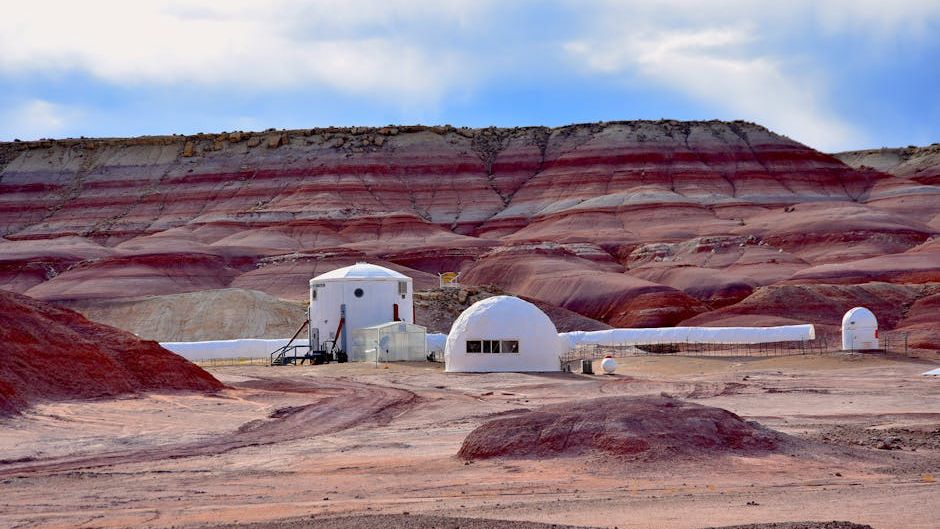
To Build a City on Mars, We Might Need to Plunder the Asteroid Belt – Image for illustrative purposes only (Image credits: Pexels)
Humanity’s ambition to build cities on Mars hinges on overcoming severe resource limitations. The planet provides ample iron but falls short on essential metals needed for durable habitats, rovers, and manufacturing equipment. Researchers led by Serena Suriano have outlined a logistics framework that taps metallic asteroids for these critical supplies, potentially enabling long-term independence from Earth shipments.[1][2]
Mars’ Metal Shortage Demands Creative Solutions
The first waves of Martian settlers will rely heavily on materials shipped from Earth or refined from local regolith. Iron oxide abounds in the soil, but processing it into usable forms requires energy-intensive operations. More problematic are scarcities of metals like nickel, cobalt, molybdenum, and boron, whose availability on Mars remains limited or uncertain.
Without diverse metals, constructing pressurized habitats or robust machinery proves challenging. The study estimates needs for thousands of tons to support dozens of habitats and hundreds of rovers. Additive manufacturing offers a way to fabricate parts on-site, but feedstock must come from somewhere beyond Mars’ surface.[3]
Earth-based industry cannot sustain endless deliveries due to launch costs and capacity constraints. Initial colonies will strain the Earth-Moon system’s output, leaving a bottleneck for expansion.
Selecting Prime Targets in the Asteroid Belt
Metallic asteroids, remnants of differentiated planetesimals, promise rich hauls of iron-nickel alloys, cobalt, and even platinum-group metals. The researchers scoured the JPL Small-Body Database for candidates within reach: those with orbits under 4.6 AU semi-major axis, spectral types indicating metal content (X, Xe, Xk, Xc), and diameters over 500 meters.
Twenty-two metallic bodies met the criteria, including 332 Siri, 44 Nysa, and 77 Frigga, primarily from the inner and outer Main Belt or Mars-crossing paths. Delta-v maps guided selection, ensuring transfers from low Mars orbit stayed under 6.4 km/s per leg for Starship-class vehicles.[2]
Carbonaceous asteroids complemented the list, chosen for water ice to produce propellant via in-situ resource utilization. Nineteen such targets, like 91 Aegina and 257 Silesia, paired efficiently with metallics to enable refueling stops and round-trip feasibility.
Optimizing the Interplanetary Supply Chain
The core innovation lies in a multi-objective genetic algorithm that designs 20-year mining schedules starting around 2040. It balances total mission delta-v against masses of extracted metals and on-site propellant, factoring launch windows, flight times, and mining rates from 100 to 800 kg per day.
Cargo spacecraft, modeled after Starship with 115-ton payload and 6.4 km/s delta-v capability, depart low Mars orbit for asteroid pairs: mine metals first, then refuel at a carbonaceous neighbor before returning. Direct metallic-only runs proved impractical without extra propellant, exceeding velocity budgets.
| Scenario | Delta-V (km/s) | Metals Delivered (tons, one ship, 20 years) |
|---|---|---|
| Metallic-Carbonaceous Pairs (min rate) | 26.59 | 111.6 |
| Metallic-Carbonaceous Pairs (max rate) | 28.12 | 203 |
| With Earth-Sun L2 Depot (min rate) | 46.96 | 344.8 |
| 70 Ships, Pairs (max rate) | N/A | 12,095 |
One vessel could visit two pairs, yielding enough metal for about 100 Perseverance-sized rovers or habitats for 15 people. Fleets scale output dramatically: 70 ships deliver over 12,000 tons, sufficient for eight housing complexes supporting 120 colonists plus extensive rover fleets.[3]
Feasibility, Limits, and Next Horizons
Results affirm viability within current propulsion tech, assuming mining and ISRU mature accordingly. An Earth-Sun L2 depot serves as backup, stocking uniform metals when asteroid variety proves tricky. Stay times span hundreds of days, allowing realistic extraction paces.
Caveats persist: actual metal assays await missions, processing efficiencies remain unproven, and orbital dynamics demand precise timing. The study assumes optimistic propellant yields from carbonaceous bodies and focuses on logistics over full mining economics.
Still, this framework shifts the paradigm from Earth-dependent outposts to a solar-system economy. As prototypes advance, asteroid-derived metals could transform Mars from frontier camp into thriving settlement.[1]