

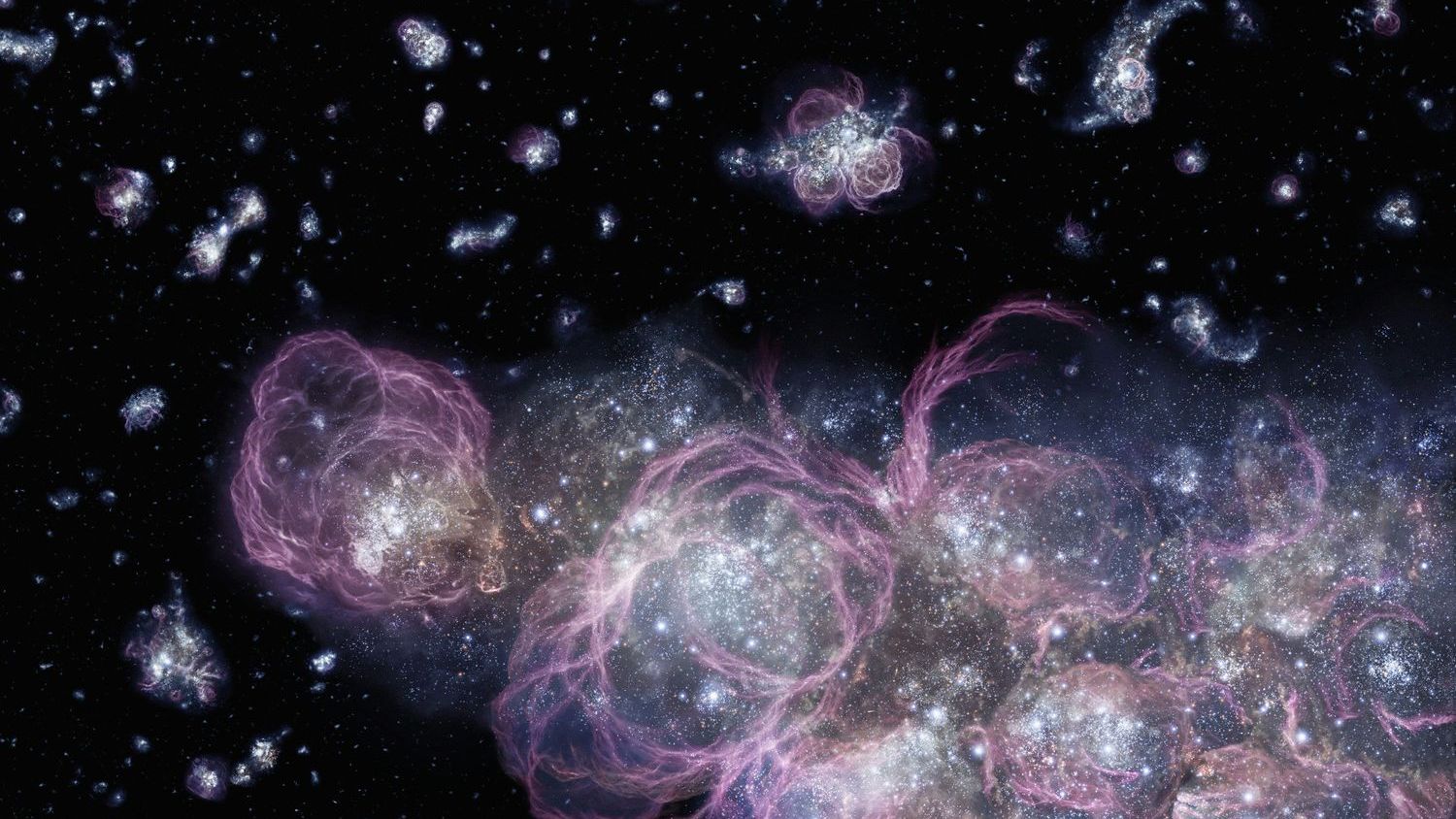
There’s A Dwarf Galaxy Hidden Inside the Milky Way – Image for illustrative purposes only (Image credits: Unsplash)
Astronomers recently pinpointed a cluster of 20 ancient stars within the Milky Way’s galactic plane that appear to hail from a long-vanished dwarf galaxy. These metal-poor stars, located just a few thousand light-years from the Sun, share uncanny chemical profiles and orbital paths. The discovery hints at an early merger that shaped our galaxy’s formative years.[1][2]
Spotting the Anomalous Stars
Researchers selected the 20 stars based on their positions near the Milky Way’s flat disk and their highly eccentric orbits. These stars reside within about 6,500 light-years of the Sun, an unusually close vantage point for such ancient relics. High-resolution spectra from the ESPaDOnS instrument at the Canada-France-Hawaii Telescope revealed 23 chemical elements in each star.[1]
The team compared these observations to stars in the galaxy’s halo and known dwarf systems. Unlike typical halo stars, this group showed tightly clustered abundances, suggesting they formed together in a distinct environment. Eleven stars follow prograde orbits, aligning with the Milky Way’s rotation, while nine trace retrograde paths in the opposite direction.[3]
Chemical Clues to an Explosive Origin
The stars proved remarkably metal-poor, with scant heavy elements beyond hydrogen and helium. Their compositions bore marks of intense early events: core-collapse supernovae, hypernovae, rapidly rotating massive stars, and neutron star mergers enriched them with elements like carbon, magnesium, calcium, titanium, manganese, strontium, barium, and europium.[1]
Strikingly, no signatures appeared from Type Ia supernovae, which stem from white dwarf explosions. This absence points to a short-lived progenitor unable to produce such stars, as white dwarfs require billions of years to form. Neutron-capture patterns matched those in classical dwarf galaxies, not ultra-faint ones.[2][4]
These findings suggest that the stars formed in an environment that experienced a homogeneous chemical evolution akin to that of dwarf galaxies.
The Trickster Named Loki
The researchers dubbed the dwarf galaxy Loki, drawing from the Norse god known for chaos and mischief. The mixed prograde and retrograde orbits, confined tightly to the galactic plane, evoked this trickster quality. Such dynamics likely arose during the Milky Way’s infancy, when its structure was still chaotic.[1]
Cosmological simulations supported a single progenitor system, with a baryonic mass akin to a dwarf galaxy. The merger occurred 11 to 12 billion years ago, an “early accretion” event that scattered Loki’s stars into the proto-Milky Way. Prograde and retrograde stars showed no chemical divide, reinforcing their shared history.[5]
Reshaping Views of Galactic Assembly
This finding underscores how the Milky Way grew by devouring smaller galaxies in its youth. Loki represents one of the earliest known victims, its remnants now embedded in the disk rather than the outer halo. Traditional models placed ancient merger debris farther out, but Loki challenges that picture.[3]
Future surveys like WEAVE and 4MOST promise to scan more candidates, testing if Loki stands alone or signals multiple buried structures. Researchers noted that these planar stars merit further scrutiny to unravel the early Milky Way’s assembly.[1]
One intriguing interpretation is that these very metal-poor stars in planar orbits might be the remnant of an ancient system that deposited its stars during the early Galactic assembly.
The unmasking of Loki offers a glimpse into cosmic cannibalism, where galaxies build empires from swallowed kin. As telescopes peer deeper, more hidden chapters of our Milky Way’s past may emerge.