

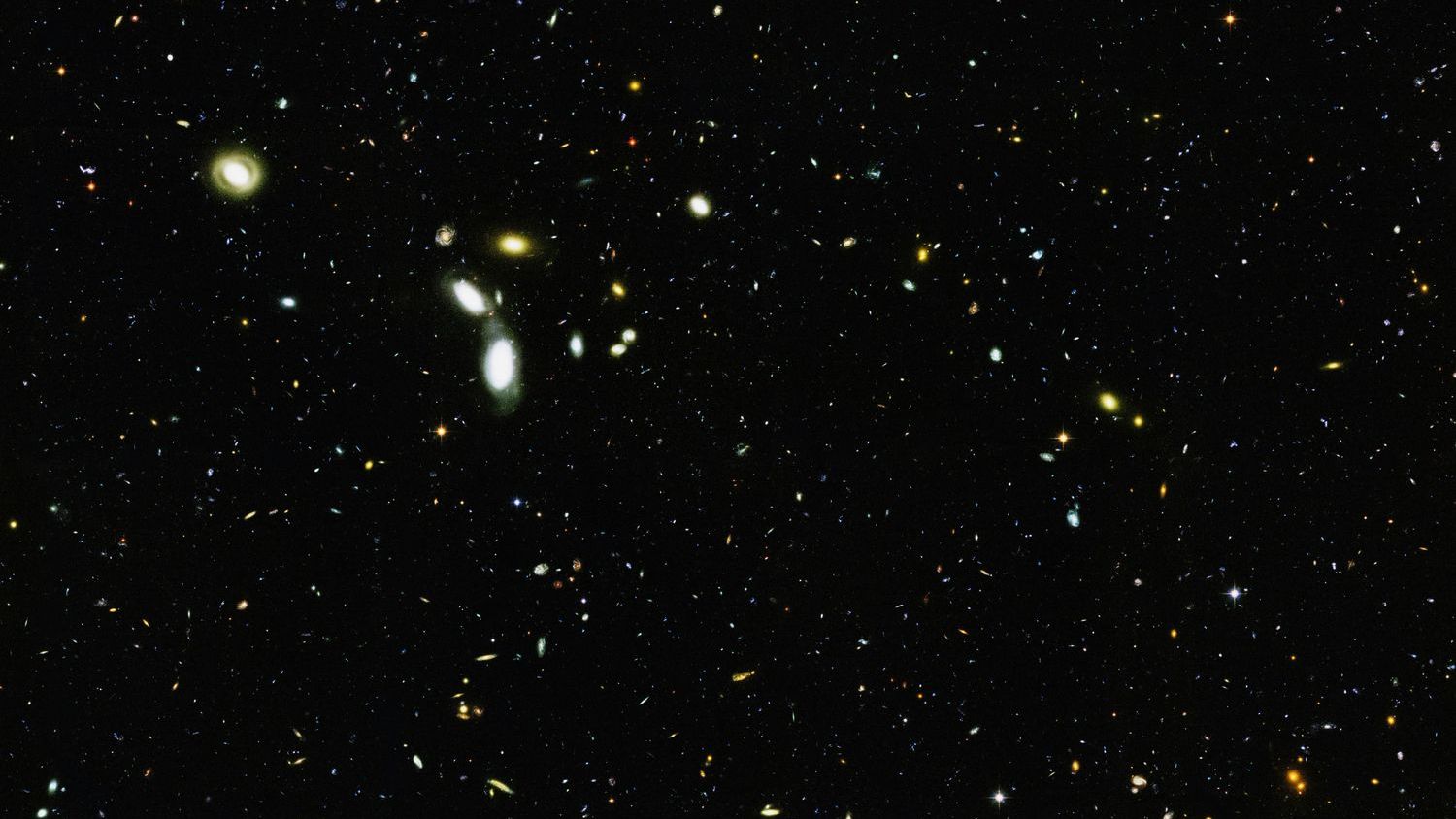
We still can’t see dark matter. But what if we can hear it? – Image for illustrative purposes only (Image credits: Unsplash)
Gravitational waves have already transformed how astronomers observe the universe by capturing the faint ripples produced when black holes merge. A fresh theoretical framework now suggests these same signals could carry subtle traces of dark matter, the invisible material thought to dominate the cosmos. Researchers at MIT and partner institutions have modeled how a black hole merger occurring inside a dense dark matter region might alter the waveform in ways that future detectors could identify. The work opens a potential new channel for studying a substance that has so far evaded every direct detection attempt.
Why Dark Matter Remains Elusive
Dark matter accounts for roughly 85 percent of the universe’s total mass, yet it neither emits nor absorbs light in any measurable way. Astronomers infer its presence only through its gravitational influence on visible galaxies and galaxy clusters. Traditional searches rely on underground detectors hoping to catch rare particle interactions or on telescopes looking for indirect decay products. Both approaches have so far returned null results, leaving open the possibility that dark matter takes a form that interacts too weakly with ordinary matter to be caught by existing instruments.
One leading candidate involves extremely light particles known as scalar fields. These particles would behave less like individual specks and more like coordinated waves when they encounter strong gravitational fields. Near a rapidly spinning black hole, such waves could interact in previously untested ways, potentially leaving an imprint that travels outward with the gravitational waves generated during a merger.
How Superradiance Could Amplify the Signal
The new model centers on a process called superradiance. When a spinning black hole meets a cloud of these light scalar waves, it can transfer some of its rotational energy into the dark matter field. The effect concentrates the waves into much higher densities, a transformation researchers compare to churning cream into butter. At sufficient density the amplified dark matter should modify the spacetime ripples that escape the merger, creating a distinctive distortion in the gravitational waveform.
Because the distortion depends on the density and distribution of the dark matter, different environments would produce different signatures. A merger in empty space would generate one clean waveform; the same pair of black holes passing through a dense dark matter halo would generate a measurably different pattern. The difference is small but, according to the calculations, potentially detectable with current and next-generation observatories.
Testing the Model Against Real Events
The team applied its waveform predictions to publicly released data from the LIGO-Virgo-KAGRA network. One event in particular, GW190728, showed a slight mismatch with standard vacuum templates that could be consistent with the presence of dark matter. The researchers stress that the match is not conclusive; many other factors could produce similar deviations. Still, the exercise demonstrates that existing data already contain enough information to begin searching for such effects.
Future runs of the detectors, expected to reach higher sensitivity, will provide larger catalogs of mergers. Each additional event increases the chance of finding one that occurred inside a dark matter overdensity, offering repeated opportunities to test the prediction.
What the Approach Could Mean Going Forward
If the imprint is confirmed, gravitational-wave astronomy would gain an entirely new capability: using black hole mergers as probes of their immediate surroundings rather than treating them as isolated events. The method would complement particle-physics experiments and astronomical surveys without requiring new hardware beyond the upgrades already planned for existing detectors.
At the same time, the model carries built-in limitations. It applies only to a narrow class of light scalar dark matter and assumes the black holes are spinning rapidly enough to trigger superradiance. Mergers in typical galactic environments may not produce a measurable effect. Continued theoretical work will be needed to refine the predictions and to distinguish dark matter signatures from other possible environmental influences such as gas or stars.
The proposal nevertheless illustrates how the growing precision of gravitational-wave observations can turn previously inaccessible questions into testable ones. Each new merger adds another data point that could eventually reveal whether dark matter leaves its mark on the fabric of spacetime itself.