

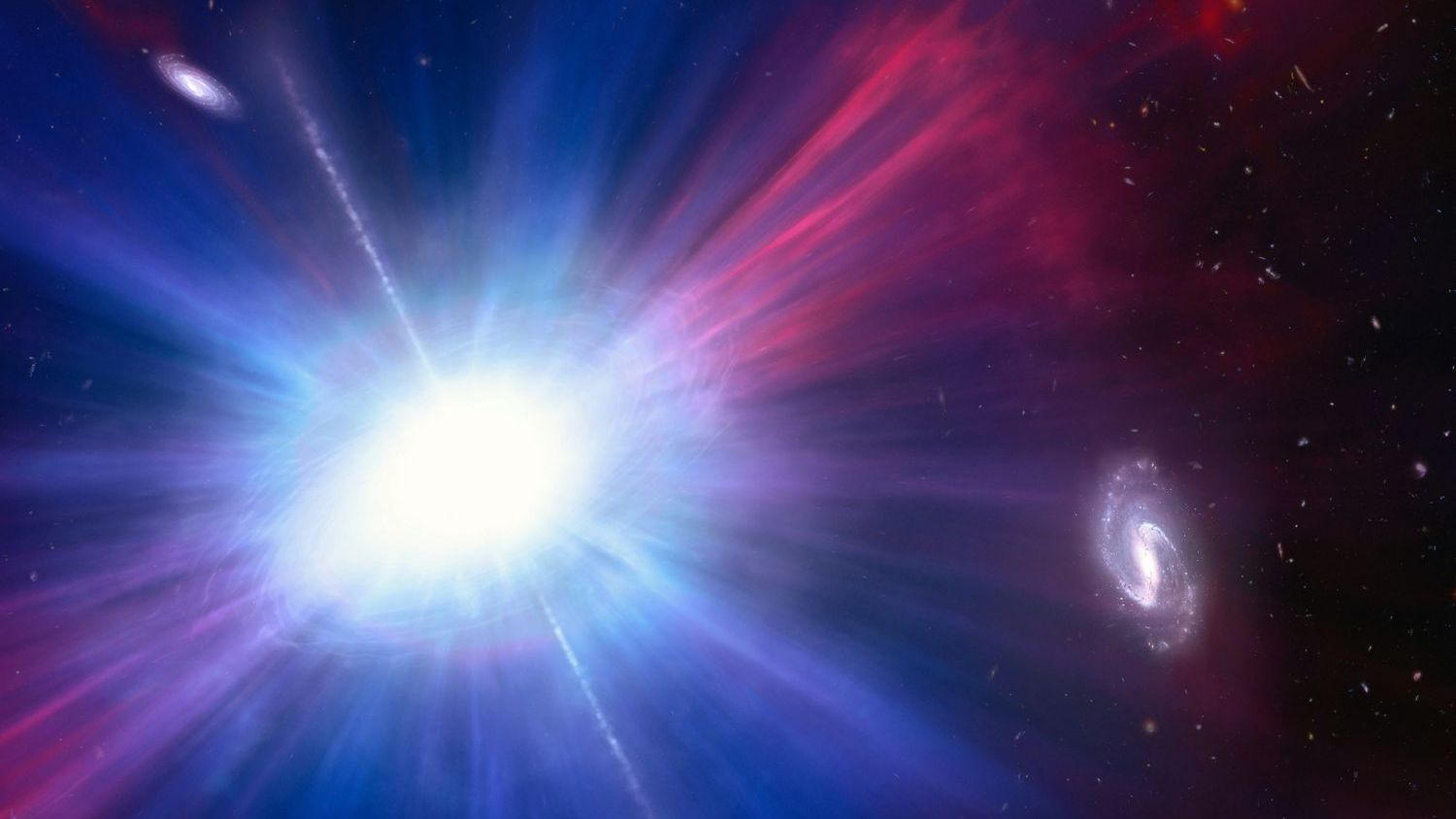
Black holes slamming into scorching stars may be causing mysterious blue flashes in the cosmos – Image for illustrative purposes only (Image credits: Unsplash)
Astronomers continue to track sudden, intense blue bursts of light that appear and vanish within days across distant galaxies. These events stand out because they reach extraordinary brightness yet leave little trace behind. A growing body of analysis now links them to rare, high-speed encounters between compact objects and the universe’s most extreme stars.
The Puzzle of Luminous Fast Blue Optical Transients
Luminous Fast Blue Optical Transients, often shortened to LFBOTs, have challenged conventional models of stellar death since their discovery. They emit most of their energy in blue wavelengths and evolve far more rapidly than typical supernovae. Observers record them at distances that place the explosions billions of light-years away, yet the precise trigger has remained unclear. The short duration and color signature set LFBOTs apart from other cosmic transients. Standard explanations involving white-dwarf detonations or core-collapse events fail to match the observed speed and temperature. This mismatch has prompted researchers to consider interactions that release energy in a single, brief surge rather than a prolonged expansion.
Collisions With the Universe’s Hottest Stars
The leading proposal centers on the hottest known stars, classified as O-type objects. These stars burn at surface temperatures exceeding 30,000 degrees Celsius and possess powerful stellar winds. When a black hole passes close enough, the gravitational interaction can strip away outer layers in seconds, releasing a flood of blue light. The process unfolds as the compact object plunges through the star’s envelope. Material spirals inward, heats rapidly, and radiates at peak blue wavelengths before the system settles. Because the encounter lasts only hours to days, the resulting flash matches the brief profile recorded for LFBOTs. The scenario preserves the star’s overall structure while producing the observed luminosity spike.
Neutron Stars as Possible Triggers
The same framework allows for neutron stars to play an identical role. These dense remnants carry strong magnetic fields and can disrupt a massive star’s outer layers with comparable violence. In both cases the outcome depends less on the exact nature of the compact object and more on the extreme conditions created during the impact. Models indicate that either a black hole or a neutron star can generate the required energy release when the target star belongs to the O-type class. The distinction between the two compact objects may become evident only through follow-up observations of any remaining remnant or ejected material. Current data do not yet favor one over the other.
What Matters Now
Continued monitoring with wide-field telescopes will test whether LFBOT locations align with regions rich in the hottest stars. Refined simulations can further narrow the range of possible impact geometries and energies.
Future surveys that capture both the rise and the rapid fade of these events should reveal whether the collision picture holds. If confirmed, the mechanism would add a new channel for understanding how compact objects interact with the most massive stars before either component reaches the end of its life.