

Dark matter in the Bullet Cluster celebrates 20 years – Image for illustrative purposes only (Image credits: upload.wikimedia.org)
Two galaxy clusters slammed into each other billions of years ago, creating a spectacle visible across 3.7 billion light-years. Astronomers first pieced together the full story of this event, known as the Bullet Cluster, in 2006 through a combination of X-ray and gravitational observations. That analysis revealed a stark separation between ordinary matter and the gravitational pull dominating the scene, providing what many consider the strongest direct evidence for dark matter’s existence.[1][2]
The Fury of a High-Speed Merger
The collision unfolded when a smaller cluster barreled through a larger one at speeds exceeding 3,000 kilometers per second. This head-on encounter, which occurred about 150 million years before the light reached Earth, generated immense energies rivaling the most violent processes since the Big Bang. The smaller subcluster, often called the “bullet,” plowed through the heart of its counterpart, leaving behind a trail of disrupted material.[3]
Galaxy clusters like these contain hundreds of galaxies bound by gravity, along with vast amounts of hot gas and inferred dark matter. During the merger, the galaxies themselves – sparse and collisionless – passed through one another largely unscathed, much like scattered buckshot. The hot intracluster gas, however, interacted fiercely through electromagnetic forces, slowing down and heating to tens of millions of degrees Kelvin. This gas, representing most of the visible baryonic matter, piled up between the two clusters and emitted intense X-rays detectable by telescopes like NASA’s Chandra Observatory.[1][2]
Unveiling the Invisible Through Light and Lens
Chandra’s 140-hour exposure in 2004 captured the pink-hued X-ray glow from the shocked gas, pinpointing where ordinary matter concentrated. Temperatures reached around 100 million Kelvin in the main cluster and 70 million in the bullet-shaped region. Overlaying these data with optical images from the Hubble Space Telescope and Magellan revealed the galaxies’ positions, strung out along the collision axis.[2]
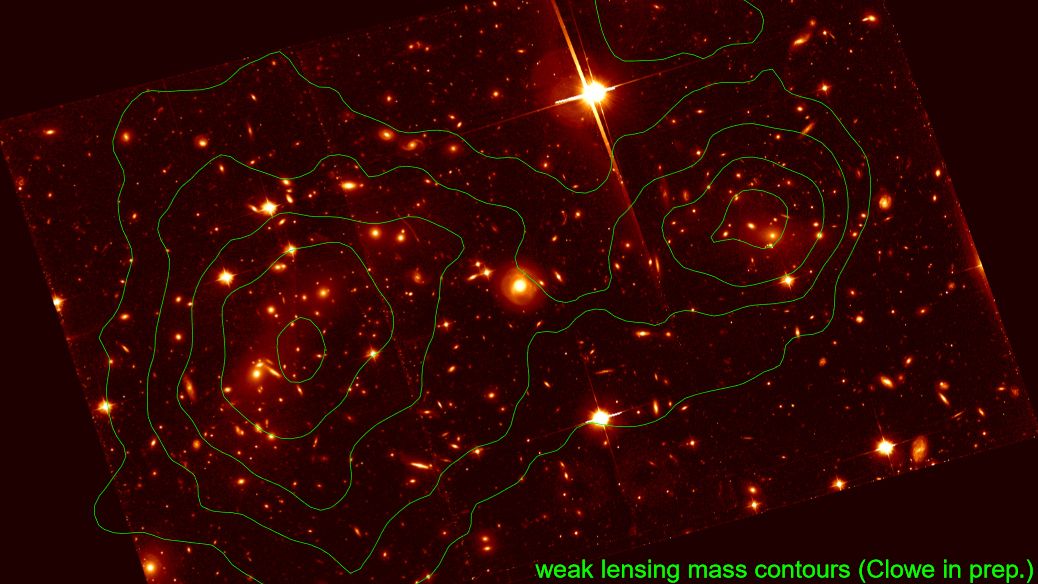
Gravitational lensing provided the crucial twist. This effect, predicted by general relativity, distorts light from background galaxies, allowing researchers to map the total mass distribution. Blue-tinted reconstructions showed mass peaks aligned with the galaxies, not the X-ray gas. The offset stood out at high statistical significance, about eight sigma, indicating that most of the clusters’ gravity came from something else – something that interacted only weakly, passing through the collision unscathed.[3][1]
- Galaxies: Passed through freely, visible in optical light.
- Hot gas: Collided, heated, and lagged behind, traced by X-rays.
- Dark matter: Continued ahead with galaxies, inferred from lensing.
A Clean Test for Dark Matter’s Reality
Prior evidence for dark matter relied on indirect clues, such as galaxy rotation curves and cluster dynamics. The Bullet Cluster offered a controlled experiment from nature. If gravity followed only the visible mass, lensing peaks should have matched the X-ray gas. Instead, the gravitational mass dominated elsewhere, demanding a collisionless component that makes up the bulk of the clusters’ heft.[1]
Studies published in 2006 by teams including Douglas Clowe and Maxim Markevitch hailed this as empirical proof. The separation ruled out scenarios where normal matter alone dictated gravity. Dark matter, interacting primarily through gravity, naturally explained the mismatch: its halos merged smoothly while the gas tangled.[3]
Similar patterns appeared in other mergers, like Abell 2744 and MACS J0025, reinforcing the case across multiple systems at different collision stages. These observations spanned from recent impacts to more evolved ones, consistently showing the same mass-gas disconnect.[1]
Withstanding Challenges Over Two Decades
Alternative theories, such as modified Newtonian dynamics (MOND), promised to explain anomalies without dark matter. Proponents argued that enhanced gravity in low-acceleration regimes could mimic the effects. Yet MOND struggled here: it predicted lensing tied more closely to baryons, and extensions like quasi-linear MOND required untested assumptions about point masses.[1]
Early critiques, including John Moffat’s nonlocal gravity, faltered against pre-collision clusters where mass and lensing aligned perfectly. Recent dwarf galaxy studies showed deviations from MOND predictions, as ultra-diffuse systems lacked the expected rotation without dark matter. Refinements to the Bullet Cluster’s velocity – from an initial 4,500 km/s to around 3,000 km/s – came from better modeling of shocks and the circumcluster medium, but aligned seamlessly with cold dark matter simulations.[3][1]
By 2024, new head-on mergers like MACS J0018.5+1626 echoed the Bullet’s features at comparable speeds, further validating the standard model. No single alternative accounted for the full spectrum, from cluster scales to cosmic microwave background patterns.[1]
Enduring Impact on Cosmic Understanding
Twenty years on, the Bullet Cluster anchors the dark matter paradigm. It shifted cosmology from inference to observation, compelling even skeptics to grapple with the data. Recent telescopes like the James Webb Space Telescope have refined its mass maps, piercing deeper into the structure.[4]
This natural laboratory continues to constrain dark matter properties, limiting self-interaction rates and supporting cold dark matter as the universe’s scaffolding. As searches for particles underground yield null results, such astrophysical proofs gain even more weight. The Bullet Cluster reminds researchers that the cosmos holds the ultimate answers, its ancient collision echoing through modern science.