

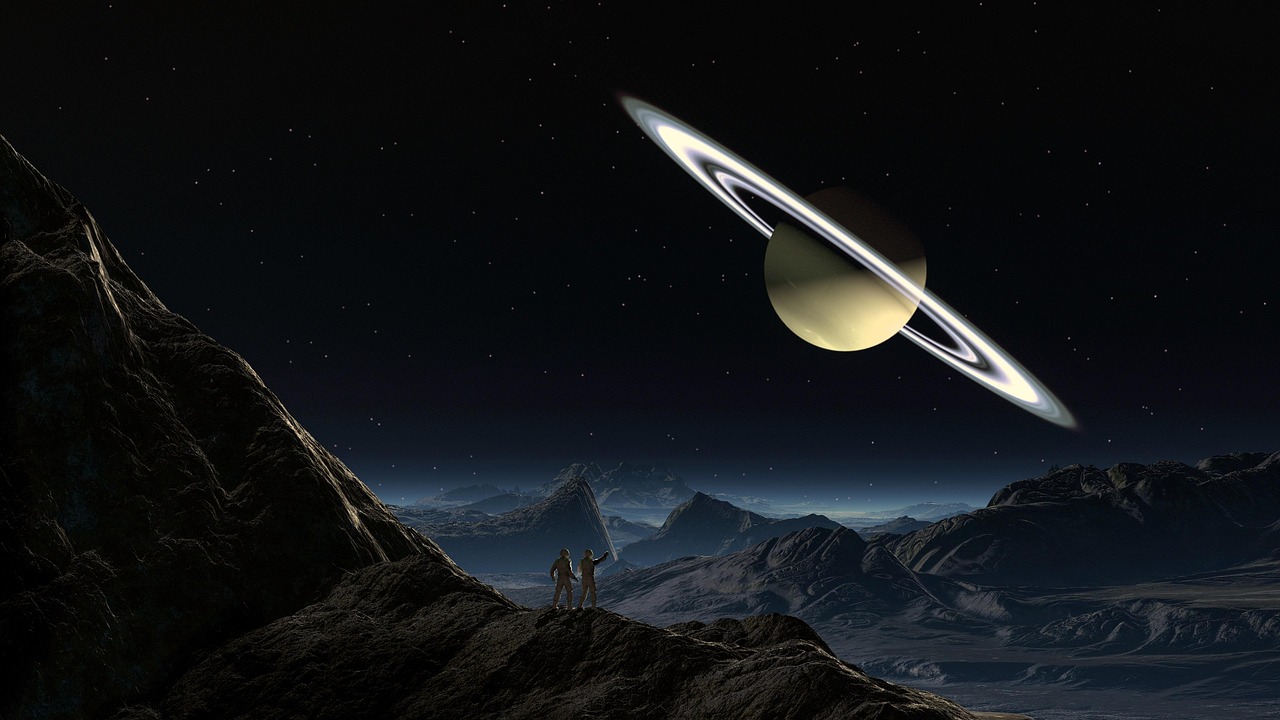
Saturn’s Icy Rings Likely Formed from Lost Moon “Chrysalis” – Image for illustrative purposes only (Image credits: Pixabay)
Planetary scientists have long puzzled over the origin of Saturn’s striking rings, which appear far younger than the planet itself. Fresh computer simulations presented at a major conference this year strengthen the case that a long-vanished moon supplied the icy material now orbiting the gas giant. The findings tie the rings’ formation to a specific event roughly 100 million years ago, a timeframe that overlaps with the age of dinosaurs on Earth. This connection offers a clearer picture of how Saturn’s system evolved into its current form.
Why the Rings Stand Out as Recent
Saturn’s rings consist mainly of water ice with traces of rock, and their brightness suggests they have not had time to accumulate much dark dust. Earlier estimates placed their age anywhere from tens of millions to several billion years, leaving researchers without a firm timeline. The new models narrow that window dramatically by linking the rings directly to the breakup of a single large body. Such a recent origin also aligns with independent measurements of the rings’ mass and purity.
Astronomers note that older rings would have darkened considerably through micrometeoroid bombardment. The observed cleanliness therefore points to a relatively late arrival of the icy debris. This recency raises questions about what processes could deliver such material so late in the solar system’s history.
The Role of a Missing Satellite
Researchers have named the hypothetical moon Chrysalis, drawing on the image of a cocoon that transforms into something more spectacular. In the simulations, Chrysalis once orbited Saturn at a greater distance before gravitational interactions with other moons, particularly Titan, altered its path. Over time the orbit decayed until the moon passed too close to the planet.
Saturn’s powerful gravity then tore Chrysalis apart during a grazing encounter. Most of the moon’s mass fell into the planet, while the remaining fraction spread into a disk that eventually settled into the rings observed today. The models show this outcome in a significant portion of the tested scenarios, lending quantitative support to the idea.
Recent Modeling at the Lunar Conference
Teams ran extensive numerical simulations to test whether the destruction of Chrysalis could reproduce both the rings’ mass and their current orbital configuration. The work was shared at the 57th Lunar and Planetary Science Conference, where participants examined dozens of possible orbital histories. In the successful runs, the timing of the breakup matched the rings’ estimated youth.
These calculations also incorporated data from the Cassini mission, which measured the rings’ composition and total mass with high precision. The agreement between the simulated debris and Cassini’s observations strengthens the overall scenario. Further refinements may come from additional observations or improved dynamical models in the coming years.
Broader Effects on Saturn’s Tilt
The same orbital disruption that destroyed Chrysalis appears to have influenced Saturn’s axial tilt. Before the event, the planet’s spin axis may have been more strongly coupled to Neptune through a resonance. The loss of the moon relaxed that resonance, allowing the tilt to settle near its present value of about 27 degrees.
This dual explanation for both the rings and the obliquity makes the Chrysalis hypothesis particularly economical. It accounts for two longstanding puzzles with a single sequence of events. Continued study of other giant-planet systems could reveal whether similar moon-loss episodes occurred elsewhere.
The emerging picture shows Saturn’s rings as the visible remnant of a dramatic rearrangement that occurred long after the planet formed. As modeling techniques advance, astronomers expect even tighter constraints on exactly when and how the transformation took place. That timeline, in turn, will help place Saturn’s evolution within the wider story of the solar system.