

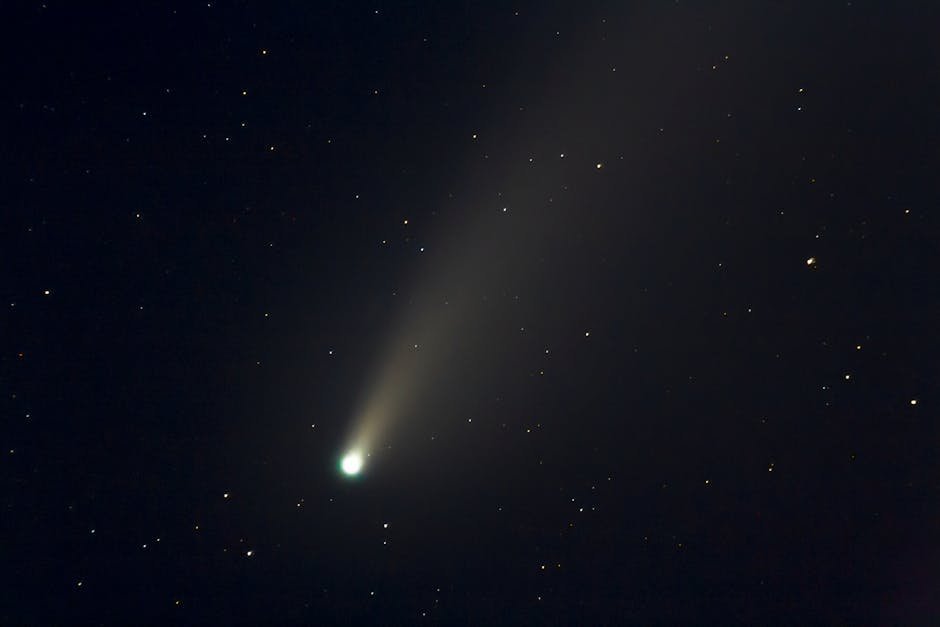
Swift Rise Captures Global Attention (Image Credits: Pexels)
Astronomy observers worldwide now train their sights on the eastern horizon before sunrise. Comet C/2025 R3 PanSTARRS has emerged as a prime target, showing steady brightening in recent days. This visitor from the distant Oort Cloud promises heightened visibility through mid-April 2026, drawing attention from both hemispheres.[1][2]
Swift Rise Captures Global Attention
Recent images reveal Comet C/2025 R3 PanSTARRS displaying a prominent ion tail stretching up to 14 degrees. The comet’s coma appears green with a bright central core, spanning about 4 arcminutes. Observers report it climbing higher each morning, transitioning from a binocular target to potential naked-eye visibility.[3][1]
NASA’s Astronomy Picture of the Day on April 12 highlighted the comet’s rapid development. It featured a stunning view over Swiss mountains, underscoring its growing allure. Such features emphasize why skywatchers act now, as the comet nears key orbital milestones.[4]
From Arizona to Poland, reports confirm consistent progress. One observer in Tucson noted improving conditions despite haze, while another in India captured it amid a mild earthquake. These accounts illustrate the comet’s accessibility under clear skies.[1]
Finding the Comet in Pegasus
Locate Comet C/2025 R3 PanSTARRS within the Great Square asterism of Pegasus. It sits low in the east, roughly 10 to 15 degrees above the horizon 90 minutes before sunrise. Northern Hemisphere viewers enjoy the prime window from now through April 20.[1][5]
Southern observers prepare for evening views later in April, as it shifts to the western post-sunset sky. A finder chart simplifies the hunt: align the Great Square’s stars, then scan slightly inside for the fuzzy object. Tools like Stellarium software replicate this layout precisely.[6]
Current coordinates place it at right ascension 23h 28m and declination +19 degrees in Pegasus. Positions evolve daily, but the asterism remains a reliable anchor. Patience rewards those facing low altitude challenges.[2]
Orbital Path and Brightness Outlook
Discovered on September 8, 2025, by the Pan-STARRS telescope in Hawaii, this hyperbolic comet originates from the Oort Cloud. It reaches perihelion on April 19 at 0.499 AU from the sun. Earth encounters its closest approach on April 26, at about 0.82 AU currently.[7])[8]
Predictions suggest peak magnitude 3 to 4, possibly naked-eye under dark skies. Currently at 4.6, it brightens steadily, though comets defy exact forecasts. Its survival past perihelion remains uncertain due to solar proximity.[9][4]
| Date | Approx. Magnitude | Altitude (Mid-Northern Lat.) |
|---|---|---|
| April 14, 2026 | 4.6 | 10-15° |
| April 19, 2026 | 3-4 (peak?) | Low, pre-dawn |
| April 26, 2026 | Fading | Evening west (South) |
This table outlines expected changes; actual performance varies with activity.[9]
Practical Tips for Successful Viewing
Binoculars or a small telescope reveal the comet best against twilight. Seek dark sites away from city lights, arriving 90 minutes early. Allow eyes 20 minutes to adapt to darkness.[1]
- Face east; identify Pegasus’ Great Square first.
- Scan low horizon; expect faint fuzziness initially.
- Check weather for clear mornings; avoid moonlight interference.
- Use apps like Star Walk or SkySafari for real-time charts.
- Photograph with long exposures to capture the tail.
- Northerners: mornings now; Southerners: evenings soon.
Challenges include low position and atmospheric extinction. Still, persistence yields rewards, as evidenced by recent successes worldwide. Share your views on astronomy forums.[5]
Key Takeaways
- Comet C/2025 R3 PanSTARRS brightens daily in Pegasus, visible pre-dawn east.
- Peak potential: magnitude 3-4 around April 19 perihelion.
- Best with binoculars; naked eye possible in pristine skies.
Comet C/2025 R3 PanSTARRS reminds us of the solar system’s dynamic edges, offering a fleeting spectacle amid April’s celestial lineup. Its journey underscores comets’ unpredictability and beauty. What do you think about it? Tell us in the comments.