

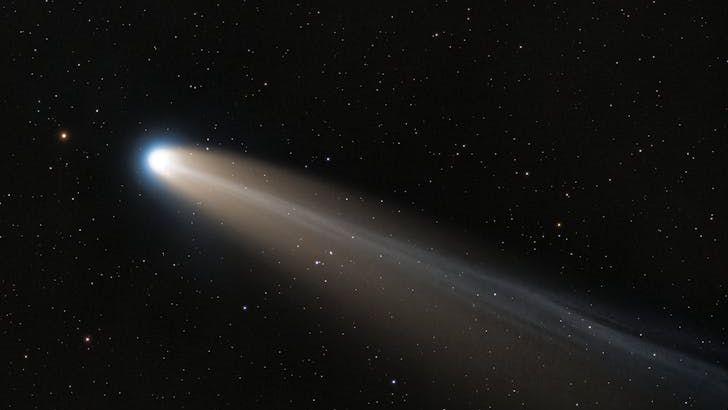
A Survivor from the Solar Depths (Image Credits: Pexels)
High in the predawn sky over remote landscapes, Comet C/2025 R3 (PanSTARRS) traces a faint glow against the fading stars. Discovered just months ago by the Pan-STARRS survey in Hawaii, this icy wanderer from the Oort Cloud recently endured its closest pass by the sun without disintegrating. Now, as it swings toward its nearest point to Earth on April 26, observers worldwide prepare for potentially the last glimpse of this ancient traveler before it departs the inner solar system.[1][2]
A Survivor from the Solar Depths
The comet reached perihelion, its closest approach to the sun, on April 19 or 20 at a safe distance of about 0.5 astronomical units, or roughly 75 million kilometers. This solar brush heated its nucleus, vaporizing ices and releasing dust and gas to form bright tails visible in recent images from mountaintops and valleys.[3][4] Astronomers noted its bushy dust tail lengthening as it pulled away from the sun’s intense radiation.
Unlike some comets that fragment under such stress, C/2025 R3 held together, doubling in brightness over recent days and climbing toward magnitude 1 or brighter. This resilience offers hope for clear views during its Earth approach, though its low position near the horizon poses challenges for city dwellers.[5]
Trajectory Toward Tomorrow’s Close Pass
On April 26, the comet will arrive at its closest to Earth, passing at approximately 0.49 to 0.52 AU, or 73 million kilometers – about half the distance to the sun. This marks the first human observation of the comet in roughly 170,000 years, as its hyperbolic orbit suggests it may escape the solar system entirely after this visit.[6][7])
Currently residing in Aries or nearby constellations, it moves eastward against the stars, crossing paths with planets like Mercury and Mars in recent APOD features. By weekend’s end, it will shift lower for northern observers, fading into twilight but potentially peaking in brightness near Earth approach.[8]
Prime Viewing Windows This Weekend
Look east about 90 minutes before sunrise, when the comet hovers 10 to 12 degrees above the horizon – roughly the span of a fist at arm’s length. Dark skies away from urban glow provide the best odds for naked-eye detection, though binoculars reveal its nucleus and tails more clearly.[9][1]
April 25 and 26 offer optimal chances before it sinks too low. From southern latitudes, visibility improves slightly, but northern hemisphere viewers should prioritize clear horizons. Recent reports confirm sightings from India, the Himalayas, and U.S. sites like Yosemite.[10]
- Time: 90-60 minutes pre-sunrise.
- Location: Eastern horizon, near Pegasus fading into Aries.
- Tools: Naked eye (mag 1-5), 10×50 binoculars, or camera with 200mm lens for tails.
- Tips: Avoid light pollution; use apps like Stellarium for precise position.
Capturing the Comet Beyond the Naked Eye
For those seeking unique perspectives, long-exposure photography has already produced striking images of its ion and dust tails stretching degrees across the sky. Ground-based setups from high altitudes, like the Himalayas, showcase its post-perihelion vigor against mountain silhouettes.[11]
Geostationary weather satellites, such as GOES or Himawari, offer full-disk views where a bright comet might appear as a transient spot in twilight full-disk imagery, especially during predawn scans over the Pacific or Atlantic. Check live feeds from NOAA or JMA sites for potential captures, zooming into the eastern limb during optimal times. Though not guaranteed, the comet’s anticipated peak aligns with weekend overpasses.[12]
Online galleries from spaceweather.com and APOD already feature community shots, hinting at more to come as it nears Earth.[13]
What Lies Ahead for This Celestial Guest
After April 27, C/2025 R3 fades from northern views, potentially lingering for southern observers before vanishing. Its one-time spectacle reminds us of the solar system’s dynamic edges, where Oort Cloud relics occasionally pierce the inner realms.
Whether through binoculars or digital feeds, this weekend’s window closes soon. Skywatchers who venture out may claim a rare connection to cosmic history, etched in the dawn light.