

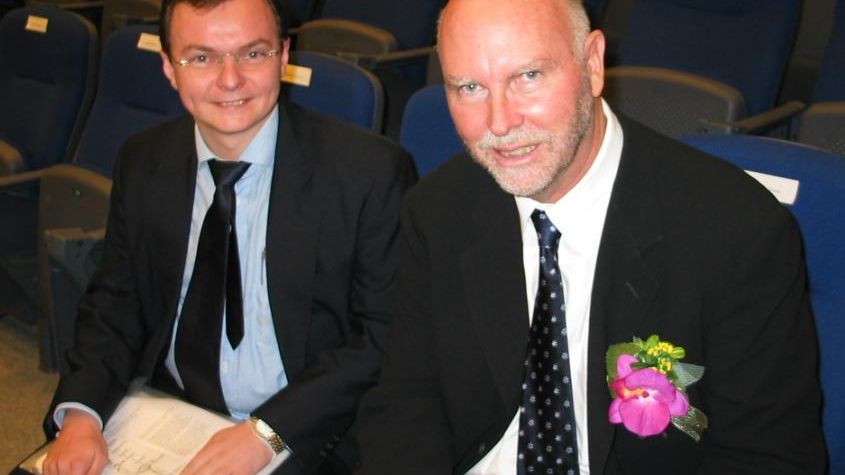
Craig Venter obituary – Image for illustrative purposes only (Image credits: upload.wikimedia.org)
Craig Venter, the geneticist whose work helped decode the human genome and upended ideas about biological destiny, has died at the age of 79. His career combined technical innovation with public confrontation over how much genes truly dictate human lives. In one of his most visible moments, he used a major international conference to argue that people are shaped far more by their surroundings than by any fixed genetic script.
A Bold Claim at the BioVision Conference
At the BioVision gathering in Lyon in February 2001, Venter delivered a striking update on the state of genetic knowledge. He revealed that humans carry roughly 30,000 genes, a figure far below the 100,000 once widely expected. The lower count, he explained, meant that genes alone could not account for the full range of human traits and behaviors.
Venter framed the finding as evidence against strict biological determinism. He told the audience that the limited number of genes left ample room for environmental influences to guide development and outcomes. The announcement drew immediate attention because it came at a time when the first draft of the human genome sequence was still fresh news.
Mapping the Genome With His Own DNA
Venter’s most enduring contribution was his role in sequencing the human genome. He led a private effort that competed with the public Human Genome Project and completed its version of the sequence in 2001. To accelerate the work, he included segments of his own DNA in the data set, a decision that underscored his willingness to merge personal risk with scientific progress.
The approach relied on whole-genome shotgun sequencing, a method that broke DNA into fragments and reassembled them computationally. While the technique sparked debate over accuracy and credit, it delivered a functional map of the genome years ahead of some projections. Venter’s team published its findings in the journal Science the same year as the public consortium’s release in Nature.
Legacy of Environmental Emphasis
Venter consistently returned to the idea that genes set boundaries but do not write the full story of any individual. He pointed to the modest gene count as proof that nurture and experience carry greater weight than many scientists had assumed. Colleagues noted that this stance helped shift public discussion away from fatalistic views of heredity.
His career also included earlier work on rapid DNA sequencing techniques and later ventures into synthetic biology. Throughout, he maintained that scientific advances should serve practical improvements in health and understanding rather than reinforce rigid categories of human potential.
Key points from Venter’s 2001 remarks:
- Humans possess about 30,000 genes, not the previously estimated 100,000.
- Environmental factors play the primary role in shaping human diversity.
- Biological determinism lacks support from the actual gene count.
Venter’s death closes a chapter in genomics that began with intense competition and ended with a broader appreciation for the interplay between genes and environment. His insistence that people are not prisoners of their DNA remains one of the clearest messages from the early days of the genome era.