

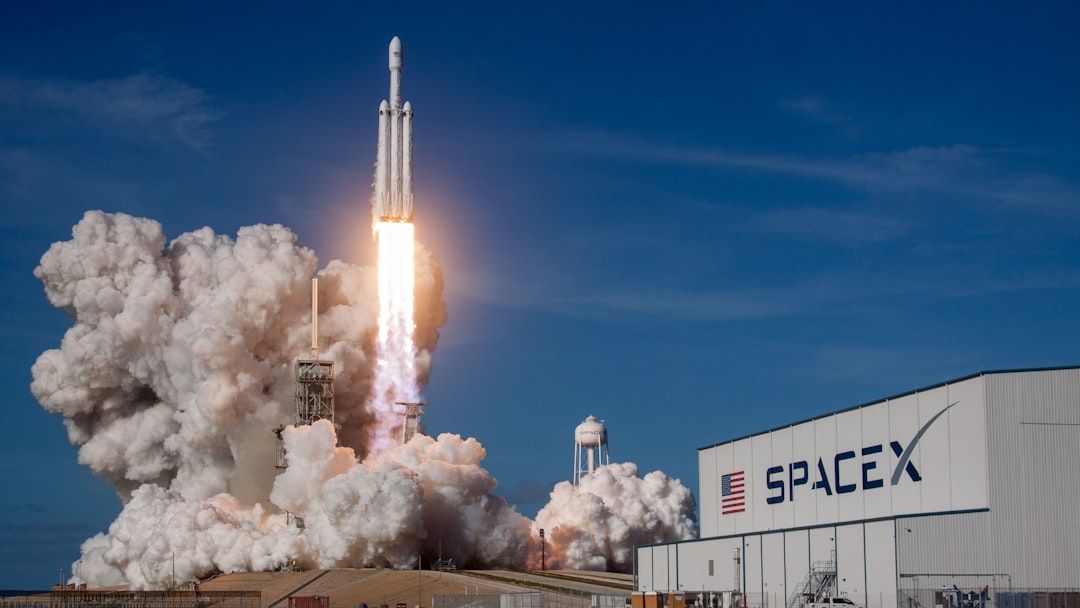
Rocket Report: Falcon Heavy is back; Russia's Soyuz-5 finally debuts – Image for illustrative purposes only (Image credits: Unsplash)
Engineers at Kennedy Space Center watched Falcon Heavy lift off on April 29, marking the heavy-lift rocket’s return after more than a year away and delivering a crucial internet satellite to orbit. Across the globe, Russia’s space program achieved a long-sought milestone as Soyuz-5 soared from Baikonur Cosmodrome on Thursday, validating years of domestic development efforts.[1][2] These successes highlight ongoing pushes for reliable access to space amid growing demands for communications, defense, and exploration infrastructure. Meanwhile, Pentagon initiatives signal deeper integration of space into national security strategies.
Falcon Heavy Delivers Payload After Extended Grounding
SpaceX conducted the 12th flight of its Falcon Heavy on April 29 from Launch Complex 39A in Florida. The triple-core rocket carried the ViaSat-3 satellite into a preliminary orbit, its first mission since deploying NASA’s Europa probe in October 2024.[2] Both side boosters separated successfully and landed on distinct pads at Cape Canaveral Space Force Station, demonstrating the vehicle’s reusability.
Company records show at least a dozen additional Falcon Heavy missions booked through the decade’s end. The next flight targets NASA’s Nancy Grace Roman Space Telescope in September from Florida. Another will loft Astrobotic’s commercial lunar lander, potentially by late 2026. Such operations underscore the rocket’s role in supporting both scientific and commercial ventures.
Soyuz-5 Marks Russia’s Push for Launch Autonomy
Roscosmos confirmed the Soyuz-5’s inaugural suborbital flight proceeded nominally. The medium-lift vehicle rose from Baikonur at 2 p.m. EDT on Thursday, with its first and second stages performing as planned. A mockup payload followed a calculated trajectory before reentering over a restricted Pacific zone.[1]
Development of Soyuz-5 began in 2017 to replace the Zenit rocket, whose Ukrainian-made tanks became unavailable after geopolitical shifts. The new design incorporates Russia-produced structures and the proven RD-171 engine. Its capabilities position it between the lighter Soyuz-2 and heavier Angara-A5, bolstering national launch options.[2]
Pentagon Advances Space-Based Missile Shield
The US Space Force named 12 contractors on April 24 to develop prototypes for Space-Based Interceptors under the Golden Dome program. This multilayer system aims to protect American territory from drones, ballistic missiles, hypersonics, and cruise threats. Prototype agreements carry a combined ceiling of $3.2 billion, with production contracts to follow at greater expense.[1]
Participants bring expertise across domains:
- Anduril Industries
- Booz Allen Hamilton
- General Dynamics Mission Systems
- GITAI USA
- Lockheed Martin
- Northrop Grumman
- Quindar
- Raytheon
- Sci-Tec
- SpaceX
- True Anomaly
- Turion Space
Gen. Michael Guetlein, the program’s director, emphasized affordability during a recent congressional hearing. “If we cannot do it affordably, we will not go into production,” he stated. Boost-phase intercepts from orbit remain under review, with alternatives eyed to avoid single failure points.[1]
Progress Across Suborbital, Lunar, and Regulatory Fronts
Virgin Galactic completed assembly of its first Delta-class SpaceShip in Arizona and shifted it for ground testing. The firm eyes flight trials in the third quarter, aiming for commercial suborbital trips by year-end. This positions it ahead in the market after Blue Origin paused New Shepard operations earlier in 2026.[2]
A Falcon 9 upper stage from early 2025 will impact the Moon’s near side on August 5 at over seven times the speed of sound. Tracking confirms its identity and path, posing no risk to lunar assets. Separately, the FAA prepares to levy launch user fees starting this year under new legislation, potentially costing SpaceX thousands per Starlink mission. Amazon advanced its Leo constellation with 61 satellites via Atlas V and Ariane 6 launches. Blue Origin pursues enhanced New Glenn stages, while Artemis III hardware moves toward integration for a 2028 lunar landing.[1][2]
Reports of drone incursions near Russia’s Plesetsk Cosmodrome prompted tighter launch secrecy. Extended airspace restrictions now obscure exact timings as Moscow deploys its own satellite network.
Implications for the Global Space Landscape
Starship awaits its next test, possibly this month, alongside Blue Origin’s lunar cargo demo. Outcomes will shape NASA’s 2028 crewed Moon ambitions. These strides – from heavy-lift revivals to defense prototypes – reflect intensifying competition and collaboration in orbit. For nations and companies alike, reliable rocketry remains key to securing economic edges and strategic advantages in an era of proliferating space activity.