

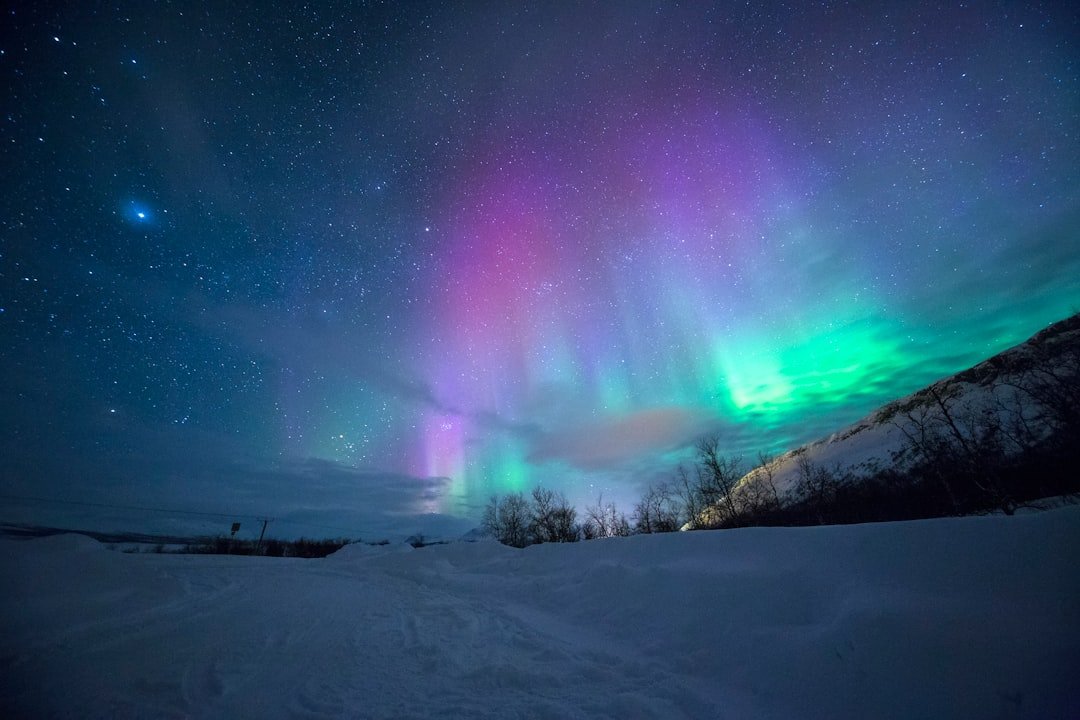
Storm Conditions Escalate Rapidly (Image Credits: Unsplash)
A moderate G2 geomagnetic storm swept across Earth’s magnetic field on April 18, 2026, propelled by fast solar winds from a vast coronal hole on the sun.[1][2] This event followed a G1 minor disturbance earlier in the day, raising expectations for vibrant auroral shows visible potentially as far south as mid-latitudes over the weekend. Sky enthusiasts prepared for displays that could continue into April 19 as these solar influences linger.[1]
Storm Conditions Escalate Rapidly
The geomagnetic activity intensified markedly starting around 21 UTC on April 17. Earth’s magnetic field shifted from very quiet levels, with Kp indices of 0-1, to active conditions.[1] A G1 threshold crossed at 7:41 UTC, followed by a G2 level at 8:25 UTC, as the Kp index reached 6.[1]
Solar wind speeds rose to moderate-high velocities during this period. The interplanetary magnetic field’s Bz component turned southward, a key factor in triggering auroral activity. NOAA’s Space Weather Prediction Center tracked these changes closely, noting the storm’s progression.[1]
Solar Origins Fuel the Disturbance
A large coronal hole on the sun’s northeast quadrant rotated into a position facing Earth earlier in the week. This feature unleashed streams of fast solar wind that reached our planet, combining with a co-rotating interaction region, or CIR, where slower winds ahead were compressed by faster ones behind.[1] The CIR amplified the effects, pushing geomagnetic conditions into storm territory.
These winds continued to influence Earth on April 18, with potential for further G1-G2 levels through April 19. By April 20, activity was forecast to subside to quiet or unsettled states. Such coronal holes represent regions of open magnetic field lines on the sun, allowing charged particles to escape at high speeds.[1]
Decoding the NOAA Geomagnetic Scale
NOAA classifies geomagnetic storms on a G-scale from G1 to G5, based on the Kp index, which measures magnetic fluctuations. A G2 moderate storm, like the current one, corresponds to Kp 6 and can produce auroras visible at mid-latitudes, along with periodic disruptions to high-frequency radio communications.[1]
| Level | Description | Kp Index | Aurora Reach |
|---|---|---|---|
| G1 | Minor | 5 | High latitudes |
| G2 | Moderate | 6 | Mid-latitudes |
| G3 | Strong | 7 | Lower mid-latitudes |
This table outlines basic thresholds; full details appear on NOAA’s scales page.[1] Power systems may experience voltage irregularities during G2 events, though widespread issues remain unlikely.
Prime Window for Aurora Hunting
NOAA’s OVATION model predicted an expanded auroral oval for the early hours of April 18, from about 4 to 8 UTC, based on real-time solar wind data. Viewers in northern regions stood the best chance, but clear skies and good fortune could bring sights to more southern locations.[1]
- Seek dark skies away from city lights for optimal viewing.
- Best times align with local midnight to pre-dawn hours.
- Monitor southward Bz for heightened activity.
- Check forecasts on SWPC for updates.
- Share captures via community platforms.
G1-G2 conditions promised ongoing opportunities through April 19. Aurora chasers reported excitement over the potential for widespread visibility.[1]
Sun’s Broader Activity Remains Muted
Flare production stayed low over the past 24 hours ending 11 UTC on April 18, with seven events: one C-class and six B-class. Active region AR4416 produced the strongest at C1.6, while AR4419, in a beta-gamma setup, contributed minimally.[1] No coronal mass ejections headed toward Earth were detected.
Forecasts anticipated low-to-moderate flares ahead, with 75% chance for C-class, 25% for M-class, and 5% for X-class. Three sunspot regions faced Earth, signaling stable but unremarkable conditions beyond the wind stream.[1]
Key Takeaways:
- G2 storm driven by coronal hole winds and CIR, peaking April 18.
- Auroras visible at mid-latitudes through April 19 with clear skies.
- Low flare risk; no incoming CMEs.
This geomagnetic event underscores the sun’s dynamic influence on our planet, blending scientific intrigue with natural spectacle. As conditions evolve, observers worldwide gained a front-row seat to solar-terrestrial interplay. What auroral sights have you spotted lately? Tell us in the comments.