

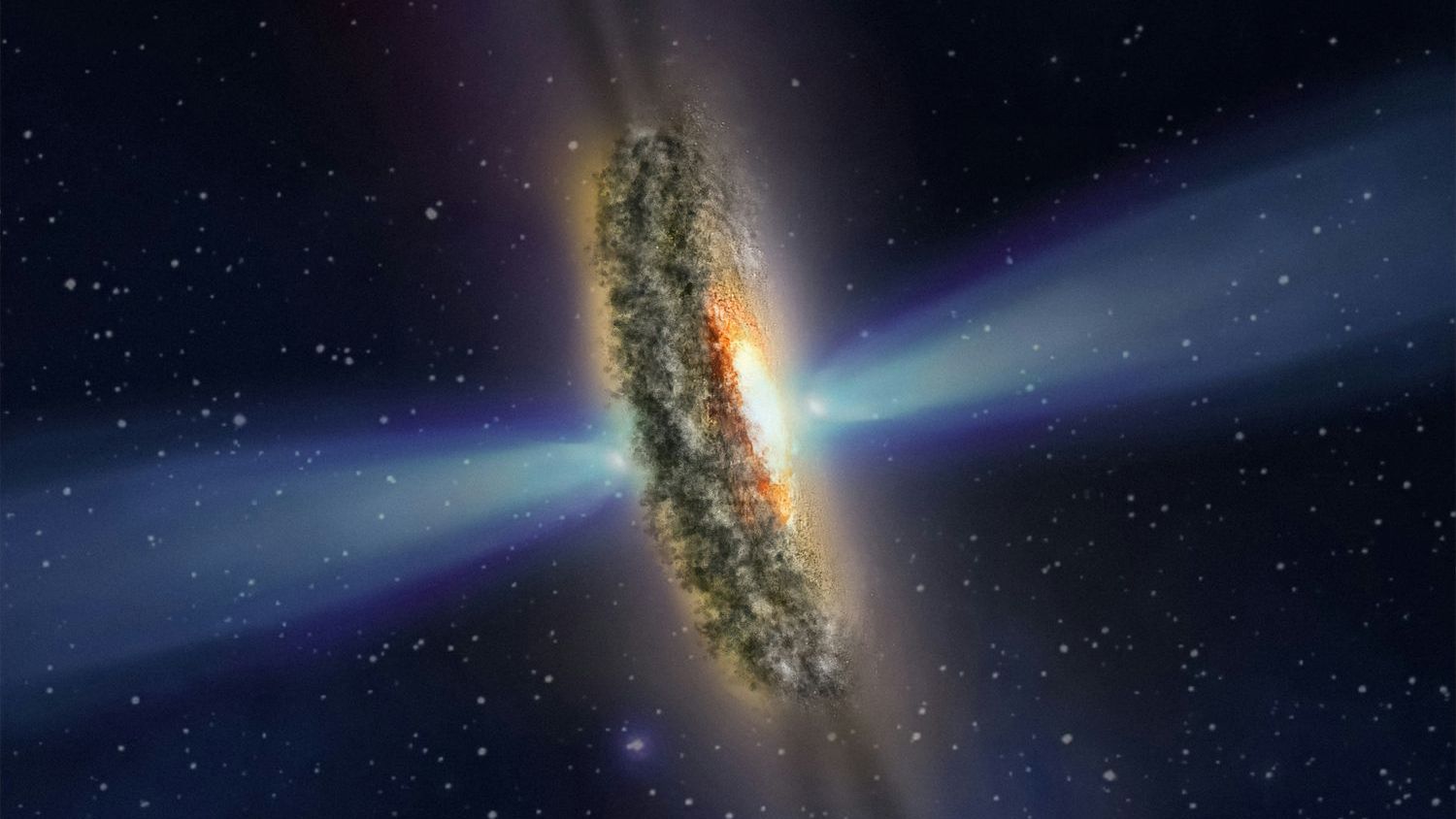
Did time move slower right after the Big Bang? – Image for illustrative purposes only (Image credits: Unsplash)
The Big Bang marked the beginning of space, time, and matter as we know them. In those earliest instants, the universe occupied an extraordinarily small volume yet held the same total amount of matter and energy that exists today. This created conditions of immense density, raising a natural question among physicists and curious observers alike: could gravity have altered the very rate at which time passed?
The Link Between Gravity and Time
Einstein’s general theory of relativity describes gravity not as a force but as the curvature of spacetime itself. In regions where mass and energy are concentrated, this curvature becomes pronounced, and clocks run more slowly compared with those in weaker gravitational fields. The effect is known as gravitational time dilation, and it has been measured in everyday settings such as the slight difference between clocks on Earth’s surface and those aboard orbiting satellites.
The principle scales with the strength of the gravitational field. Near a black hole or inside a neutron star, the slowing becomes dramatic. The same mathematics applies to the early universe, where the average density far exceeded anything observed in the present cosmos. Under those conditions, time would have advanced more gradually for any observer embedded in the dense plasma.
Conditions in the Immediate Aftermath of the Big Bang
Within the first fractions of a second, the universe was filled with a hot, uniform soup of particles and radiation. Its size was minuscule by today’s standards, yet the total energy content remained constant. As a result, the density reached values comparable to or greater than those inside the most compact objects known today. This extreme compression produced gravitational effects on a cosmic scale.
Expansion began almost immediately, diluting the density rapidly. Within minutes, the universe had grown large enough for the average gravitational influence to weaken. The period during which time dilation would have been most noticeable was therefore brief, confined to the first moments when the cosmos was still extraordinarily compact.
Key points on gravitational time dilation
- Clocks tick slower in stronger gravitational fields.
- Early-universe density created a uniformly strong field everywhere.
- The effect diminishes quickly as expansion proceeds.
- Modern observations cannot directly measure this early phase.
What Observers Today Can Infer
Because the dilation would have affected every location equally, there is no external reference frame against which to compare the slowed passage of time. From our present vantage point, cosmic expansion and the cooling of the universe appear to have followed the standard timeline predicted by the Big Bang model. Any slowing of time was relative and internal to that early environment.
Scientists continue to test the predictions of general relativity through observations of the cosmic microwave background and the large-scale structure of galaxies. These data remain consistent with an expanding universe that began in a hot, dense state, yet they do not provide a direct clock reading from those first instants. The question therefore stays within the realm of theoretical interpretation rather than direct measurement.
Remaining Questions and Future Directions
Researchers are exploring whether quantum gravity theories might modify the picture at the very earliest moments, before classical general relativity fully applies. Such models could alter how time itself emerges from the initial singularity. For now, the gravitational slowing of time remains a logical consequence of known physics applied to the conditions immediately after the Big Bang.
Continued advances in observational cosmology and theoretical modeling will help clarify the precise duration and magnitude of any such effect. The idea underscores how profoundly the universe’s earliest state differed from the one we inhabit today.