

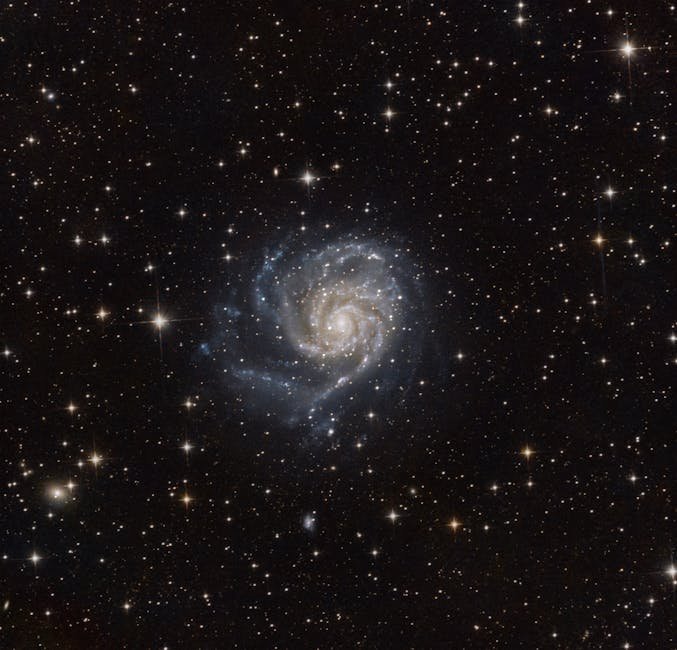
A Central Bar Fuels Galactic Activity (Image Credits: Pexels)
The NASA Hubble Space Telescope recently captured a mesmerizing view of IC 486, a barred spiral galaxy perched on the edge of the constellation Gemini. Located approximately 380 million light-years from Earth, this cosmic structure showcases a blend of serene beauty and underlying turmoil.[1][2] Discovered in 1891 by astronomer Rudolf Ferdinand Spitaler, IC 486 now stands out through Hubble’s lens as a face-on spiral with intricate details that hint at active processes within.[3]
A Central Bar Fuels Galactic Activity
At first glance, IC 486 presents an orderly facade, yet its prominent central bar reveals a hub of dynamic forces. This elongated structure channels gas and stars toward the galaxy’s heart, sparking bursts of star formation and feeding a voracious supermassive black hole.[1] Astronomers noted that Hubble’s imaging highlights how such bars shape the evolution of spiral galaxies over millions of years.
The spiral arms extend from this bar in a smooth, nearly ring-like pattern, creating a luminous swirl against the void of space. Subtle color shifts across the disk – pale hues in the core and faint blues outward – map the ages of stellar populations. Dust wisps weave through these arms, marking dense molecular clouds primed for new stars.[2]
Star Formation Blooms Amid Dust
Faint bluish patches pepper the galaxy’s disk, signaling regions where young, hot stars recently ignited. These areas contrast sharply with the older, reddish stars dominating the luminous center. Hubble’s resolution uncovers these pockets, which trace ongoing stellar nurseries fueled by gravitational instabilities.[3]
Dust lanes further enrich the scene, threading through the structure and dimming background light. These features indicate heightened concentrations of gas, essential for birthing future generations of stars. Though the galaxy appears tranquil, these processes underscore its living, breathing nature.
The Blazing Active Galactic Nucleus
Dominating the core, a brilliant white glow eclipses surrounding starlight, emanating from IC 486’s active galactic nucleus, or AGN. Powered by a supermassive black hole exceeding 100 million solar masses, the AGN devours gas and dust in a swirling accretion disk. This frenzy generates intense radiation, including X-rays, that can rival the galaxy’s overall brightness.[1]
Every large galaxy harbors a central black hole, but IC 486 exemplifies an active one, classifying it among Seyfert galaxies. The observing programs behind this image, led by principal investigators M. J. Koss and A. J. Barth, targeted such systems to probe nuclear environments. Their work links spiral arms and bars to this central powerhouse, illuminating galaxy growth mechanisms.[3]
Hubble’s Role in Decoding Galaxy Evolution
Data from Hubble programs 17310 and 15444 combined sharp imaging with broad surveys of active galaxies. Researchers employ citizen science via Galaxy Zoo alongside machine learning to classify morphologies, scaling insights to massive datasets from upcoming telescopes like Euclid and the Vera C. Rubin Observatory.[1] This approach reveals interactions between stars, gas, dust, and black holes in galactic cores.
IC 486 serves as a prime example for these studies, its structure offering clues to how bars drive material inward. Background galaxies and foreground stars in wide-field views add cosmic context, emphasizing the universe’s depth.[4]
- Bright central bar funnels resources to the core.
- Bluish regions indicate active star formation.
- Dust lanes signal molecular gas reservoirs.
- AGN powered by massive black hole outshines stars.
- Face-on orientation reveals intricate details.
Key Takeaways
- IC 486’s AGN highlights black hole-galaxy feedback.
- Bar structures influence star formation and evolution.
- Hubble data aids machine learning for large-scale surveys.
IC 486 embodies the universe’s ceaseless transformation, where gravity sculpts stars and black holes alike. As Hubble continues to peer into such distant realms, it deepens our grasp of cosmic history. What do you think about the role of active nuclei in galaxy development? Tell us in the comments.