

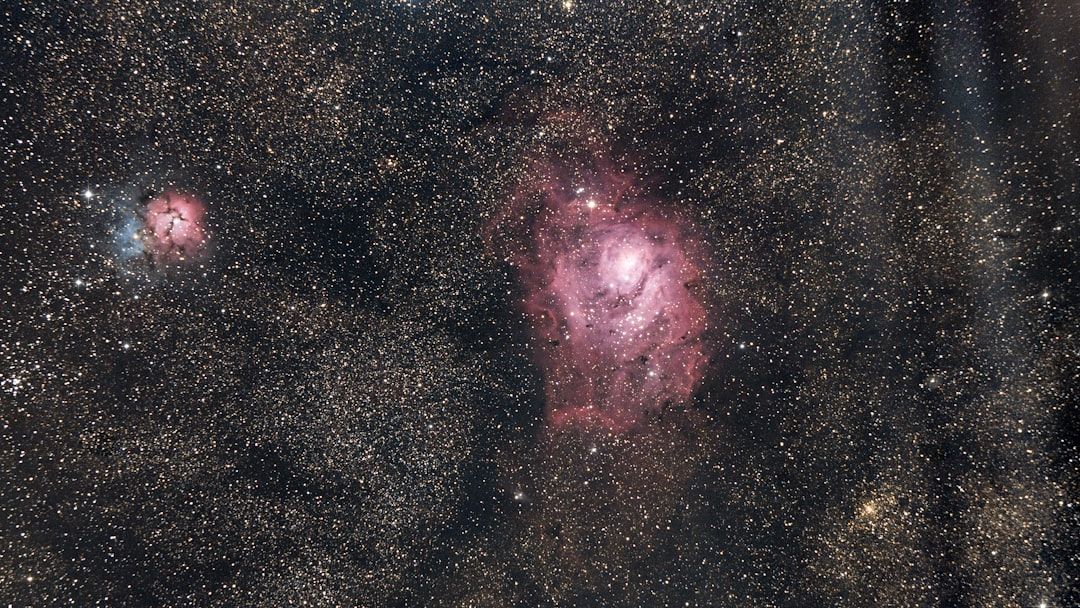
The Allure of the Trifid Nebula (Image Credits: Unsplash)
Ahead of its 36th launch anniversary on April 24, NASA’s Hubble Space Telescope released a detailed image of the Trifid Nebula on April 20, 2026. This star-forming region, situated about 5,000 light-years from Earth, appears in vivid colors that mimic the subtle movements of sediments in ocean depths. The photograph underscores Hubble’s ongoing ability to capture the dynamic processes of the universe, even after decades in orbit. Such releases remind astronomers and the public alike of the telescope’s vital role in exploring distant cosmic phenomena.
The Allure of the Trifid Nebula
The Trifid Nebula stands out as a shimmering expanse of gas and dust where new stars emerge. Hubble’s visible light observation reveals intricate details within this close-up view. Fine structures flutter across the scene, evoking an underwater landscape suspended in the void of space.
Astronomers have long studied this nebula for its role in stellar evolution. The image highlights layers of material compressed and illuminated by nearby energies. This particular capture draws attention to the nebula’s complex beauty, making distant events feel almost tangible.
Forces Driving Star Birth
Massive stars, positioned just beyond the frame, have influenced the Trifid Nebula for at least 300,000 years. Their intense radiation and stellar winds have carved out an enormous bubble in the surrounding cloud. This bubble, partially visible here, exerts pressure on the gas and dust.
The compression from these winds sparks fresh bouts of star formation. Waves of collapsing material ignite into protostars, perpetuating the cycle. Hubble’s precision allows scientists to trace these interactions, revealing how such processes sustain galactic nurseries over vast timescales.
Hubble’s Technical Mastery
The image processing by Joseph DePasquale at the Space Telescope Science Institute brought out the nebula’s subtle hues. Credits extend to NASA, ESA, and STScI for the collaborative effort. Visible light data transformed raw observations into a coherent portrait of cosmic activity.
Hubble’s instruments continue to excel at resolving fine details in remote objects. This release coincides with the mission’s milestone, showcasing sustained performance. The telescope’s longevity enables repeated visits to targets like the Trifid, building a richer dataset for analysis.
What matters now: As Hubble approaches 36 years, images like this affirm its irreplaceable contributions to star-formation studies. They also bridge to upcoming observatories, ensuring continuity in cosmic exploration.
A Legacy in the Stars
The Trifid Nebula image serves as more than a visual treat; it embodies decades of Hubble’s discoveries. Launched in 1990, the telescope has reshaped understanding of nebulae and beyond. This anniversary view reinforces its place in astronomical history.
Future observations will likely delve deeper into such regions. Scientists anticipate combining Hubble data with newer telescopes for comprehensive insights. The enduring bubble sculpted by ancient stars hints at timeless processes still unfolding across the cosmos.
In the end, this glimpse into the Trifid Nebula captures not just light from 5,000 years ago, but a testament to human ingenuity peering into the universe’s depths.