

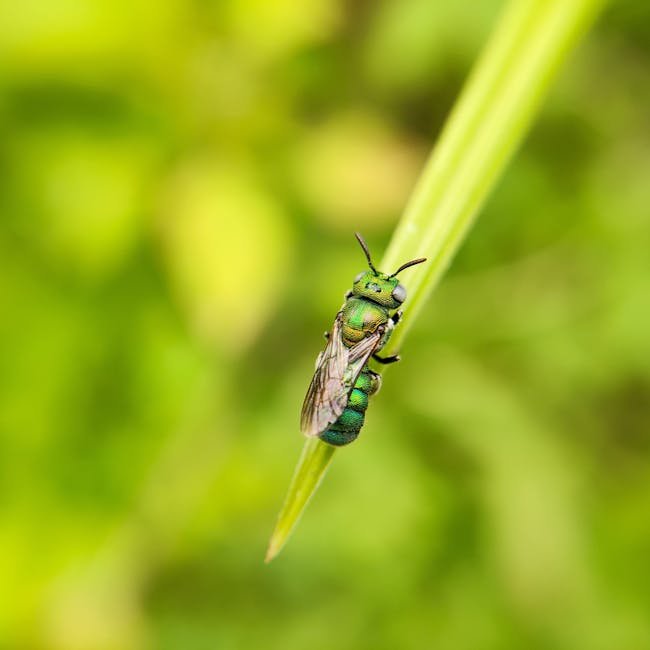
Museum Specimens Reveal an Unexpected Phenomenon (Image Credits: Pexels)
North America – Fine-striped sweat bees displayed a captivating transformation as researchers observed their metallic hues changing with ambient moisture levels. In arid conditions, these insects shimmered blue-green, but elevated humidity triggered a shift to a coppery green. Scientists reported this reversible effect in a study published today, suggesting it reveals an underappreciated dynamic in insect coloration.[1]
Museum Specimens Reveal an Unexpected Phenomenon
A startling shift caught the attention of researchers handling bee collections. Museum specimens appeared to dramatically alter their color when placed in high-humidity chambers designed to soften them for mounting and imaging. “It can be a bit alarming when you’re not expecting it,” noted Madeleine Ostwald, a functional ecologist at Queen Mary University of London.[1]
Jorge De La Cruz, an undergraduate at the University of California, Santa Barbara, first noticed the effect while curating specimens. This observation prompted a deeper investigation into the fine-striped sweat bee, Agapostemon subtilior. The team documented how the bees transitioned from a rich blue-green in dry air to a lighter copper green in moist environments. Such iridescent changes occur rapidly, with most transformation happening within the first 24 hours.
Controlled Tests Confirm the Humidity Link
Researchers exposed two dozen preserved specimens of Agapostemon subtilior to contrasting humidity conditions over 55 hours. At under 10 percent humidity, the bees retained their blue-green appearance. Conditions rose to 95 percent humidity shifted them toward copper green, demonstrating the effect’s consistency.[1]
To validate findings beyond lab settings, the team analyzed more than 1,000 photographs of live sweat bees uploaded to the citizen science platform iNaturalist. They correlated images with recorded humidity data from the observation sites and times. Patterns emerged: drier locales and moments yielded bluer tones, while humid ones produced greener shades. This real-world evidence reinforced the experimental results.
Exoskeleton Layers Hold the Secret
The color alteration stems from structural properties in the bees’ exoskeletons rather than pigments. Thin layers within the cuticle manipulate light reflection, producing iridescence. Humidity causes these layers to swell, increasing spacing and scattering longer, redder wavelengths.
“Because we saw redder bees in more humid conditions, this fits with that scientific explanation,” Ostwald explained.[1] Future microscopic analysis could verify the swelling mechanism. Many bees, including sweat bees from the Halictidae family, rely on such structural coloration for their shimmering appearances. This adaptability allows day-to-day variations tied to weather.
- Low humidity (<10%): Blue-green sheen dominates.
- High humidity (95%): Coppery green emerges.
- Change timeline: Primarily within 24 hours, fully reversible.
- Sources: Museum specimens and field photos.
- Species focus: Agapostemon subtilior, a North American native.
Implications Extend Beyond Sweat Bees
The discovery challenges assumptions about static insect colors. “Color can be really dynamic and respond to the environment in ways we didn’t expect,” Ostwald stated. “It’s really important to study the color of the living organism in its natural environment, because as soon as we remove them from that context, the color changes.”[1]
Sweat bees contribute to biogeographic color variations across regions. The effect likely applies to other iridescent insects using similar non-pigment mechanisms. Researchers published their findings in Biology Letters today (doi: 10.1098/rsbl.2025.0803), urging further exploration of environmental influences on appearance.[1]
Key Takeaways
- Humidity swells exoskeleton layers, shifting reflected light wavelengths.
- Effect observed in lab and wild via citizen science data.
- May explain color differences in museum vs. live specimens.
This humidity-responsive trait underscores how environmental factors shape even subtle traits like coloration. As climate patterns fluctuate, such adaptations could influence insect visibility, mating, or camouflage. Scientists anticipate broader studies will uncover similar responses in diverse species. What do you think about this color-changing marvel? Tell us in the comments.