

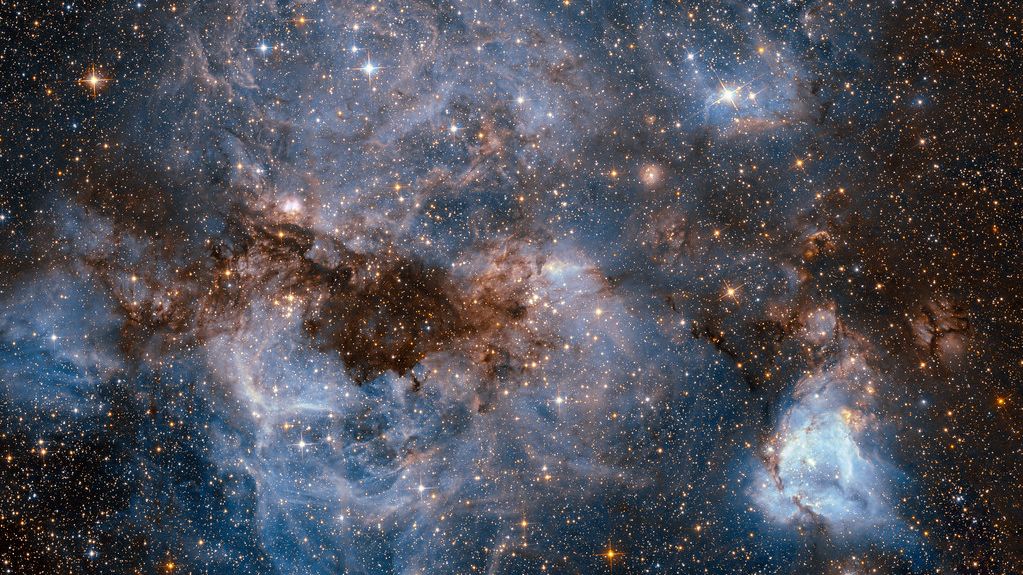
Hebe’s Unexpected Glow (Image Credits: Flickr)
Astronomers using the James Webb Space Telescope have identified a remote gas cloud that bears the chemical signature of the universe’s earliest stars. Located near the galaxy GN-z11, this clump – named Hebe – exists roughly 450 million years after the Big Bang and shows no traces of elements heavier than helium. The presence of high-energy radiation within the cloud suggests powerful sources, possibly the massive first-generation stars known as Population III, illuminating the pristine gas.[1]
Hebe’s Unexpected Glow
Researchers first spotted Hebe in 2024 during observations of GN-z11, a galaxy with the mass of about a billion suns. Higher-resolution James Webb data from 2025 confirmed the clump’s unusual properties. Spanning up to 1,200 light-years, Hebe consists of two distinct clusters with a total mass equivalent to 10,000 to several hundred thousand suns. Yet, given the expected size of primordial stars, it likely harbors only a few hundred such objects.[1]
The cloud glows brightly in light from highly ionized helium, a telltale sign of extreme radiation. No signatures of carbon, oxygen, or other heavy elements appear in the spectra. This purity aligns with gas composed mainly of hydrogen, helium, and trace lithium – remnants from the Big Bang itself. Such conditions point to an internal source capable of stripping electrons from helium atoms multiple times over.[1]
Signatures of Population III Stars
Population III stars represent the universe’s inaugural stellar generation, formed from untouched Big Bang material. These behemoths could reach up to 1,000 times the sun’s mass, burning fiercely before exploding and seeding heavier elements. Hebe’s emissions match predictions for such stars: intense ultraviolet light energizes the surrounding gas, producing the observed helium glow. Previous candidates for these stars dated to about 1 billion years post-Big Bang; Hebe pushes that timeline back significantly.[1]
“It’s a textbook case for the first generation of stars,” stated Roberto Maiolino of the University of Cambridge, a coauthor on the studies. “There’s no other really satisfactory explanations for other kinds of sources.” The radiation levels exceed what typical young stars could produce, reinforcing the Population III hypothesis. Simulations had predicted these stars in isolated pockets, yet Hebe’s location challenges that view.[1]
Proximity to GN-z11 Raises New Questions
GN-z11 itself shows chemical evolution, with heavier elements from prior stellar cycles. Hebe’s position in its halo puzzled observers, as large galaxies should mix and pollute nearby gas. Some models propose that gravitational forces could draw in distant pristine pockets, allowing late formation of Population III stars. Others suggest the clump survived due to inefficient mixing in the early universe.[1]
Seiji Fujimoto of the University of Toronto, who was not involved, noted that Hebe’s proximity to GN-z11 “opens up new questions about how such systems form and survive.” Three studies submitted in March 2026 detail the findings: one confirms the helium emitter without metal lines, another verifies pristine gas near GN-z11, and a third constrains the mass distribution of potential first stars. These papers, led by Maiolino and colleagues, appeared on arXiv as 2603.20362, 2603.20360, and 2603.20363.[1]
Key Characteristics of Hebe:
- Age: 450 million years after Big Bang
- Size: Up to 1,200 light-years across
- Mass: 10,000–hundreds of thousands of suns
- Composition: Hydrogen, helium, trace lithium – no heavier elements
- Notable emission: Highly ionized helium glow
Pathways to Deeper Insights
The discovery bolsters hopes for detecting more Population III signatures as James Webb surveys the cosmic dawn. Maiolino emphasized that “the discovery of Hebe, along with future studies of population III candidates, will help astronomers better understand the birthplaces of these pristine stars.” Enhanced observations could reveal individual stars or refine models of early galaxy formation. Such insights promise to clarify how the universe transitioned from primordial simplicity to the metal-rich cosmos of today.[1]
Astronomers now anticipate scouring similar regions for additional clumps. Hebe stands as the strongest candidate yet, bridging theory and observation in the quest for cosmic origins. This finding underscores James Webb’s power to pierce the veil of the early universe.