

Delivery Marks Critical Pre-Launch Phase (Image Credits: Pixabay)
Tanegashima Space Center, Japan — A pivotal moment arrived for Japan’s space ambitions as the Martian Moons eXploration spacecraft touched down at this remote island facility, marking the transition from assembly to final launch preparations.[1][2] This delivery underscores JAXA’s progress toward the world’s first sample return from a Martian moon, a feat that promises to illuminate longstanding questions about our solar system’s formation. With liftoff targeted for fiscal year 2026 aboard an H3 rocket, the mission positions Japan at the forefront of deep-space exploration.[3]
Delivery Marks Critical Pre-Launch Phase
The MMX spacecraft departed Mitsubishi Electric’s Kamakura Works on March 28, 2026, and reached Tanegashima via a dedicated vessel to Shimama Port three days later.[1] Teams wasted no time, moving the probe into the Spacecraft Test and Assembly Building for continued system protoflight testing. These rigorous evaluations ensure every subsystem functions flawlessly under simulated space conditions.
Officials at JAXA expressed satisfaction with the handover, viewing it as a testament to years of meticulous engineering. The spacecraft, now secured at the launch site, awaits final integrations and environmental checks before mating with the H3 booster. This step clears a major hurdle, especially after earlier delays tied to rocket development.[4]
Unveiling the Mysteries of Phobos and Deimos
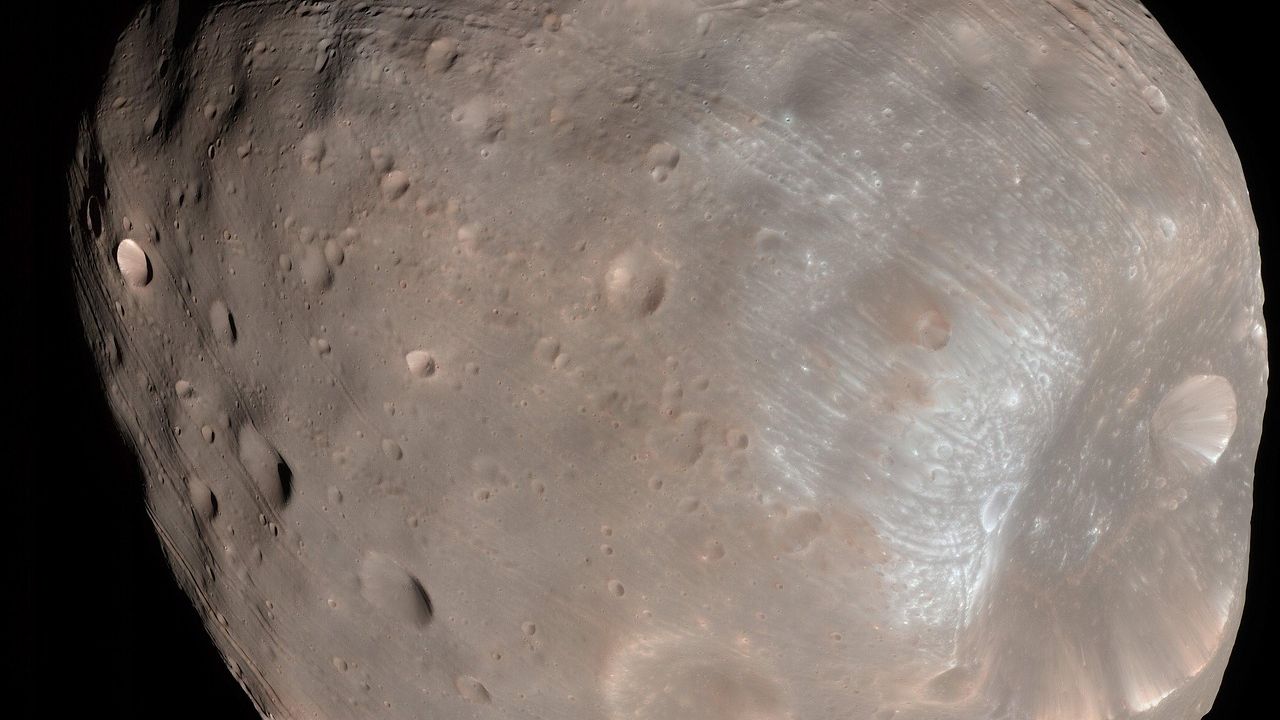
At its core, MMX seeks to resolve the origins of Mars’ irregular moons, Phobos and Deimos. Scientists debate whether these potato-shaped bodies formed from debris ejected by a massive impact on early Mars or represent asteroids captured from the outer solar system.[5][3] Phobos samples, exceeding 10 grams, will provide direct evidence through mineral composition and isotopic analysis, while remote observations map surface features and internal structures.
The mission extends beyond origins to Mars’ evolutionary history. Instruments will monitor atmospheric interactions and material circulation around the moons, shedding light on how the planet lost much of its early atmosphere and water. Deimos flybys complement Phobos work, offering comparative data on the Martian system’s dynamics.[4]
Engineering Marvel: Design and Operations
Weighing around 4,000 kilograms at launch, the spacecraft comprises three separable modules: propulsion for interplanetary travel and maneuvers, exploration for science operations, and return for sample delivery.[4] Chemical thrusters enable a quasi-stationary orbit around Phobos, a challenging low-gravity environment where traditional orbits prove unstable.
Sampling employs dual methods: a coring device penetrates over two centimeters into regolith via robotic arm, while a pneumatic system scoops surface particles near landing legs. A lander touches down once or twice, deploying the 30-kilogram IDEFIX rover for mobility tests and in-situ measurements with its Raman spectrometer and cameras.[5][4] Eleven instruments, including cameras, spectrometers, and a NASA gamma-ray detector, capture comprehensive data during three years at Mars.
What Matters Now: MMX timeline at a glance
– FY2026: Launch from Tanegashima
– 2027: Mars arrival, Phobos orbit
– 2027-2030: Sampling, rover ops, Deimos flybys
– FY2031: Sample return to Earth
Global Partnership Powers the Mission
JAXA leads this endeavor, but success hinges on international contributions. NASA supplies the MEGANE gamma-ray and neutron spectrometer to probe elemental composition, selecting scientists for joint analysis.[6][4] ESA provides deep-space transponders and ground station access, while France’s CNES delivers the infrared spectrometer and co-develops the rover with Germany’s DLR.
This collaboration mirrors Japan’s Hayabusa successes, fostering shared expertise in sample handling and low-gravity navigation. Recovered in Australia, the capsule will enable labs worldwide to study pristine Phobos material, accelerating planetary science.[3]
As testing progresses at Tanegashima, MMX stands ready to bridge Earth and the Martian frontier. The samples it returns could redefine our grasp of moon formation and habitable worlds, paving the way for future Mars ventures.