

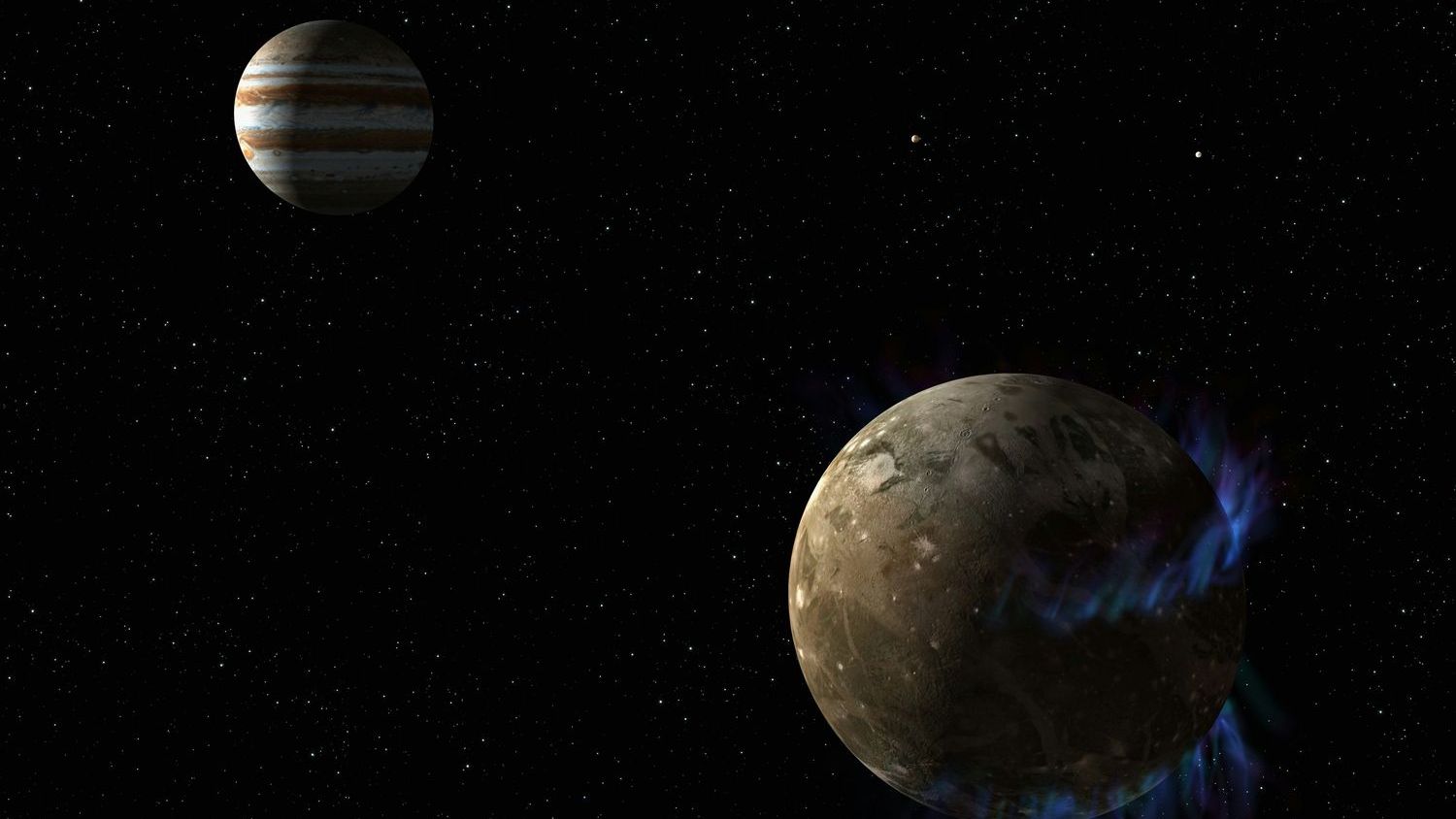
Study identifies geysers the JUICE mission could explore on Ganymede – Image for illustrative purposes only (Image credits: Unsplash)
Jupiter’s largest moon stands out even among the solar system’s most remarkable bodies. Ganymede exceeds the size of Mercury and carries its own magnetic field, a trait shared by few other worlds. Scientists have long suspected a vast subsurface ocean beneath its icy crust, and fresh analysis now points to geysers that could vent material from that hidden reservoir. The European Space Agency’s JUICE spacecraft, already en route, offers the first realistic chance to study those features up close.
A World of Surprising Scale and Complexity
Ganymede ranks as the biggest satellite in the solar system. Its diameter surpasses that of the innermost planet, giving it a surface area larger than South America. The moon also generates its own magnetic field, something previously observed only on Earth and the gas giants. These traits set Ganymede apart from typical icy moons and make it a prime target for understanding how magnetic fields and liquid water can coexist far from the Sun.
Researchers have modeled an interior ocean that may hold more water than all of Earth’s seas combined. The ocean sits beneath a thick shell of ice, protected from the harsh radiation environment around Jupiter. Evidence for this reservoir comes from magnetic measurements and surface observations gathered by earlier missions. The presence of liquid water raises basic questions about whether Ganymede could support chemical processes linked to life, even if no direct signs have appeared yet.
Active Geysers Identified in New Analysis
A recent study has pinpointed locations where geysers may erupt through cracks in Ganymede’s ice. These plumes would carry material from the subsurface ocean to the surface, offering a direct sample of what lies below. The features appear tied to regions of geological stress, where tidal forces from Jupiter flex the moon’s crust. Such activity would mark Ganymede as more dynamic than previously assumed.
Detecting geysers from Earth or orbit remains difficult because the plumes are faint and intermittent. The study combined existing spacecraft data with updated models of ice thickness and internal heat flow. Results suggest several candidate sites where water vapor or ice particles could escape. Confirmation will require instruments capable of flying through or near the plumes, something no prior mission has attempted at Ganymede.
How JUICE Will Investigate the Plumes
The Jupiter Icy Moons Explorer, or JUICE, launched in 2023 and is scheduled to reach the Jupiter system in 2031. After several flybys of other moons, the spacecraft will enter orbit around Ganymede itself, the first time any probe has done so. Its suite of cameras, spectrometers, and particle detectors is designed to map surface composition and search for signs of recent activity.
During close passes, JUICE can sample any geyser material directly. Mass spectrometers will analyze the chemical makeup of ejected ice and gas, while magnetometers track how the plumes interact with Ganymede’s magnetic field. The mission timeline includes multiple opportunities to target the most promising sites identified in the new study. Engineers have already adjusted observation plans to prioritize these regions once the spacecraft arrives.
Uncertainty remains about how often the geysers activate and how much material they release. JUICE’s instruments carry the sensitivity needed to detect even modest plumes, yet the exact timing of eruptions cannot be predicted with current data. Mission scientists therefore plan flexible observation sequences that can respond to new detections in real time.
What the Findings Mean for Habitability Searches
Any confirmed geyser activity would strengthen the case that Ganymede’s ocean stays in contact with the surface environment. That connection matters because it could cycle nutrients and energy sources through the water layer. Similar processes on Enceladus and Europa have already shaped thinking about icy-moon habitability.
Still, Ganymede’s greater distance from Jupiter and thicker ice shell introduce different conditions. The moon’s own magnetic field adds another layer of complexity, shielding parts of the surface while allowing radiation to reach others. JUICE data will help clarify whether these factors support or limit the kinds of chemistry associated with life.
Key points to watch: Ganymede’s subsurface ocean volume, locations of candidate geysers, and JUICE’s planned plume-sampling passes.
The mission’s findings will arrive years from now, yet the identification of accessible geysers already narrows the search for answers. Ganymede continues to reveal itself as a world where ice, water, and magnetic forces interact in ways that challenge simple models of planetary evolution.