

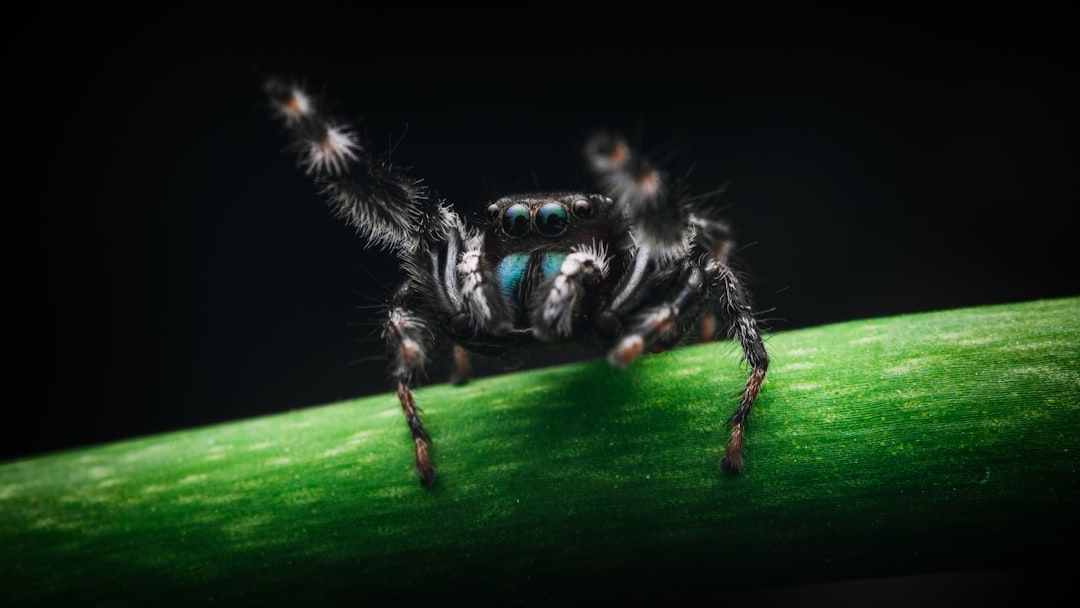
Extraordinary Creatures: Jumping Spiders – Image for illustrative purposes only (Image credits: Unsplash)
High atop mountain peaks reaching 7,000 meters or submerged beneath water surfaces, jumping spiders persist in environments that challenge most life forms. These compact arachnids, measuring from just 2 millimeters to 25 millimeters in length, represent nearly 7,000 species worldwide – accounting for 10 to 13 percent of all known spiders. Absent only from Antarctica, they showcase a versatility that has captivated researchers for decades. Their story reveals nature’s ingenuity in packaging extraordinary capabilities into tiny frames.
A Prolific Family Across Continents
Jumping spiders thrive on every continent except the coldest one. Their global distribution highlights an adaptability unmatched by many spider families. From tropical rainforests to arid deserts, these creatures carve out niches wherever conditions allow.
The sheer number of species underscores their success. Biologists estimate close to 7,000 varieties, a figure that positions them as one of the most diverse spider groups. The largest among them, Hyllus giganteus, roams Southeast Asia, stretching up to 25 millimeters long. Such variety ensures they fill roles from predators of insects to occasional plant visitors.
Enduring Extremes with Clever Biology
These spiders push boundaries of survival. They ascend to altitudes of 7,000 meters, where thin air and low temperatures test endurance. Even more remarkably, some endure underwater immersion, protected by hydrophobic hairs that trap air bubbles around their bodies.
This air-trapping mechanism acts like a personal scuba system, allowing oxygen access in submerged states. Such traits enable persistence in floods or streams. Researchers note these adaptations contribute to their metabolic efficiency, conserving energy in harsh settings. No other spiders match this combination of high-altitude and aquatic resilience.
Dispersal and Locomotion Redefined
Young jumping spiders, or spiderlings, employ a daring strategy for travel known as ballooning. They release electrostatically charged silk strands that catch winds, propelling them vast distances. Records show journeys from Australia to New Zealand, spanning 3,000 kilometers across open ocean.
Adults, meanwhile, leap with precision using hydrostatic pressure rather than traditional muscles. Blood pumped into their limbs extends them pneumatically, a system that demands less energy than muscular action. This efficiency powers jumps several times their body length. Combined with keen senses, it turns them into agile hunters on leaves, bark, or walls.
Vision: A Window to Their World
Central to their prowess lies an unparalleled visual system. Jumping spiders possess multiple eyes arranged to deliver a near-360-degree field of view. This setup grants detailed awareness of surroundings, crucial for spotting prey or rivals from afar.
Ximena Nelson, a researcher at the University of Canterbury in New Zealand, has dedicated 30 years to decoding this vision. Her work explores how these eyes facilitate hunting strategies and mating displays. Females assess potential partners through visual cues, while males perform intricate dances visible across distances. Nelson’s investigations reveal the complexity: principal eyes handle sharp, color-rich detail, while secondary ones scan for motion.
Recent findings, detailed in a Journal of Experimental Biology article published April 15, 2026, highlight these mechanisms. The spiders’ eyes process a broad spectrum, aiding navigation in varied light. Limitations persist, however; not all species share identical eye configurations, and underwater vision remains underexplored. Ongoing studies aim to clarify how neural processing integrates inputs from up to eight eyes.
This visual supremacy explains their daytime activity and bold approaches to larger threats. Unlike web-builders, jumping spiders stalk actively, leaping to capture meals. Their eyes also detect ultraviolet patterns, invisible to humans, enriching courtship rituals.
Implications for Understanding Arachnid Evolution
The jumping spider’s traits offer insights into evolutionary pressures favoring efficiency and perception. By minimizing muscle reliance and maximizing sensory input, they exemplify streamlined design. Future research may uncover genetic bases for their air-trapping hairs or ballooning silks.
Though small, these spiders remind us of nature’s capacity for innovation. Their story continues to unfold, promising discoveries in biology and behavior. As habitats shift, their adaptability could provide lessons for resilience in changing ecosystems.