

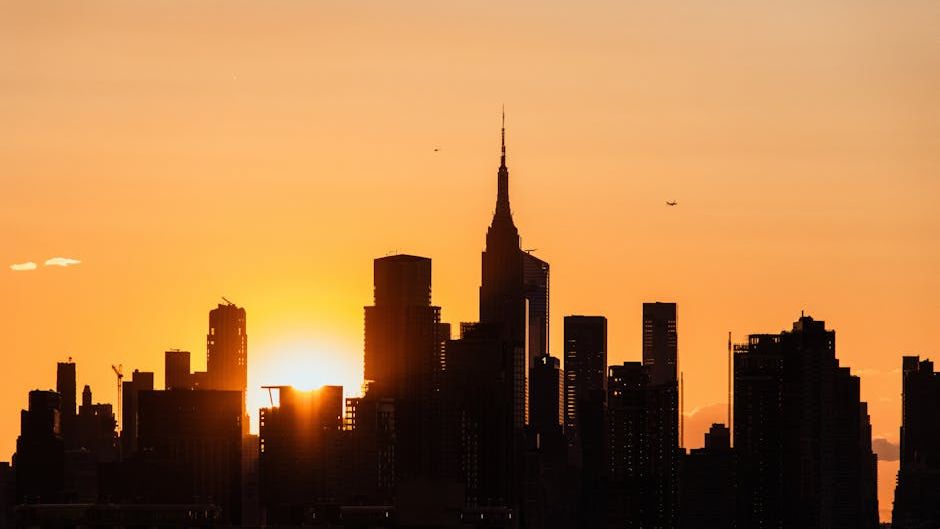
Manhattanhenge 2026 is coming this month: Here’s when and where to see the sunset spectacle – Image for illustrative purposes only (Image credits: Pexels)
New York City – Twice each year the setting sun slips into perfect alignment with the city’s north-south avenues, casting long golden rays that stretch for miles along the grid. The result is a brief but unforgettable spectacle that draws photographers, residents, and visitors alike to the sidewalks and rooftops. In 2026 the event returns this month, offering another chance to watch the sky and the streets merge in a single luminous moment.
The Geometry Behind the Glow
Manhattanhenge occurs when the sun’s path coincides exactly with the orientation of Manhattan’s street grid. The avenues run roughly 29 degrees east of true north, a layout set more than a century ago. On the chosen evenings the sun drops below the western horizon at that precise angle, flooding the corridors between buildings with direct light.
The alignment lasts only a few minutes, yet the visual effect is dramatic. Skyscrapers on either side act as natural frames, turning ordinary cross streets into glowing tunnels. Observers standing far to the east can look west and see the sun framed by the distant skyline, an image that has become one of the city’s signature seasonal sights.
Why the Phenomenon Captures So Much Attention
Unlike many astronomical events that require special equipment or remote locations, Manhattanhenge unfolds in the middle of one of the world’s busiest urban centers. The contrast between the orderly grid and the fleeting natural light creates a powerful sense of scale and timing. For many New Yorkers it serves as a quiet reminder that even the most engineered environment remains subject to the rhythms of the sky.
The event also carries a practical appeal. Because it happens at sunset, it coincides with the end of the workday for thousands of people. Commuters and after-work crowds often pause on sidewalks or climb to higher vantage points, turning a routine evening into a shared public moment. The brief window of perfect alignment encourages planning and anticipation in a city that rarely slows down.
Best Practices for Watching the Alignment
Clear western sightlines are essential. Streets that run uninterrupted from the East River toward the Hudson offer the strongest views. Elevated spots such as bridges, parks, or building terraces can extend the visible arc of the sun as it descends. Arriving early helps secure a good position before crowds gather.
Weather remains the single most important variable. A cloudless western horizon is required for the full effect. Even thin clouds can soften or obscure the alignment, so checking forecasts in the hours before sunset is worthwhile. Photographers often bring tripods and neutral-density filters to manage the bright light and capture the long shadows that stretch down the avenues.
What the Event Reveals About the City
Manhattanhenge highlights the deliberate choices made when Manhattan was laid out. The grid plan, adopted in 1811, prioritized efficient real-estate development over perfect cardinal orientation. The slight offset from true north is what makes the twice-yearly alignment possible. In that sense the spectacle is as much a product of urban planning as it is of astronomy.
Each occurrence also underscores how rare moments of natural symmetry can still emerge inside a dense metropolis. Residents who have lived in the city for decades often describe the event as a small but reliable point of connection with the larger sky, one that repeats on schedule regardless of daily headlines or construction projects.
Key points to remember: The alignment happens twice annually, lasts only minutes, and depends on clear western skies. Elevated or unobstructed western views improve the experience, and the event remains free and open to anyone with a clear line of sight.