

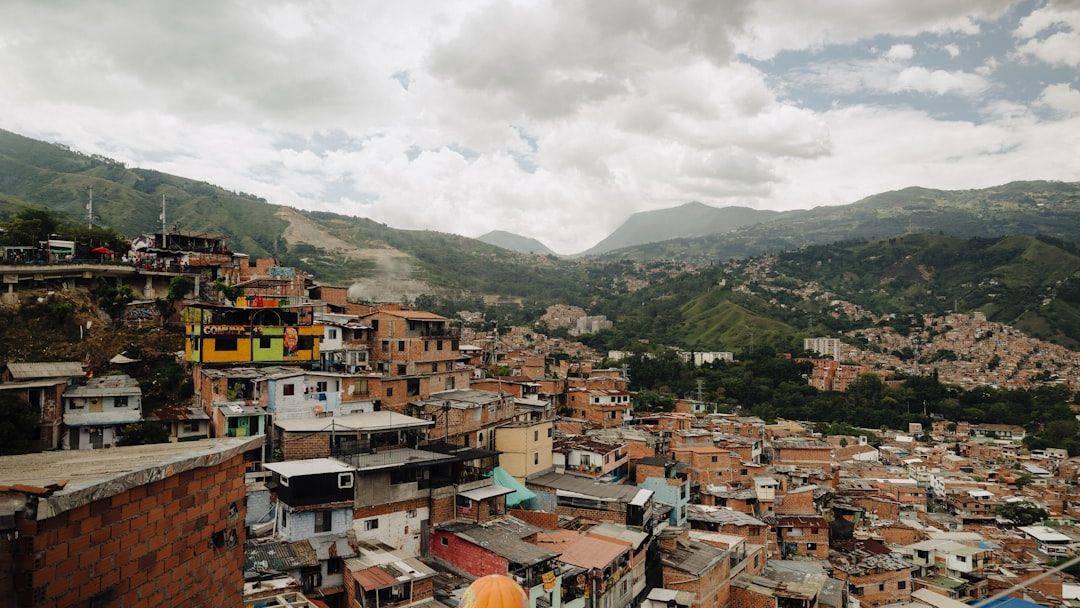
The landslide drivers of structural damage in Medellin, Colombia – Image for illustrative purposes only (Image credits: Unsplash)
Medellin has expanded rapidly across steep hillsides to accommodate its roughly four million residents, creating dense neighborhoods where reports of damaged buildings have become routine. For years, those failures were widely attributed to rushed construction on informal settlements. A detailed new analysis now indicates that many of the problems stem instead from slow, persistent ground movement linked to ancient landslides buried beneath the city surface.
Urban Expansion on Unstable Terrain
The second-largest metropolitan area in Colombia has pushed outward into surrounding slopes at a pace that outstripped formal planning in many districts. Informal communities now occupy steep ground where natural drainage and soil stability were already marginal. Landslides have long been a recognized hazard, yet the assumption that poor building quality alone explained the pattern of structural complaints persisted until recently.
That view is being challenged by evidence that links clusters of damage reports to deeper geological processes rather than surface-level construction standards.
Mapping Subtle Ground Shifts with Satellite Data
Researchers applied InSAR satellite measurements to track millimeter-scale displacements across Medellin over time. Three neighborhoods stood out for elevated rates of movement: Doce de Octubre, Manrique, and Villa Hermosa. In each case, the zones of active deformation aligned closely with the outlines of large, deep-seated landslides that predate modern development.
Pre-urban aerial imagery helped confirm that the underlying topography in these districts already reflected repeated ancient slope failures. The ongoing deformation detected by satellites matches the locations where residents have reported the highest concentrations of cracked walls, tilted floors, and foundation issues.
Damage Patterns Independent of Building Type
One of the clearest findings is that the density of structural complaints does not track with the age or apparent quality of construction. Both older informal dwellings and more recent formal buildings show similar problems when they sit inside the mapped deformation zones. This decoupling suggests the ground itself is shifting beneath structures regardless of how they were built.
In the Manrique district, for example, the pattern of movement follows the boundaries of multiple overlapping ancient landslides rather than any visible differences in building materials or engineering.
Recent Events Reinforce the Long-Term Risk
The same zones of elevated ground movement have also hosted several acute landslide incidents in recent years. One such event on 24 June 2025 claimed 27 lives and occurred squarely within an area previously flagged by the satellite analysis for ongoing deformation.
These incidents illustrate how slow, deep-seated processes can eventually trigger sudden failures, especially when rainfall or human alterations to slopes and groundwater increase stress on already weakened ground.
Planning for a Changing Climate
The study underscores Medellin’s underlying vulnerability to slope processes that operate on timescales far longer than individual construction projects. As rainfall patterns shift and urban development continues to modify drainage and vegetation, the need for slope monitoring and targeted stabilization measures grows more pressing.
Recognizing the geological legacy beneath the city offers a clearer path for prioritizing resources where they can reduce both chronic building damage and the potential for future tragedies.