

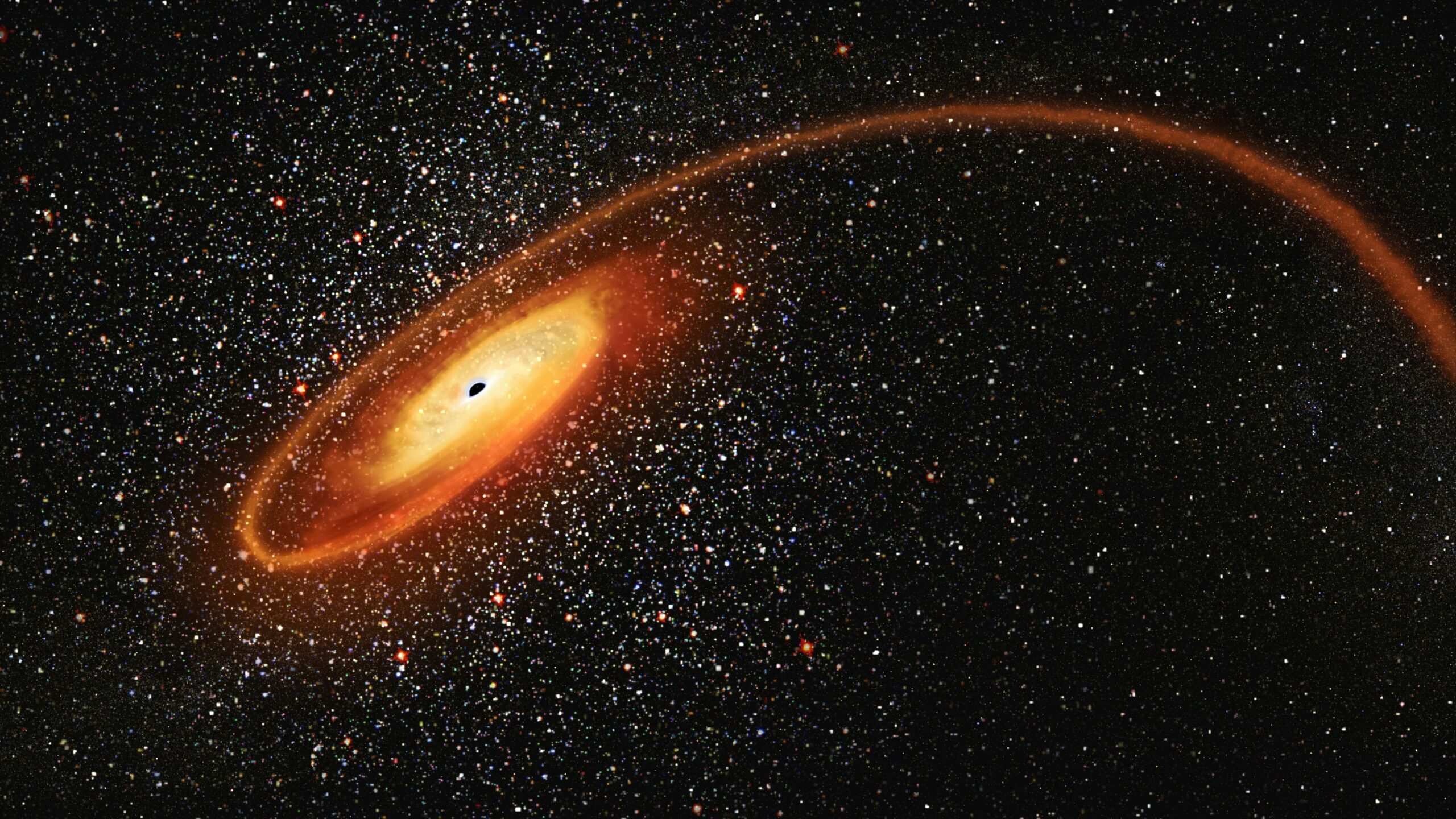
A new way to spot signs of dark matter – Image for illustrative purposes only (Image credits: Unsplash)
Dark matter accounts for the vast majority of matter in the universe, yet it reveals itself only through gravitational effects. Physicists have long sought ways to observe it more directly, and a team from MIT working with colleagues across Europe has now developed a targeted method to search for its influence in signals from distant black hole mergers. The approach focuses on how dense pockets of dark matter could subtly alter the gravitational waves that reach detectors on Earth.
Why Dark Matter Has Remained So Hard to Pin Down
Astronomers infer the presence of dark matter from the way gravity bends light around galaxies and clusters, an effect that cannot be explained by visible matter alone. Unlike ordinary matter, dark matter does not emit, absorb, or reflect light, making it invisible to conventional telescopes. Theories suggest it could consist of extremely light particles that behave more like waves than individual particles when near massive objects such as black holes. These waves are predicted to interact with a spinning black hole through a process called superradiance, in which the black hole transfers rotational energy to the dark matter and builds up unusually high densities.
How Merging Black Holes Could Carry Detectable Traces
When two black holes spiral together and merge inside such a dense dark matter region, the resulting gravitational waves may carry a distinctive imprint. In empty space the waveform follows a well-understood pattern, but the extra gravitational pull from concentrated dark matter can change the frequency and amplitude in measurable ways. The MIT-led group created detailed numerical simulations that predict exactly how those changes would appear after the waves travel across vast distances to reach Earth-based observatories.
Testing the Model Against Real Observations
The researchers applied their predictions to the clearest gravitational-wave events recorded during the first three observing runs of the LIGO-Virgo-KAGRA network. They examined 28 high-quality signals and compared each one against both a standard vacuum model and their new dark-matter model. Twenty-seven events matched the vacuum expectation, as anticipated. One signal, GW190728, showed a closer match to the dark-matter scenario, though the team stresses that the statistical preference remains too modest to claim a detection.
| Category | Number of Events | Interpretation |
|---|---|---|
| Clear vacuum match | 27 | Consistent with empty space |
| Possible dark-matter preference | 1 (GW190728) | Requires further verification |
What Comes Next for Gravitational-Wave Searches
The new framework gives analysts a practical tool to screen future detections for similar signatures without assuming every merger occurs in isolation. As the LIGO-Virgo-KAGRA detectors continue to collect data, the method could identify additional candidates that warrant closer study with independent techniques. “We now have the potential to discover dark matter around black holes as the LVK detectors keep collecting data in the coming years,” noted co-author Soumen Roy. The work, published in Physical Review Letters, was supported in part by the U.S. National Science Foundation and MIT’s Center for Theoretical Physics.