

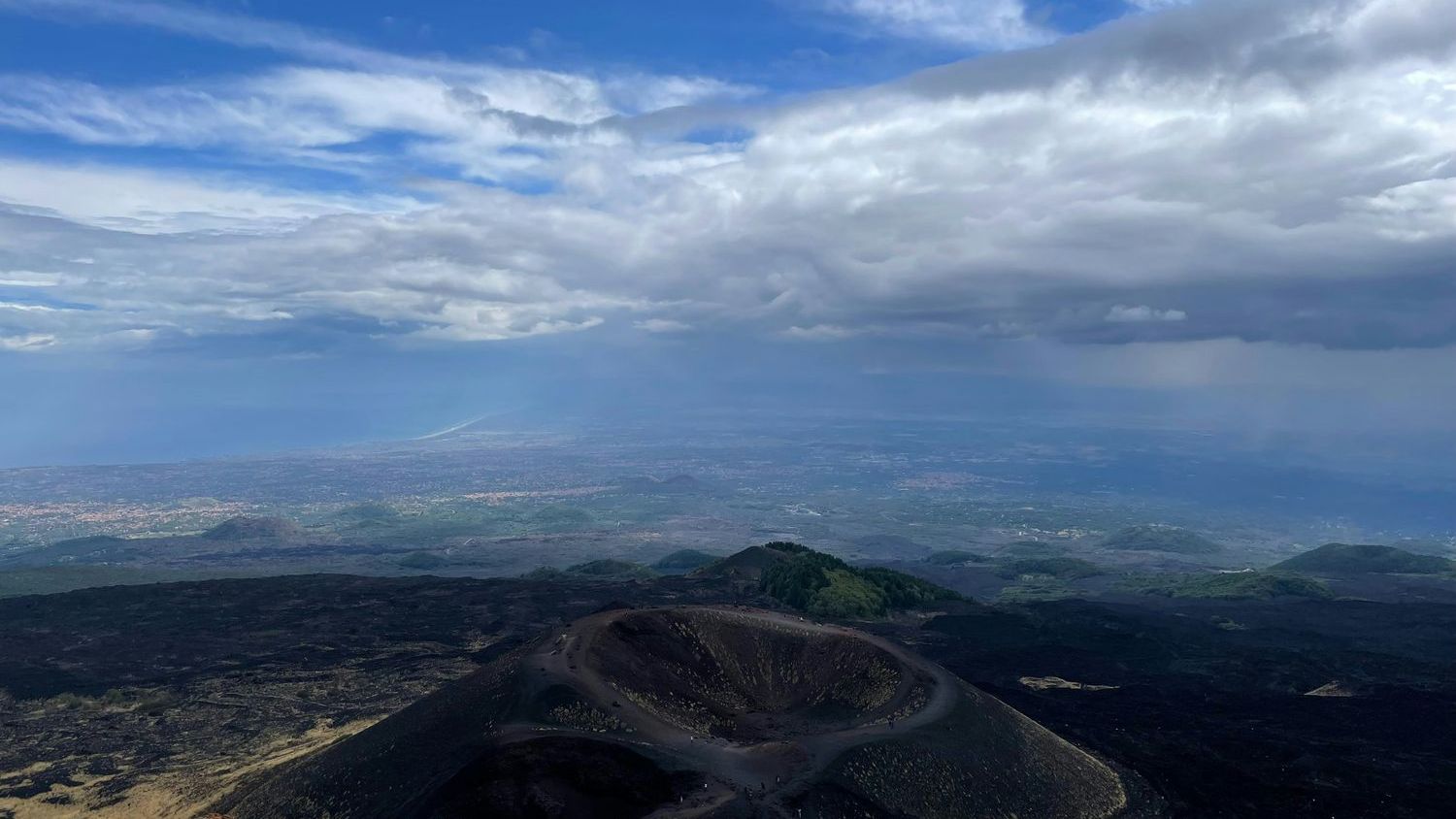
The Puzzle of Etna’s Distinctive Eruptions (Image Credits: Unsplash)
Sicily’s Mount Etna towers more than 3,000 meters above the Mediterranean landscape, a persistent force that has erupted dozens of times in recent years alone.[1][2] Scientists have long scrutinized its alkaline-rich lavas, which carry chemical signatures more typical of distant hotspot volcanoes than those near subduction zones. Recent analysis of rock samples spanning half a million years now points to an unusual origin, suggesting the volcano draws from ancient magma pockets far below the surface.
The Puzzle of Etna’s Distinctive Eruptions
Mount Etna has shaped Sicily’s eastern coast for over 500,000 years, building into Europe’s tallest active volcano through layers of lava flows and ash deposits.[1] Its frequent activity – several eruptions annually – produces lavas high in sodium and potassium, defying expectations for a site near where the African plate collides with the Eurasian one. Researchers noted this mismatch early on, as the compositions echoed those from intraplate hotspots like Hawaii, yet no such plume lies nearby.
Traditional models struggled to account for the volume and consistency of these emissions. Etna churned out roughly 346 cubic kilometers of alkaline lava over about 60,000 years without major shifts in chemistry, a feat that hinted at a stable, pre-existing supply rather than fresh melts formed just before each event.[3] This stability persisted even as regional tectonics shifted, prompting geologists to question whether Etna operated under entirely different rules.
Tracing Magma Back to the Upper Mantle
A team led by Sébastien Pilet of the University of Lausanne examined 85 rock samples from eastern Sicily, reconstructing the volcano’s chemical history across its lifespan.[1][3] Their work, detailed in a study published this month in the Journal of Geophysical Research: Solid Earth, revealed a consistent source about 80 kilometers beneath the surface – in the low-velocity zone at the top of the upper mantle.
These findings indicated small pockets of melt, trapped long ago, that ascend in bursts through crustal fractures. The process resembles wringing water from a sponge, driven by the bending and collision of tectonic plates rather than rising heat columns or water-induced melting.[2] Early eruptions transitioned from smaller volumes to dominant alkaline flows after interactions with surrounding mantle rock carved efficient pathways upward.
Evidence from older lavas on the nearby Hyblean Plateau further supported this deep continuity, linking scattered ancient activity to Etna’s main edifice. Such persistence over hundreds of thousands of years underscored a supply mechanism decoupled from short-term tectonic changes.
Petit-Spot Parallels in an Unexpected Scale
Petit-spot volcanoes, first identified by Japanese researchers in 2006, typically form small submarine mounds where oceanic plates flex and release stored mantle melts.[4] These features rise just hundreds of meters and differ sharply from the massive stratovolcanoes at plate edges. Yet Pilet’s team proposed Etna follows a similar dynamic, albeit amplified to continental proportions.
“Our study suggests that Etna may have formed through a mechanism similar to the one that generates petit-spot submarine volcanoes,” Pilet explained. “This is unexpected, as such processes had previously only been observed in very small volcanic structures, typically rising no more than a few hundred meters.”[1][2]
- Plate boundaries: Mantle rises as plates diverge, forming new crust.
- Subduction zones: Water from sinking plates lowers melting points, yielding explosive magmas.
- Hotspots: Deep plumes punch through stable plates, like in Hawaii.
- Petit-spot (proposed for Etna): Pre-stored melts leak via tectonic stress.
This framework positions Etna outside standard categories, potentially heralding a broader recognition of deep-melt leakage in volcanic systems worldwide.
Hazards and Horizons for Monitoring
Etna’s proximity to Catania and Messina, cities housing hundreds of thousands, amplifies the stakes of its unrest. Since 1986, summit craters have unleashed over 240 paroxysmal events – sudden fountains of lava and ash plumes.[3] Recent flows, such as those in late 2025 near Valle del Bove, reminded observers of its reach.
The new model shifts focus toward tectonic signals: fault movements, crustal deformation, and plate flexure could signal when deep pockets vent. While exact predictions remain elusive, integrating these with seismic and gas data might refine alerts. Geophysical surveys already detect melt-rich layers under other subduction settings, bolstering the idea that Etna exposes a hidden planetary process.
As researchers probe further, Etna emerges not as an anomaly but as a window into how ancient mantle stores influence surface fury. This giant among volcanoes continues to erupt, its lavas carrying whispers from 80 kilometers down, challenging scientists to expand the atlas of Earth’s fiery expressions.