

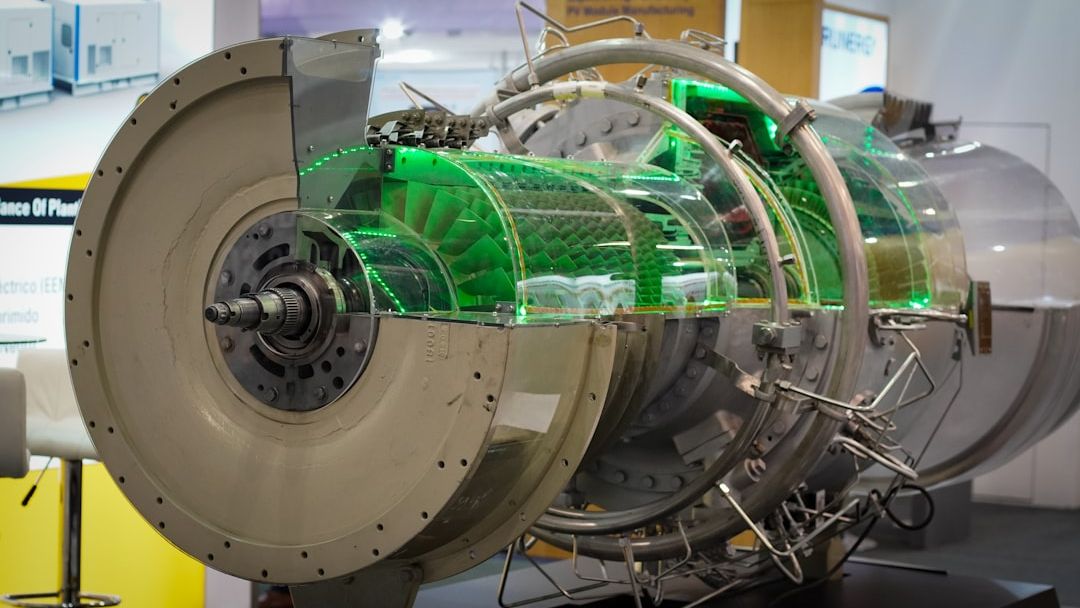
NASA is making a powerful new ion engine to send astronauts to Mars – and it just passed its 1st test – Image for illustrative purposes only (Image credits: Unsplash)
Advancements in electric propulsion hold the key to making human trips to Mars more feasible, as they promise substantial reductions in propellant needs compared to chemical rockets. Engineers at NASA’s Jet Propulsion Laboratory recently demonstrated this potential by igniting a prototype thruster that operates on lithium metal vapor. The device reached power levels of 120 kilowatts during its debut ground test, marking a significant benchmark for future deep-space missions.[1][2]
First Firing Delivers Record Performance
The test took place on February 24, 2026, inside JPL’s specialized condensable metal propellant vacuum facility in Southern California. This 26-foot-long, water-cooled chamber allowed safe operation with metal vapors. Over five ignitions, the thruster hit its target power of up to 120 kilowatts, the highest ever recorded for an electric propulsion system in the United States.[1]
A central tungsten electrode glowed bright white at temperatures exceeding 5,000 degrees Fahrenheit, while the nozzle-shaped outer electrode produced a striking red plume. James Polk, a senior research scientist at JPL who has studied lithium-fed thrusters for decades, led the effort alongside teams from Princeton University and NASA’s Glenn Research Center. “Designing and building these thrusters over the last couple of years has been a long lead-up to this first test,” Polk said. “It’s a huge moment for us because we not only showed the thruster works, but we also hit the power levels we were targeting.”[2]
Mechanics of the MPD Thruster
This magnetoplasmadynamic thruster, or MPD, vaporizes solid lithium into plasma and accelerates it using powerful electric currents combined with a magnetic field. Unlike traditional ion engines that rely on electrostatic fields, the MPD design leverages electromagnetic forces for higher thrust at elevated power levels. Development on this prototype spanned the past two and a half years, building on concepts researched since the 1960s but never flown in space.[1]
The system demands precise control to manage extreme heat, with components enduring intense conditions during operation. Data from the initial run now guides refinements to the hardware. Researchers emphasize that such thrusters could operate far more efficiently when paired with nuclear power sources, enabling sustained performance over vast distances.[3]
Power Comparison Highlights the Advance
Current NASA spacecraft like Psyche rely on Hall-effect thrusters fueled by xenon gas, which produce modest power outputs of around 4 to 5 kilowatts each. These systems deliver low, steady thrust that builds to impressive speeds over months, as seen with Psyche reaching 124,000 mph en route to its asteroid target. The new MPD prototype, however, generated more than 25 times that power in a single unit.[1]
| Thruster System | Power Level | Propellant |
|---|---|---|
| Psyche Hall Thrusters | ~4-5 kW | Xenon |
| MPD Prototype | 120 kW | Lithium Metal Vapor |
This table underscores the scale of the leap, though Psyche’s thrusters remain proven in flight while the MPD awaits further validation.[2]
Path Forward for Mars Missions
NASA Administrator Jared Isaacman highlighted the test’s relevance to broader goals. “At NASA, we work on many things at once, and we haven’t lost sight of Mars,” he stated. “The successful performance of our thruster in this test demonstrates real progress toward sending an American astronaut to set foot on the Red Planet.”[1] A crewed Mars journey could require 2 to 4 megawatts total, achievable with several MPD units running for over 23,000 hours alongside nuclear reactors.
Such systems might slash propellant use by up to 90% versus chemical propulsion, easing launch demands and allowing larger payloads. The technology aligns with NASA’s Space Nuclear Propulsion project, which funds this work through the Space Technology Mission Directorate.[3]
What matters now: This test establishes a reliable platform for scaling electric propulsion, bridging the gap between today’s spacecraft and the megawatt-class engines needed for human exploration.
Endurance and Scaling Remain Key Hurdles
High operating temperatures pose ongoing challenges, as components must survive prolonged exposure without degradation. Future tests will probe these limits, using insights from the February run to iterate designs. Polk noted the team’s confidence in the testbed for tackling these issues systematically.[2]
Plans call for pushing individual thrusters toward 500 kilowatts to 1 megawatt, a step essential for practical Mars applications. Collaboration across NASA centers ensures steady progress amid these technical demands.
The February test at JPL stands as a quiet but firm affirmation of persistent innovation in propulsion. As data analysis continues, this lithium-fed system edges closer to enabling the efficient, high-thrust travel required for humanity’s next planetary frontier.