

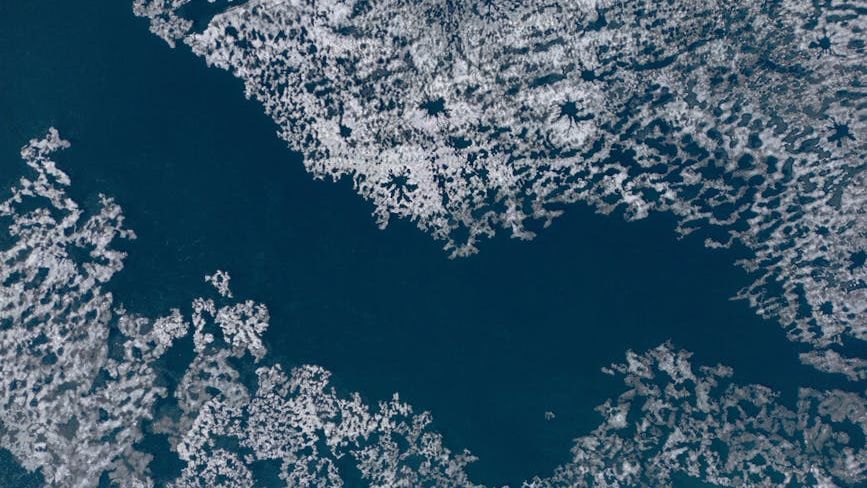
Canadian ’emoji’ lake vanishes after dramatic, landslide-like collapse – Earth from space – Image for illustrative purposes only (Image credits: Pexels)
In the remote forests south of Waswanipi, Quebec, a Cree trapper stumbled upon a scene that shattered generations of family tradition. Lac Rouge, once a pristine 3-square-kilometer lake teeming with trout and sturgeon, had emptied completely, leaving behind a vast mudflat scarred by a violent outflow. The sudden collapse in spring 2025 not only reshaped the landscape but also cut off access to hunting camps and clean drinking water sources long cherished by the local First Nation.[1][2]
The Harrowing Discovery
On May 9, 2025, Freddie Dixon arrived at his family’s trapline W-26 and found eagles circling over dead fish amid thick mud. His great-uncle William Dixon had received alerts about washed-out roads near a campsite, prompting the visit. What they encountered was no ordinary flood: the lake’s eastern bank had given way, unleashing a torrent that carved a new 10-kilometer path through ponds and forest to Lac Doda downstream.[2]
William Dixon later reflected on the abrupt change. “It happened all of a sudden,” he said. “All that water went down to Doda Lake.”[2] The family had used the site for decades, netting sturgeon and drawing drinking water from its clear depths. Now, a suspended dock hung over dry ground, and boat landings lay buried in sand.
Satellite Images Expose the Scale
Landsat 9 captured the transformation starkly. On June 21, 2024, Lac Rouge gleamed full, its shape forming the open mouth of a shocked emoji when paired with two smaller nearby lakes. By June 15, 2025, it had vanished, replaced by a sediment-choked trail snaking northeast.[3][4]
The breach occurred between April 29 and May 14, 2025, according to imagery analysis. Dark water contrasts highlighted the fresh scar: sediment-laden floodwaters punched through untouched terrain, turning Lac Doda temporarily muddy while sparing adjacent Father Lake. Air surveys confirmed land collapse around the lake, with debris destabilizing slopes.[1]
Contributing Forces to the Collapse
Several elements converged to trigger the outburst flood, a rare event for non-glacial lakes. Heavy snowfall that winter swelled the lake, while rapid spring melt exerted pressure on softened banks. Wildfires in 2019 and 2023 – one of Canada’s worst fire seasons – stripped vegetation, leaving soil hydrophobic and prone to erosion.[3]
Logging and post-fire scarification accelerated runoff by removing tree shade and roots that stabilized soil. The region, shaped by retreating ice sheets just 20,000 years ago, remains a young landscape vulnerable to such shifts. As forest hydrologist François-Nicolas Robinne noted, “It’s a very young landscape that’s evolving very fast.”[3]
- Wildfires (2019, 2023): Reduced soil stability and absorption.
- Logging/scarification: Faster snowmelt, higher water tables.
- Snowmelt and rainfall: Overloaded vulnerable banks.
- Beaver dams and culverts: Potentially blocked normal outflows.
Devastation for Waswanipi Cree Nation
The Cree First Nation of Waswanipi issued urgent warnings to avoid the area, citing unstable land and risks near altered forests. Chief Irene Neeposh described the sight as resembling a natural disaster, unlike anything witnessed before. Traditional campsites became inaccessible, and downstream Lac Doda faced sediment pollution, threatening moose yards, caribou, and fish stocks.[1]
Emotional toll ran deep. Elder Paul Dixon, nearly 70, wept at the loss, recalling shaded forests that slowed melts and sustained wildlife. “The first time, I cried,” he said. Families like the Dixons lost protected cultural sites and worried about mercury buildup in food sources, blending traditional knowledge with calls for scientific probes.[5]
Uncertain Recovery and Broader Warnings
Quebec officials deemed the event natural, but communities and experts probed human influences like forestry practices. Water and soil samples continued into June 2025, assessing stability and contamination. Similar landslides have risen regionally, linked to extreme weather and land changes.[2]
For Waswanipi’s tallymen, the drained basin serves as a stark reminder of northern Quebec’s fragility. Restoration remains elusive, with poplar and birch likely to regrow amid clay shifts. The incident underscores growing risks to Indigenous lands, prompting vigilance for other lakes teetering on the edge.[5]