

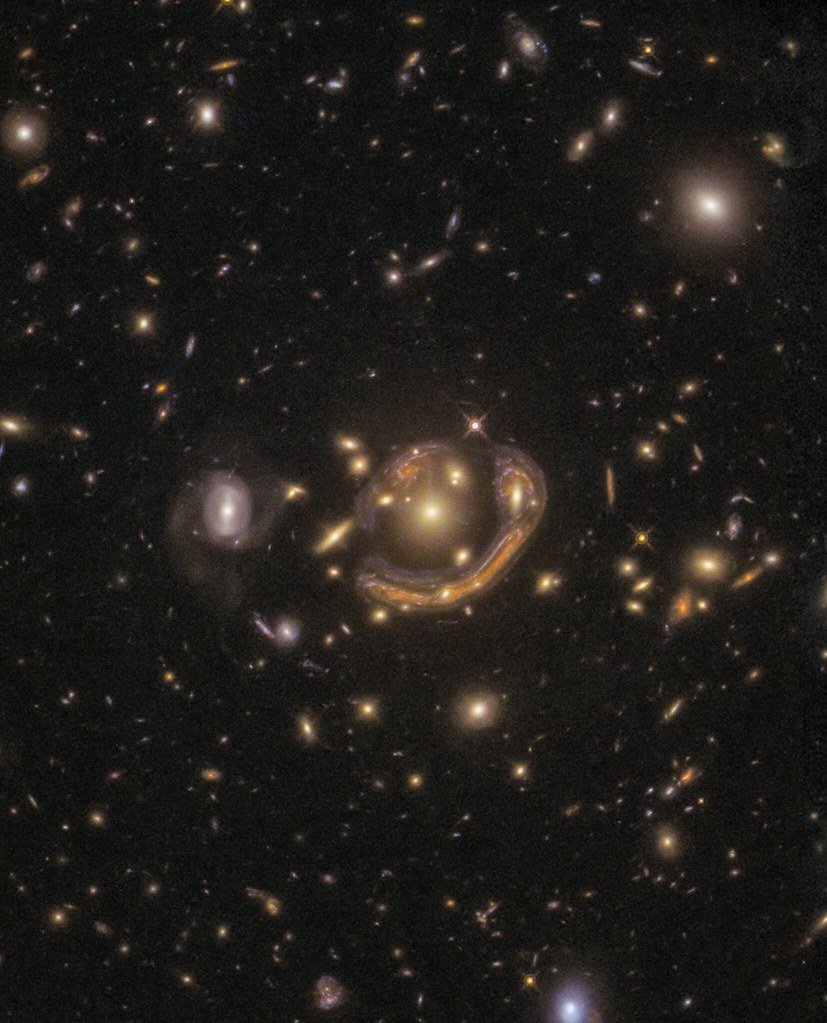
Gravitational Lensing: Nature’s Cosmic Magnifying Glass (Image Credits: Flickr)
Astronomers have identified a remarkable gravitational lens known as an Einstein Cross, offering unprecedented views into the heart of an elliptical galaxy from the universe’s distant past. This configuration magnifies light from a galaxy that formed when the cosmos was still in its infancy, revealing stars far older than expected for such a young system. The finding challenges assumptions about how galaxies mature and assemble their stellar populations over cosmic time.[1]
Gravitational Lensing: Nature’s Cosmic Magnifying Glass
Gravitational lensing occurs when massive objects, such as galaxies, bend spacetime according to Einstein’s general theory of relativity. Light from more distant sources passing behind these masses follows curved paths, often creating multiple images of the background object. In the rare case of an Einstein Cross, the alignment produces exactly four distinct images arranged symmetrically around the lensing galaxy, resembling a cross.[2]
These perfect alignments are exceedingly uncommon due to the precise positioning required along the line of sight. Only a handful have been documented since the first Einstein Cross quasar system surfaced in 1985. The phenomenon not only confirms predictions from relativity but also amplifies faint signals from the early universe, enabling detailed spectroscopy that would otherwise be impossible.[3]
Researchers rely on telescopes like Hubble, ALMA, and ground-based observatories to detect these systems. The magnification can boost brightness by factors of tens or more, exposing fine details in the spectra of remote objects.
A Surprising Glimpse into Early Galaxy Cores
The latest Einstein Cross targets an elliptical galaxy existing in a remote epoch, shortly after the Big Bang. Elliptical galaxies typically feature smooth, featureless shapes dominated by older, redder stars with little ongoing star formation. Finding one so early raises questions about rapid assembly processes in the young universe.
The lensing effect provided clear views of the galaxy’s central regions. Spectral analysis indicated stars with compositions and luminosities suggesting greater age than the galaxy’s overall formation timeline would predict. This anomaly suggests accelerated stellar evolution or mergers that quickly built a mature core.[1]
“The discovery of this exceptional object has allowed us to accurately study the nature of the stars at the center of an elliptical galaxy in a remote era of the universe, when the galaxy was still young,” stated a member of the research team. Such direct observations refine models of chemical enrichment and dynamical mixing in primordial environments.
Probing Stellar Populations Through the Lens
Without lensing, the galaxy’s light would appear too dim for resolving individual stellar properties. The cross configuration delivered multiple vantage points, each slightly offset, akin to stereo vision for astronomers. This allowed mapping of velocity fields and abundance patterns in the core.
Key advantages of this setup include:
- Higher signal-to-noise ratios for absorption lines tracing heavy elements from supernovae.
- Resolution of central density cusps where supermassive black holes and old stars coexist.
- Time-delay measurements between images, potentially constraining cosmic expansion rates.
- Isolation of the galaxy’s intrinsic properties from foreground contamination.
- Opportunities to detect subtle outflows or inflows shaping the stellar disk.
These insights reveal a core populated by stars that underwent multiple generations of formation, defying expectations for a “young” galaxy. Traditional simulations predict gradual buildup over billions of years, yet this example points to faster pathways, perhaps via gas-rich mergers.
Challenging Models of Galaxy Evolution
Elliptical galaxies dominate the universe’s stellar mass budget today, yet their origins remain debated. Current theories posit hierarchical merging: small protogalaxies collide, shedding gas and halting new stars while preserving older populations. A young elliptical with mature stars supports scenarios where major mergers quench star formation early.
This discovery aligns with growing evidence from surveys like JWST, which uncover compact, massive systems at high redshifts. However, the Einstein Cross adds precision by piercing the core, where dynamical friction concentrates the oldest components.
Future observations could quantify the stellar initial mass function or detect intermediate-age populations. Comparative studies with unlensed peers will test if such maturity is typical or exceptional.
| Lensing Type | Typical Use | Rarity |
|---|---|---|
| Einstein Ring | Full magnification circle | Moderate |
| Einstein Cross | Quadruple symmetric images | Very rare |
| Arclets | Partial bends | Common |
Key Takeaways
- The Einstein Cross magnifies a young elliptical galaxy, exposing unexpectedly old central stars.
- This enables precise stellar spectroscopy from an era when galaxies were forming rapidly.
- Findings suggest accelerated core assembly, informing evolution models.
This rare alignment not only showcases gravity’s artistry but also propels our grasp of cosmic history forward. As telescopes advance, more such lenses promise revelations about the universe’s stellar foundations. What surprises might the next cross unveil? Share your thoughts in the comments.