

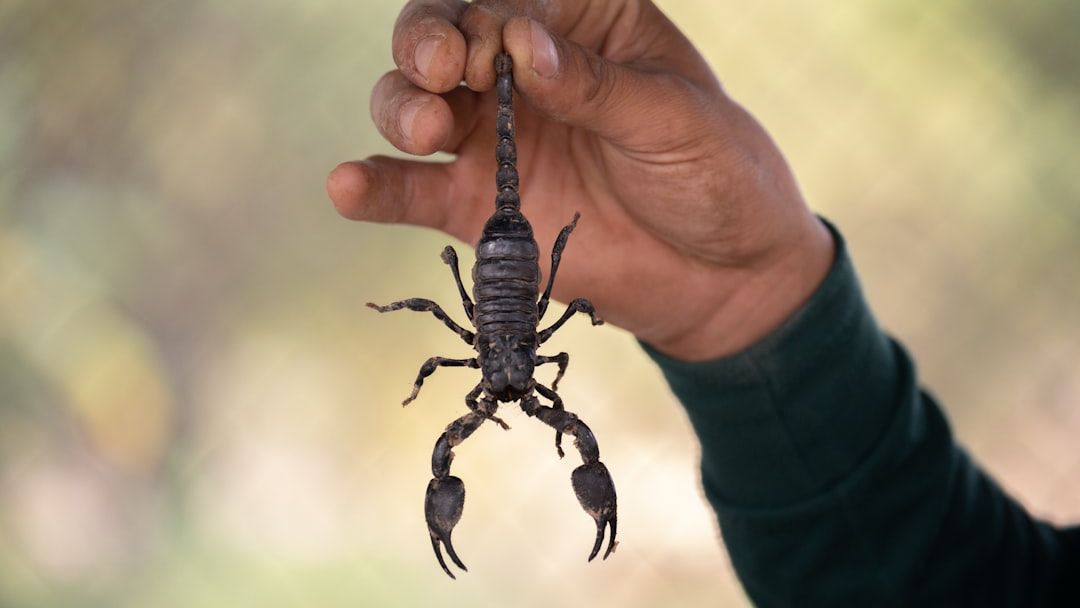
Advanced Imaging Reveals Hidden Strength (Image Credits: Unsplash)
Deep in arid landscapes and humid tropics, scorpions deploy pincers and stingers with lethal precision against insects and small vertebrates. A new study uncovers how these arachnids incorporate zinc, iron, and manganese into their exoskeletons, transforming fragile chitin into resilient tools of predation.[1][2] Researchers found consistent patterns across species, suggesting an evolutionary strategy honed over 400 million years.
Advanced Imaging Reveals Hidden Strength
Biologists turned to high-resolution tools to map metal distribution in scorpion anatomy. They analyzed samples from 18 species spanning diverse families, using micro X-ray fluorescence microscopy and electron microscopy. These techniques fired laser beams thinner than a human hair at stingers and claws, producing vivid maps of elemental composition.[2]
Lead author Sam Campbell, a former Smithsonian fellow, noted the surprise in the uniformity. “Scorpions are incredible hunters, and while we knew that metals strengthen the weapons in some species’ arsenals, we don’t know if all scorpions’ weapons contain metal, and if so, whether this metal enrichment relates to how they hunt,” he explained.[1] The findings appeared in the Journal of the Royal Society Interface last week.
Zinc Dominates the Stinger Tip
Every stinger examined featured a zinc-rich piercing point. This metal concentrated at the needle-like apex, where it penetrates prey to deliver venom. In many cases, a distinct band of manganese layered just beneath the zinc, creating a stacked reinforcement resembling a fortified dart.[2]
Edward Vicenzi, a co-author from the Smithsonian’s Museum Conservation Institute, described the structure: “It really kind of looks like a layered popsicle.” Such layering likely enhances penetration and durability, critical since adult scorpions cannot regenerate damaged parts. Zinc’s presence here proved consistent, appearing at the tip in 12 of the stingers studied.
Claw Variations Reflect Hunting Styles
Pincers showed more diversity in metal use, tailored to mechanical demands. Tiny toothlike structures along the inner edges – used to grip struggling victims – contained zinc alone or blended with iron. Iron appeared exclusively in claws, absent from stingers.
Species differences emerged clearly. Scorpions with stout, powerful pincers for crushing prey invested less zinc there. Instead, those with slender, weaker claws loaded higher zinc levels into the teeth. This pattern defied initial expectations of metal scaling with raw strength. Slender-claw species, like certain spider hunters, needed extra durability to hold fast without snapping during quick strikes.[3]
Hannah Wood, a Smithsonian curator of arachnids and senior author, highlighted the strategy split. “Some scorpions rely more on stinging their prey, and other scorpions rely more on capturing and grasping their prey with their pincers,” she said. Burrowing species with robust claws, such as the black-legged scorpion, prioritized crushing power over metal additives. Fattail scorpions, known for potent neurotoxins, emphasized stinger fortification.
Statistical analysis accounted for evolutionary relationships, confirming metals evolved in tandem with weapon function. Closely related species shared similar distributions, strengthening the links to behavior.
Evolutionary Trade-Offs Shape Survival
A key insight involved resource allocation. High zinc in stingers correlated with lower levels in claws, and vice versa – an apparent trade-off in metal uptake. This mirrors hunting preferences: stinger-reliant hunters fortified tails, while pincers-focused ones bolstered front-line weapons.
Scorpions diverged from other arachnids around 435 million years ago, among the first to conquer land. Their basic body plan – pincers forward, tail aft – persisted through eons. Metal enrichment likely contributed to this endurance, fortifying irreplaceable tools against wear and impact. Over 3,000 species exist today, hinting at untapped variations.
- Zinc: Piercing tips and claw teeth for hardness and wear resistance.
- Manganese: Sub-layer in stingers for added layering.
- Iron: Blended in claw teeth for grip strength.
Broader Implications for Arachnid Design
The study standardized methods for measuring metals in arthropod exoskeletons, opening doors to compare spider fangs or insect stings. Questions linger on diet’s role in uptake, sex differences, and prevalence across all scorpions. Lauren Esposito, a scorpion expert unaffiliated with the work, called it an “exciting” advance in understanding these ancient survivors.
These findings recast scorpions not just as venomous threats, but as master engineers of biological weaponry. Their metallic upgrades underscore nature’s ingenuity, predating human metallurgy by epochs and reminding us of the fierce adaptations driving survival in a predator-filled world.