

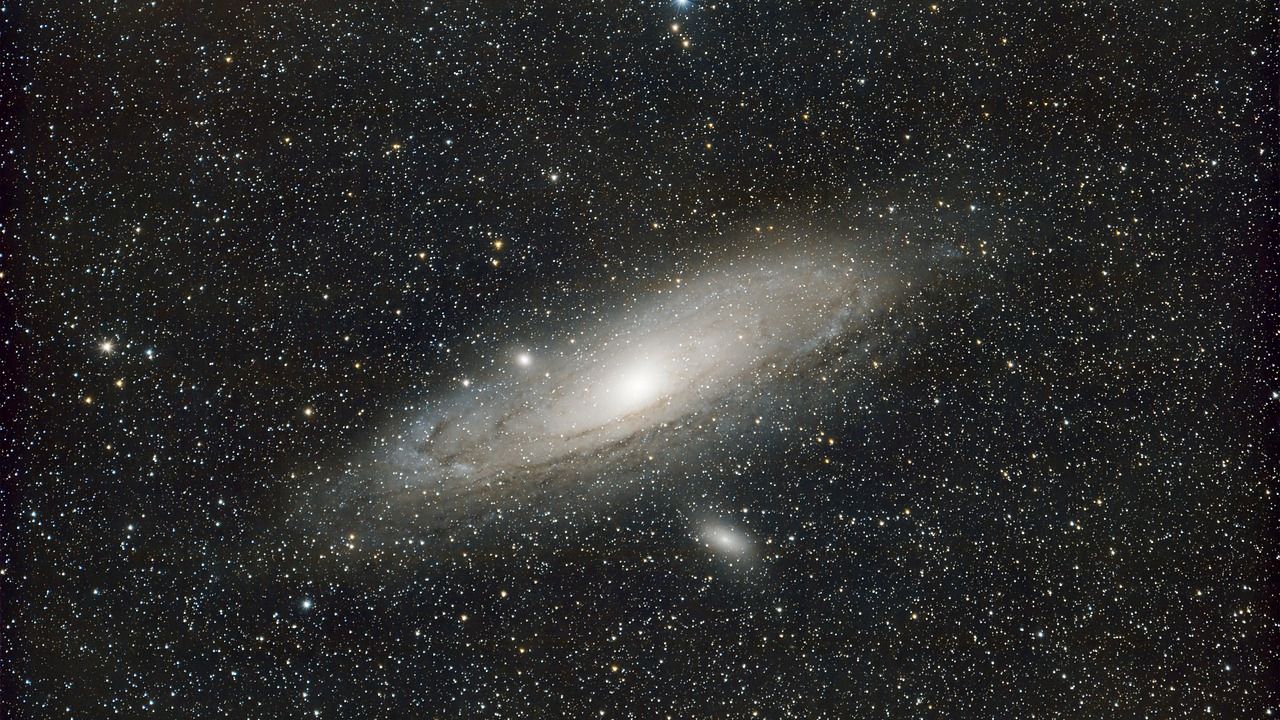
A New View of the Spectroscopic Universe – Image for illustrative purposes only (Image credits: Pixabay)
The Sloan Digital Sky Survey has long stood as a cornerstone of modern astronomy, shifting the field from occasional mountaintop observations to vast, automated data collection. Its latest iteration, SDSS-V, builds directly on that foundation with a detailed blueprint published in The Astronomical Journal. The survey’s design emphasizes continuous refinement rather than a single dramatic leap, promising spectra from millions of targets across the entire sky.
Building on Two Decades of Sky-Wide Data
Astronomy’s embrace of large-scale surveys began in earnest with the original SDSS observations in 1998. Those early efforts introduced electronic detectors and automated processing pipelines that handled enormous volumes of images and spectra. Subsequent projects have adopted similar strategies, yet the twin 2.5-meter SDSS telescopes in New Mexico and Chile retain unique advantages through their proven survey infrastructure and global coverage.
Upgrades completed in 2021, despite pandemic-related constraints, equipped the existing facilities with improved spectrographs and added a dedicated new telescope in Chile. This incremental approach allows the collaboration to maintain momentum while preparing for even larger future facilities, such as the Legacy Survey of Space and Time at the Vera C. Rubin Observatory.
Three Distinct Mapping Programs
SDSS-V organizes its observations around three complementary programs that together address different scales and phenomena. The Milky Way Mapper targets stars throughout our galaxy, while the Black Hole Mapper focuses on active galactic nuclei and quasars. The Local Volume Mapper, handled by the new Chilean facility, will instead capture spectra across extended regions of nearby gas and dust rather than individual point sources.
Each exposure from the new telescope will record a full spectrum for every location within an area the size of the full Moon. This integral-field approach differs sharply from the fiber-based systems used for the other two mappers, which can observe up to 500 discrete targets simultaneously by positioning robotic arms. The combination yields both high-resolution point measurements and wide-field contextual data.
By survey completion, astronomers expect optical and near-infrared spectra for roughly six million objects, including repeated observations for about one million sources. Such time-series coverage opens possibilities for tracking variability in quasars and identifying companions around young stars, including brown dwarfs. The dataset’s combination of spatial breadth and temporal depth remains unmatched in existing spectroscopic archives.
Practical Implications for Ongoing Research
Researchers will gain immediate access to processed spectra through established SDSS data-release channels. This continuity reduces barriers for scientists who rely on public archives rather than new telescope time. The survey’s emphasis on both static maps and evolving phenomena also supports studies that span multiple epochs, something single-epoch surveys cannot provide.
Questions about quasar evolution and the frequency of brown-dwarf companions around young stars illustrate the range of science enabled. These topics require precisely the mix of wide coverage and repeated measurements that SDSS-V is structured to deliver.
What stands out now
- Three coordinated mappers covering stars, black holes, and nearby gas
- Six million spectra plus time-series data for one million objects
- Continued use of proven 2.5-meter telescopes alongside one new facility
- Public data releases that build directly on prior SDSS releases
Looking Ahead
The publication of the SDSS-V design paper marks another step in the survey’s evolution from pioneering industrial astronomy to a sustained, adaptive enterprise. As larger facilities come online, the moderate-sized SDSS telescopes continue to fill a distinct niche through their combination of heritage, upgrades, and carefully planned observing strategies. The resulting archive will serve as a reference point for years of subsequent analysis.