

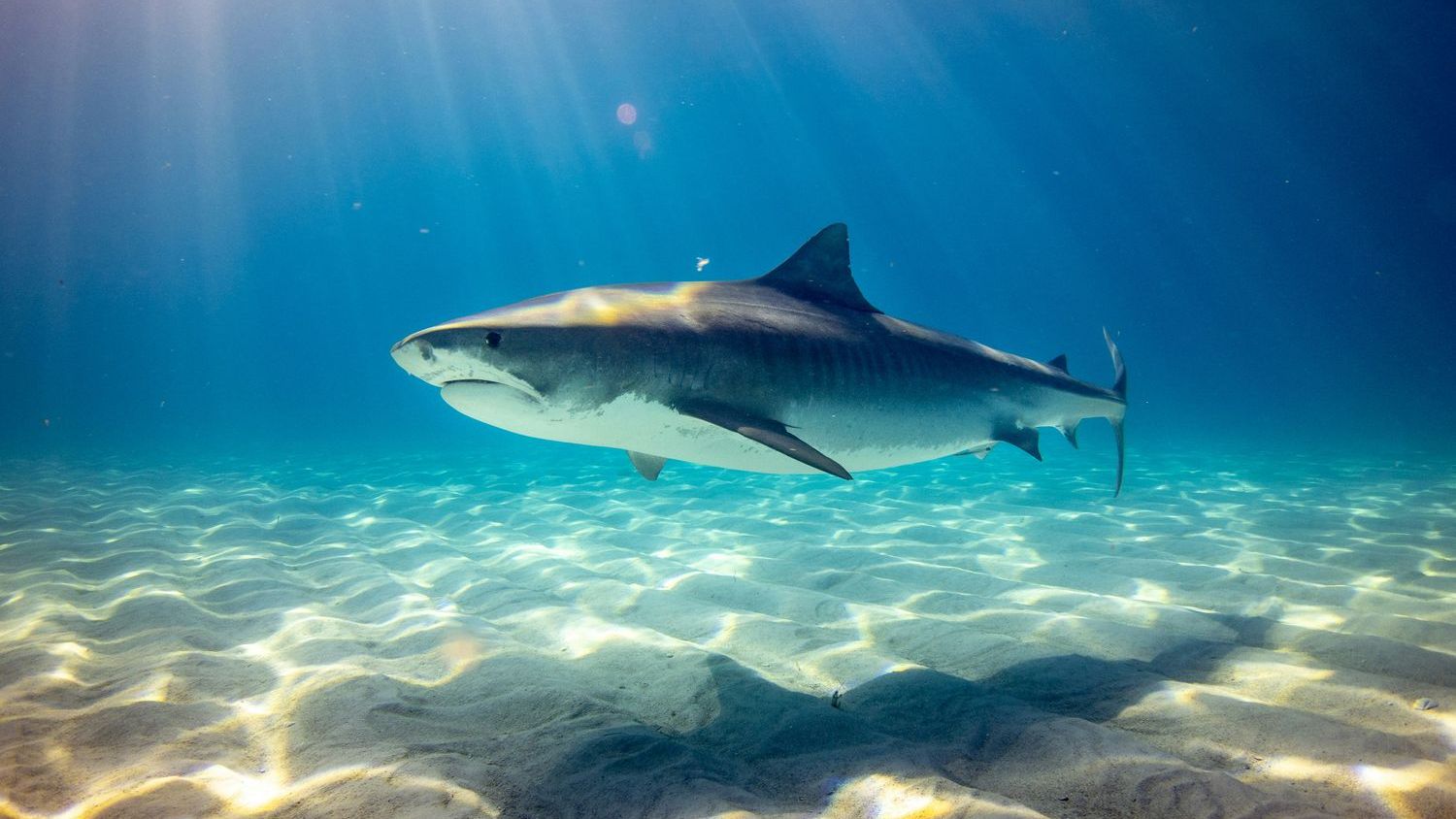
Greenland sharks can live for more than 400 years – meaning some of the ones swimming the North Atlantic today were alive when Isaac Newton was – and almost all of them spend those centuries functionally blind, navigating the deep ocean with parasites permanently attached to their eyes. – Image for illustrative purposes only (Image credits: Unsplash)
Greenland sharks have long captured attention for their extreme longevity. Some of the largest individuals swimming in the North Atlantic today may have been born in the 1600s or 1700s. That places their early years around the lifetime of Isaac Newton. A new study now shows these ancient fish maintain a working visual system despite a common eye parasite.
The Longevity Evidence Holds Up
Researchers established the species’ remarkable lifespan in a 2016 study published in Science. They used radiocarbon dating on the eye lens nuclei of 28 female sharks. Because the lens nucleus forms early in development and stays stable, the carbon-14 levels inside it reveal the animal’s approximate birth year. The largest sharks in that sample reached estimated ages of roughly 335 and 392 years, with wide confidence intervals that still point to centuries-long lives.
Those findings remain the foundation for understanding how long Greenland sharks survive. The data indicate that some current members of the population predate many modern nations and scientific revolutions. Yet the precise maximum age stays uncertain because of the statistical range in the original measurements.
Old Claims About Blindness Get Revised
For decades, accounts described the sharks as functionally blind. The idea stemmed from observations of a copepod parasite, Ommatokoita elongata, that attaches to the cornea and causes local damage. Earlier papers noted possible severe vision impairment but included careful qualifiers that later summaries often dropped.
A January 2026 paper in Nature Communications examined the question directly. Scientists at the University of Basel and UC Irvine combined genomic, transcriptomic, histological, and functional tests on retinal tissue. They found no signs of age-related degeneration across the sampled age range. Molecular pathways for low-light processing remained active, and DNA repair mechanisms appear to help maintain photoreceptor function over long periods.
Video Evidence Changed the Research Direction
The project began when one researcher noticed footage of a Greenland shark moving its eye to follow a light source. That simple observation prompted deeper investigation. Evolution rarely preserves complex organs without benefit, so the team tested whether the visual system actually functions.
The results show the sharks see well enough to track light even when parasites are present. They navigate the deep ocean by using whatever vision remains or by compensating through other senses. The parasite causes real corneal harm, yet the overall visual machinery stays intact and operational.
What the Revision Means for Long-Lived Species
Popular stories about extreme longevity often add a layer of tragedy. The Greenland shark was cast as an ancient, drifting creature that witnesses little because of permanent blindness. The new evidence replaces that image with a more ordinary biological reality: an organism that actively maintains key sensory systems across centuries.
Many details remain unknown, including exactly how the retina avoids cumulative damage and what other adaptations support such extended function. The study highlights preserved low-light processing rather than complete immunity to the parasite. Future work will need to clarify how these mechanisms operate in the wild over full lifespans.