

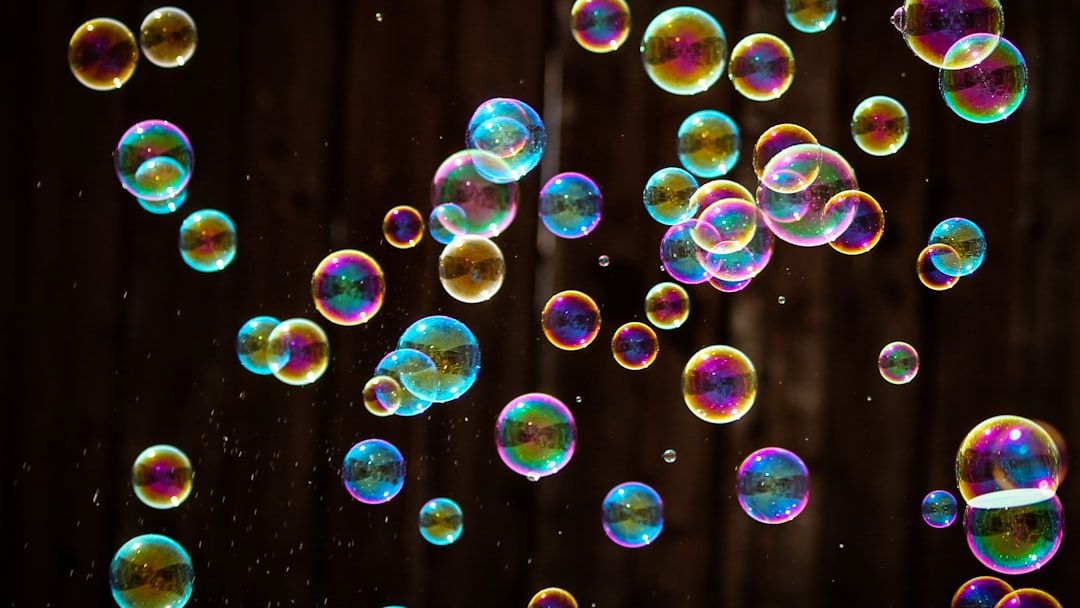
Water drops on soap bubble films act like merging galaxies – Image for illustrative purposes only (Image credits: Unsplash)
Scientists have found that water droplets placed on thin soap films can orbit one another and eventually merge in patterns that closely resemble the gravitational interactions between colliding galaxies. The observation provides researchers with a compact, controllable system for examining processes that normally unfold across millions of light-years. Because the setup uses only common laboratory materials, it may lower the barrier to exploring certain aspects of cosmic evolution that remain hard to capture in direct observation.
The Unexpected Similarity
When a droplet lands on the delicate surface of a soap film, surface tension and fluid dynamics cause it to move in curved paths around other droplets. Over time these paths bring the droplets together until they combine into a single larger drop. The motion arises from the same basic principles of attraction and momentum that govern galaxy pairs pulled together by gravity, even though the physical scales differ by many orders of magnitude.
Why the Finding Matters Now
Astronomers have long relied on computer simulations and distant telescope data to understand how galaxies merge and reshape the universe. A tabletop analog offers the chance to adjust variables such as droplet size, film thickness, and initial separation in real time. Such flexibility could help test theoretical predictions that are difficult to isolate in full-scale cosmological models.
What the Experiments Show So Far
Early trials indicate that the droplets follow stable orbits before spiraling inward, much like the stellar streams observed in galaxy mergers. The final coalescence releases energy in the form of surface waves that propagate across the film, echoing the tidal tails and shock fronts seen in space. Researchers note, however, that the analogy remains limited to two-body interactions and does not yet capture the full complexity of multi-galaxy encounters or dark-matter effects.
What matters now is whether the same patterns persist when the films are subjected to controlled temperature changes or external vibrations that mimic cosmic turbulence.
Next Steps and Open Questions
Teams are already exploring whether the technique can be scaled to include more than two droplets or combined with high-speed imaging to record finer details of the merger process. It remains unclear how closely the fluid-based results will align with predictions from general relativity once additional physical forces are introduced. Continued refinement could determine whether the method becomes a standard complement to numerical simulations or stays a specialized demonstration of fluid dynamics. The work illustrates how carefully chosen laboratory systems can illuminate distant astrophysical events without requiring new telescopes or supercomputers. Further validation will show whether this approach yields lasting contributions to the study of cosmic structure formation.