

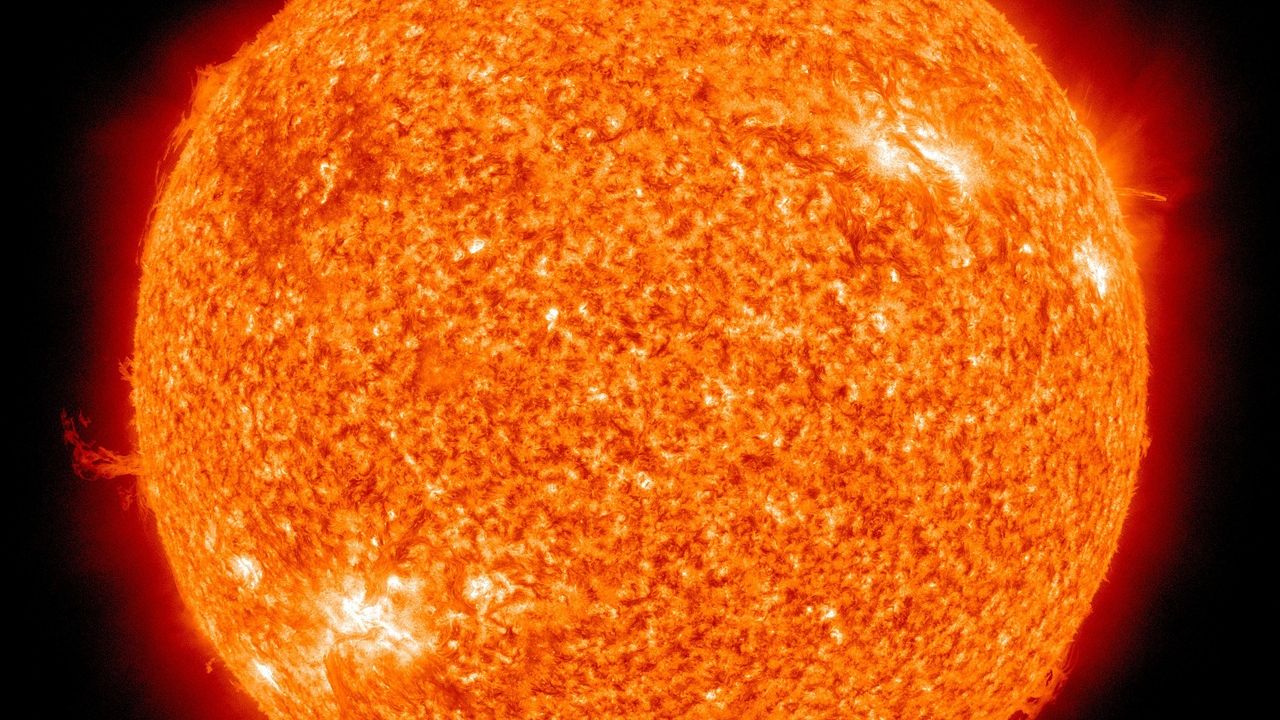
Simulating Centuries of Sunspot-Driven Magnetism (Image Credits: Pixabay)
Scientists have reconstructed the Sun’s magnetic field evolution from 1755 to 2020, drawing on centuries-old sunspot observations to simulate patterns that modern instruments only began capturing in the 1970s. This achievement anchors three recent studies in the Astrophysical Journal, which also dissect the origins of the corona’s tiniest jets and reveal how elusive polar magnetic fields shape coronal mass ejections. Together, these efforts illuminate the Sun’s dynamic behavior, from historical cycles to immediate space weather risks.
Simulating Centuries of Sunspot-Driven Magnetism
Historical sunspot records, dating back to the 1700s, offered researchers a rare window into the Sun’s long-term magnetic fluctuations before systematic monitoring began. Bibhuti Kumar Jha from the Southwest Research Institute and his team developed a Synthetic Active Region Generator to transform these records into realistic models of solar active regions. They fed sunspot numbers from 1755 to 2020 into this tool, which relied on contemporary statistics about active region properties.
The generated regions then powered an Advective Flux Transport model, simulating how magnetic features emerged, evolved, and decayed across the solar surface. This approach captured key cycle behaviors, including the polarity reversals that mark activity peaks. Although nonlinear physics limited perfect fidelity for every metric, the simulations aligned well with observed large-scale trends over multiple cycles. The team plans to release these historical magnetic field maps for public use, paving the way for refined predictions.
Probing the Corona’s Smallest Explosive Jets
Solar Orbiter’s Extreme Ultraviolet Imager, operating as close as 0.3 astronomical units from the Sun, captured unprecedented details of picoflare jets – minuscule bursts in the corona driven by magnetic reconnection. Annu Bura of the Indian Institute of Astrophysics and colleagues pinpointed these events through their signature “Y”-shaped structures: a bright, hot spire paired with a cooler, dark streak. Measurements showed bright features averaging 650 kilometers wide, dark ones at 490 kilometers, and jets stretching about 16,900 kilometers while lasting roughly six minutes.
Radiation magnetohydrodynamics simulations clarified the jets’ mechanics. The bright components stemmed from heated, low-density coronal plasma, while dark streaks traced denser, cooler material rising from the chromosphere. This mechanism, triggered by emerging magnetic flux and reconnection, mirrored processes in larger coronal jets, suggesting a unified driver across scales. The findings bridge picoflares and slightly bigger jetlets, with energies matching picoflare expectations.
Polar Fields: Overlooked Shapers of Space Weather
Most solar observations cluster near the ecliptic plane, leaving polar regions largely uncharted until missions like Ulysses and Solar Orbiter provided glimpses, including the first polar images in November 2025. Xiao Zhang from the Chinese Academy of Sciences led simulations probing how polar magnetic field strength alters a coronal mass ejection from December 4, 2021, tracked by spacecraft at Mercury and Mars. Stronger polar fields slowed the CME’s propagation and expansion through the heliosphere.
These fields also densified and decelerated the ambient solar wind, influencing the ejection’s path. The model highlighted gaps in current space weather forecasting, where polar data scarcity hampers accuracy. Future expansions to more CME events could integrate these insights into operational models.
| Study Focus | Main Method | Key Insight | Limitations/Next Steps |
|---|---|---|---|
| Solar Magnetic History | Synthetic regions + flux transport model | Reproduced cycle polarity reversals | Nonlinear physics challenges; public map release |
| Picoflare Jets | Solar Orbiter EUV + simulations | Reconnection from emerging flux | Scale overlap with jetlets; broader validation |
| Polar Field Effects | CME propagation simulations | Slower, denser wind with stronger poles | Limited to one event; expand sample |
These studies underscore the Sun’s interconnected physics, where historical data, high-resolution imaging, and modeling converge to demystify its influence on Earth. As solar activity ramps toward cycle peaks, such reconstructions and forecasts gain urgency for safeguarding satellites, power grids, and astronauts. Researchers continue refining tools, hinting at more precise space weather vigilance in the years ahead.