

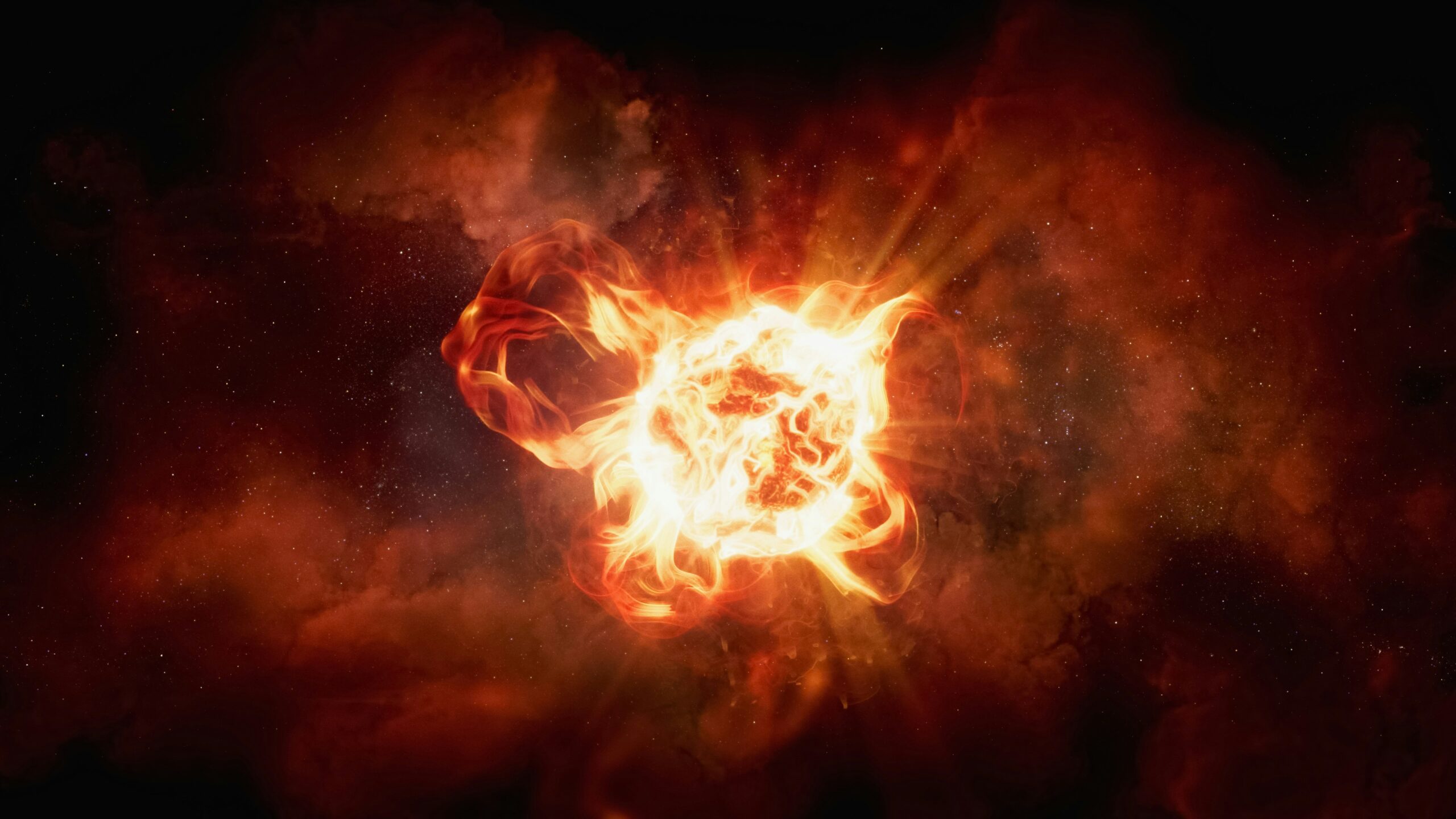
Stars’ Lifelong Slowdown Meets an Unexpected Twist (Image Credits: Unsplash)
Kyoto, Japan — A new set of detailed simulations has revealed that massive stars do not always wind down in their final evolutionary stages. Researchers at Kyoto University found that interactions between magnetic fields, convection, and rotation can cause some stars’ cores to spin faster just before core collapse. This finding challenges decades of assumptions and could reshape models of how stars end their lives, influencing everything from supernova explosions to black hole formation.[1][2]
Stars’ Lifelong Slowdown Meets an Unexpected Twist
From formation to their eventual demise, most stars gradually lose rotational speed. Astronomers observed this process through the Sun, where solar wind carries away angular momentum over billions of years. Overall, stars slow by factors of 100 to 1,000 compared to their initial rates, a phenomenon known as spin-down.[1]
Recent advances in astroseismology, which analyzes stars’ internal vibrations, confirmed this trend across many stars. Yet the data hinted at gaps in existing theories, as rotation slowed more dramatically than predicted. These observations prompted scientists to delve deeper into the hidden dynamics within stellar interiors.[2]
Simulating the Chaos Inside Massive Stars
A team led by Ryota Shimada at Kyoto University turned to three-dimensional magnetohydrodynamic simulations to model a rapidly rotating progenitor of a core-collapse supernova. Collaborators in Australia and the UK had laid groundwork with prior simulations, but this effort focused on the convective zones of massive stars. The model captured violent convection alongside rotation and magnetic fields, mirroring processes in the Sun’s dynamo.[1]
“Our coauthors in Australia and the UK have already performed 3D magnetohydrodynamic simulations for massive stars before core-collapse,” Shimada noted. “We suspected that the flow inside the massive star’s convective zone may evolve analogously with the solar convective zone.”[2] The simulation zeroed in on late burning phases, including oxygen and silicon shells surrounding the iron core, right before collapse.
Magnetic Fields as the Deciding Factor
The interplay proved pivotal: rotation and magnetic fields altered the speed and direction of convective motions on short timescales. This, in turn, transported angular momentum radially—outward for spin-down or inward for spin-up. The geometry and strength of magnetic fields emerged as key determinants during these advanced stages.[1]
Co-author Lucy McNeill highlighted the surprise: “We were surprised to discover that some configurations of the magnetic fields actually spin the core up, suggesting that the final spin rate will be unique to the star’s properties.” In certain cases, slow rotation might even prove impossible for specific classes of massive stars.[2] Researchers formulated equations to predict these evolutions mathematically.
What Drives the Final Spin?
- Magnetic field geometry: Dictates inward or outward angular momentum transport.
- Convection properties: In oxygen-burning regions, influences motion direction.
- Rotation baseline: Interacts dynamically over short timescales.
- Star-specific traits: Yield unique core speeds before collapse.
Broader Ramifications for Stellar Death
This magnetic angular momentum transport during late burning phases bridges gaps between solar-type stars and their massive counterparts. The mechanisms appear universal, extending dynamo-like processes to explain rotation across stellar masses. Final core spin now seems highly individualized, varying with internal conditions rather than mass or age alone.[3]
The work appeared April 27, 2026, in The Astrophysical Journal (DOI: 10.3847/1538-4357/ae53da). For full details, see the Kyoto University announcement.[1] Such insights matter now, as they inform predictions about supernova outcomes and compact remnants.
Looking forward, the team aims to simulate entire stellar lifetimes for low- to high-mass stars. These models will forecast rotation at every phase, potentially unveiling more surprises in how stars truly dance toward their end.