

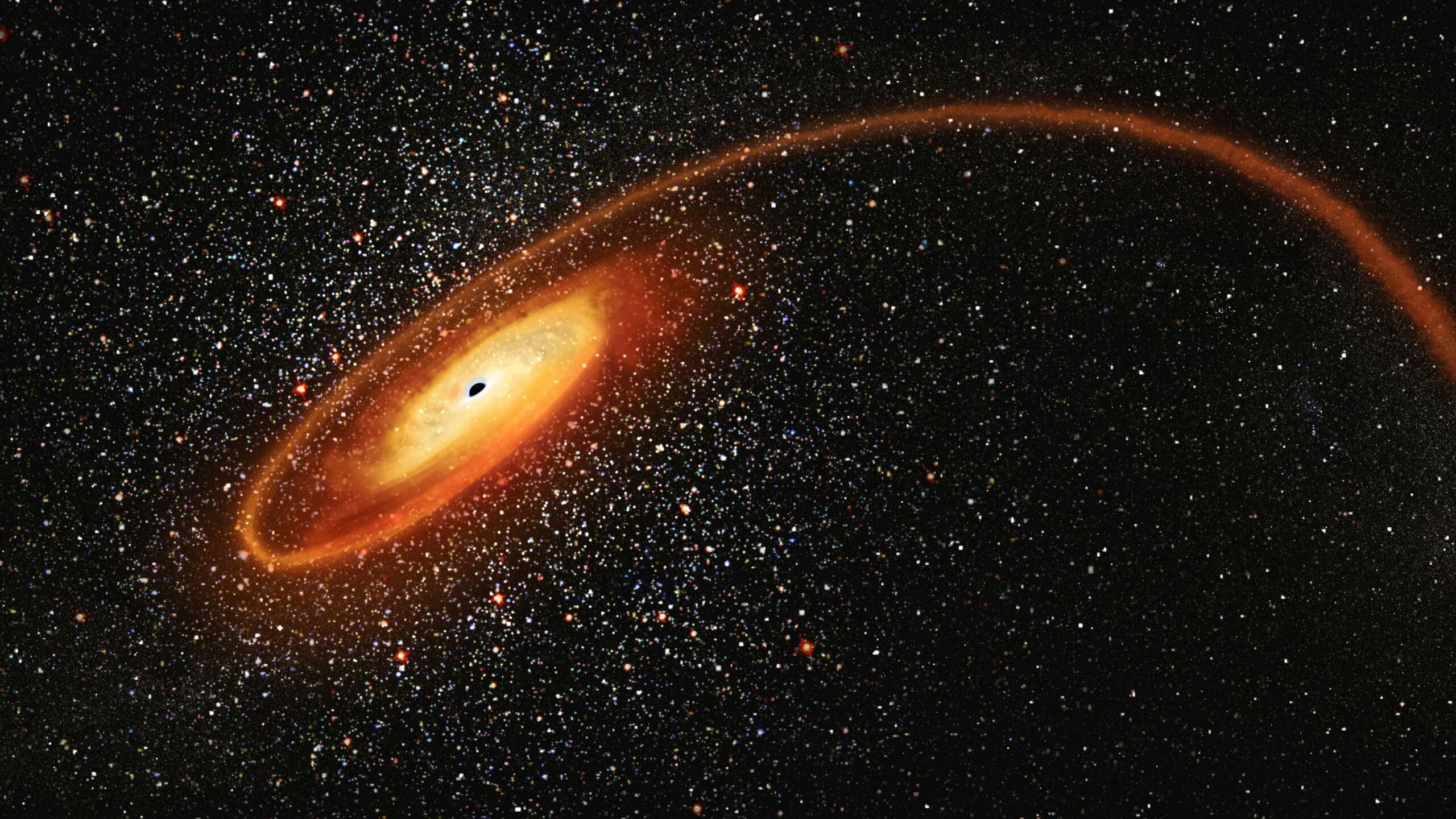
How do the biggest black holes in the universe form? Ripples in spacetime provide a clue – Image for illustrative purposes only (Image credits: Unsplash)
Astronomers have long wondered how the universe built its most enormous black holes, objects millions or even billions of times the mass of the Sun. Fresh data from gravitational-wave detectors now suggest that some of these giants grew through repeated mergers of smaller black holes and neutron stars. The signals reveal that many of these pairs followed elongated, oval paths in the moments before they collided, a detail that does not fit neatly with standard models of how such systems should evolve.
Why Supermassive Black Holes Remain a Puzzle
The largest black holes sit at the centers of most galaxies, yet their growth histories are difficult to trace. One leading idea holds that they assembled gradually through the merger of many smaller black holes over cosmic time. Another possibility is that they formed directly from the collapse of enormous gas clouds in the early universe. Distinguishing between these scenarios requires direct evidence of how black holes actually pair up and merge. Gravitational waves carry that evidence across billions of light-years. Each merger produces a brief burst of spacetime distortion that instruments on Earth can record. By studying the shape and timing of these bursts, researchers can reconstruct the orbits of the objects just before they fell together.
How Gravitational Waves Reveal Orbital Details
When two compact objects spiral inward, they emit gravitational waves at frequencies that match their orbital motion. Circular orbits produce a smooth, predictable signal that rises steadily in frequency. Oval, or eccentric, orbits create a more complex waveform with sudden spikes each time the objects swing close together. Detectors have now captured several events whose signals match the eccentric pattern rather than the circular one. These detections come from the LIGO-Virgo-KAGRA network, which has recorded dozens of black-hole mergers since 2015. A subset of those events shows the telltale signature of non-circular motion. The finding implies that at least some black holes formed or were captured in dense stellar environments where gravitational encounters can stretch orbits into elongated shapes.
The Challenge to Existing Formation Models
Standard theory predicts that isolated pairs of black holes should circularize their orbits long before they merge. Close encounters in star clusters or galactic nuclei, however, can leave orbits eccentric until the final moments. The observed oval paths therefore point toward cluster environments as important sites for building larger black holes through successive mergers. Yet the same data also highlight gaps in current understanding. Models of how black holes pair up in clusters still struggle to produce the exact number and eccentricity distribution seen in the gravitational-wave catalog. Additional factors, such as the presence of gas or the influence of a central supermassive black hole, may be required to explain the observations fully.
What the Findings Mean Going Forward
Continued operation of gravitational-wave observatories will deliver more events with higher precision. Future detectors, both on the ground and in space, should capture mergers involving even heavier black holes and reveal whether eccentricity remains common at larger masses. Such measurements will help determine whether repeated mergers in dense environments can account for the supermassive black holes observed today. The oval orbits detected so far already demonstrate that the universe assembles its largest black holes through pathways more varied than once assumed. Each new signal adds a concrete piece to that picture, showing how ripples in spacetime can illuminate processes hidden from ordinary telescopes.