

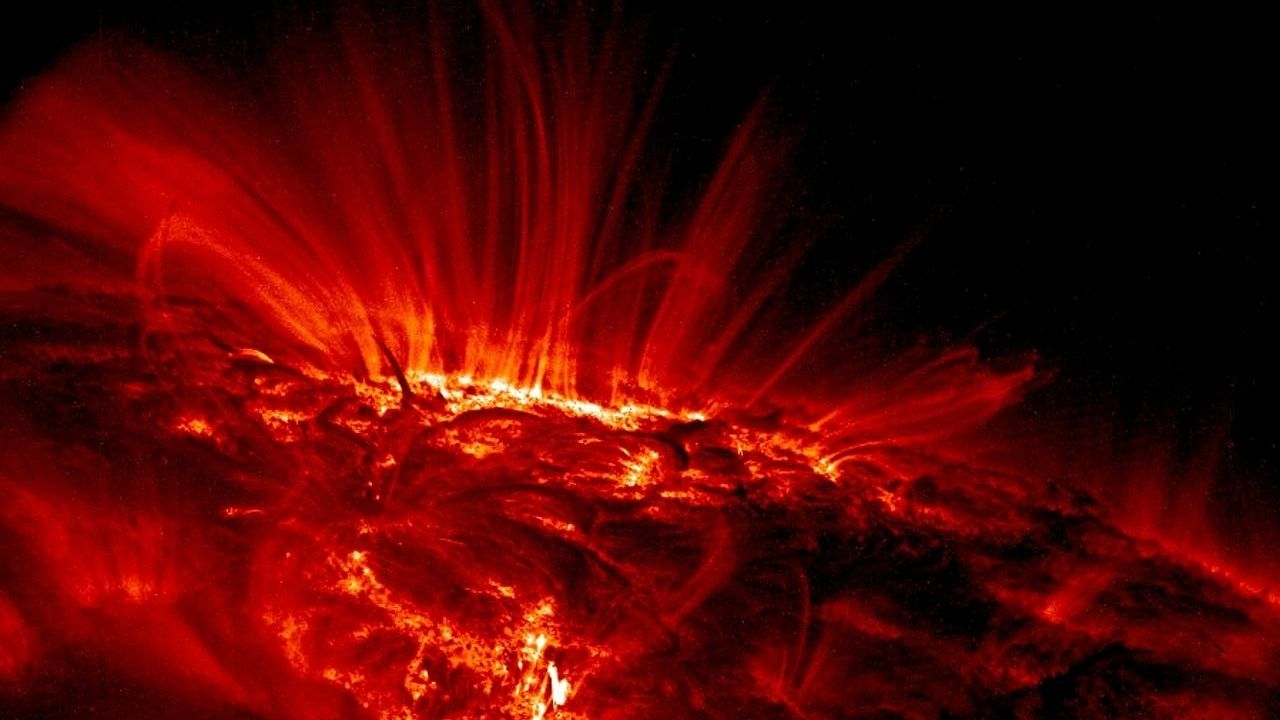
The Paradox of Cool Clouds in Extreme Heat (Image Credits: Pixabay)
Solar prominences resemble towering mountains of cooler gas suspended against the Sun’s blistering corona. These structures stretch for hundreds of thousands of kilometers, yet their plasma remains at roughly 10,000 degrees Kelvin amid surroundings exceeding a million degrees.[1][2] Researchers at the Max Planck Institute for Solar System Research recently unveiled the most comprehensive simulations to date, showing how dual mechanisms sustain these enigmatic formations.
The Paradox of Cool Clouds in Extreme Heat
Solar prominences emerge as dense, filamentary clouds of plasma that defy the intense conditions of the Sun’s outer atmosphere. Far cooler and denser than the surrounding corona, they appear flame-like when viewed against the solar disk but reveal their full scale along the limb.[1] Magnetic fields provide the scaffolding, with arched field lines creating dips where the plasma pools and remains trapped.
These features often endure for weeks or even months, a longevity that has challenged solar physicists. Without ongoing replenishment, gravity pulls the material downward, causing the structure to dissipate. Instability can lead to eruptions, propelling billions of tons of charged particles into space.[2]
Multi-Layer Simulations Unlock New Insights
A team at the Max Planck Institute for Solar System Research developed advanced computer models that incorporate processes across multiple solar layers, from the turbulent convection zone below the surface to the corona above. The simulations replicate a common magnetic configuration for prominences: field lines forming a double arcade with a central dip.[1][2]
Lead author Lisa-Marie Zeßner-Ondratschek noted the realism of these calculations. “Our calculations show, more realistically than ever before, how both processes interact to supply the prominences with material and thus keep them alive,” she stated. Previous efforts focused mainly on atmospheric dynamics, but these extend deeper, capturing interactions previously overlooked.
Key Supply Processes:
- Chromospheric Ejections: Turbulent magnetic bursts in the chromosphere launch jets of cool plasma upward into the magnetic dip.
- Coronal Condensation: Hot coronal plasma streams along field lines, cools, and accumulates in the dip.
A Delicate Balance of Gain and Loss
The simulations demonstrate a dynamic equilibrium within prominences. Plasma continuously drains back toward lower solar layers through fine-scale “rain,” yet the structure persists thanks to steady inflows. The primary replenishment comes from below, where small-scale magnetic reconnection events in the chromosphere – reaching up to 20,000 degrees – propel blobs of material skyward.[2]
Supplementary contributions arrive from above as coronal material condenses. This interplay ensures the prominence’s density stays over 100 times that of the ambient corona. The magnetic field not only traps the plasma but also drives the transport, highlighting its central role in solar atmospheric physics.
Such detail reveals why prominences appear fragile yet robust, akin to a perpetual cascade where losses match gains precisely.
Advancing Space Weather Defense
Understanding prominence stability holds promise for forecasting coronal mass ejections, which originate from erupting prominences. These events can disrupt satellites, power grids, and communications on Earth. Prof. Sami K. Solanki, a co-author, emphasized the stakes: “To protect Earth’s infrastructure in time, reliable forecasts of dangerous space weather are needed. A deeper understanding of prominences is a crucial piece of the puzzle.”[2]
The research, published in Nature Astronomy, bridges gaps in prior models and sets the stage for refined predictions. As solar activity peaks in the coming years, these insights could safeguard technology from solar whims.
Solar prominences no longer seem impossible. Instead, they emerge as finely tuned systems, sustained by the Sun’s intricate plasma dynamics.